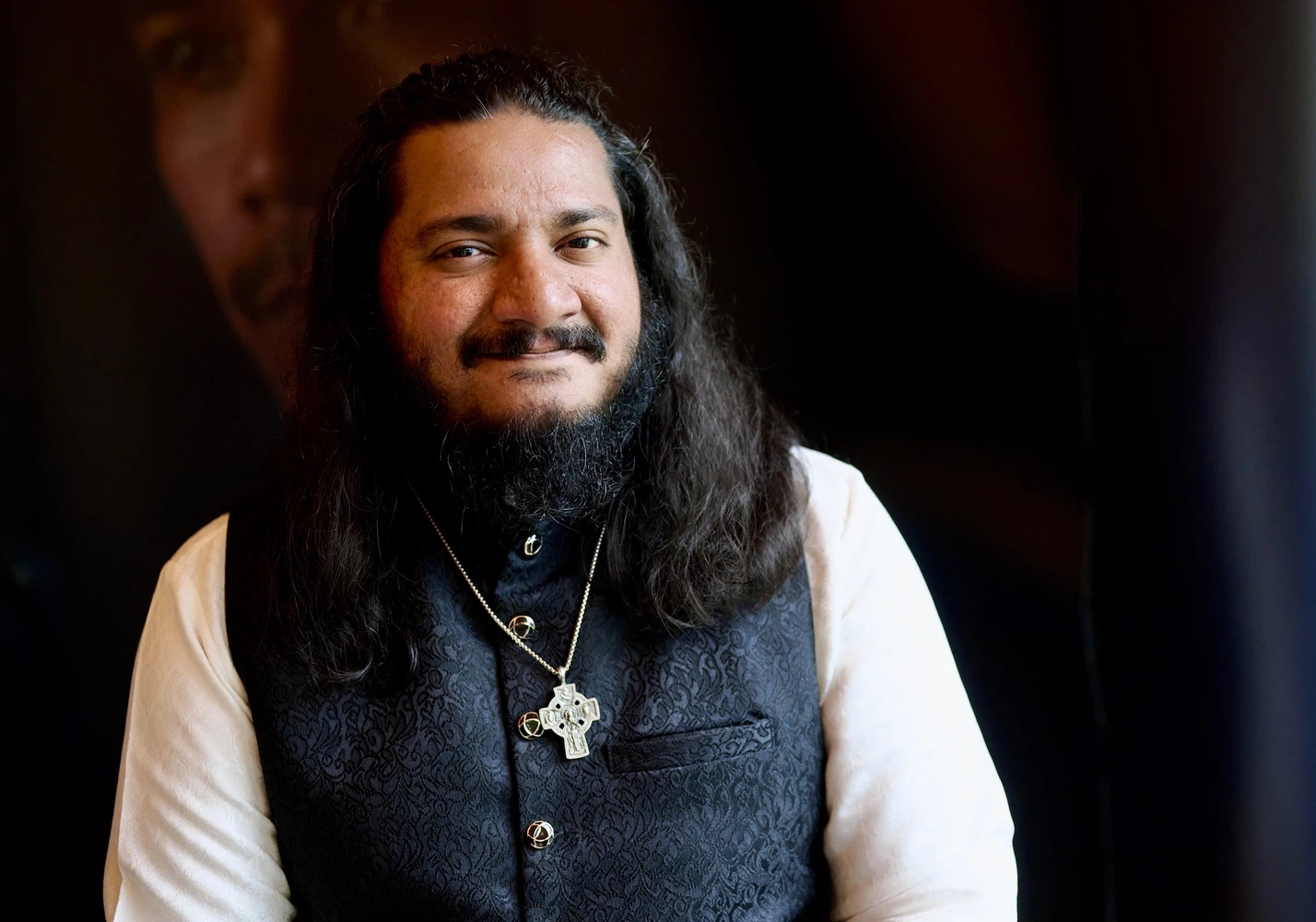
Editor's Note: The following is an excerpt of Joash P. Thomas's book, The Justice of Jesus: Reimagining Your Church's Life Together to Pursue Liberation and Wholeness, published in 2025 by Brazos Press.
Joash Thomas currently serves as National Director of Partnerships for International Justice Mission (IJM) Canada. IJM is a global organization known for its work to combat human trafficking and slavery, violence against women and children, and police abuse of power. He has a master's degree in Political Management from The George Washington University and master's degrees in Christian Leadership and Christian Studies from Dallas Theological Seminary.
“This social justice stuff isn’t Christian; it’s Marxist.”
A friend from church left this comment when I shared online about the work of a Christian human rights organization—one I someday hoped to work for. It rattled me. I was a new immigrant to the United States, and here was a white brother I worshiped alongside saying that my faith-fueled calling to pursue justice was not Christian at all.
What if I’m wrong about this? I remember asking myself. What if he is right? He is an American Christian, after all.
It would take me years to unpack the layers of complexity here. Years of following Jesus into the work of systemic justice. Years of studying theology at a leading evangelical seminary. Years of examining the complex history of injustice, sugarcoated with gospel language, in the North American church. Years of working out how Global South Christians allow our theology of justice to be colonized by the Western theological tradition.
I realized over time that this beloved friend was merely the product of his Western church environment. After being challenged in similar ways by other Western Christians in my years of mobilizing churches in Canada and the United States to seek systemic justice, my curiosity was sparked. I began to ask and explore these questions:
- Why do so many Western Christians see the work of systemic justice as separate and distinct from the gospel?
- Why do I, as a Global South Christian, see the work of justice so differently from my Western (and mostly white) siblings?
- Who is ultimately in the right here? Whose vision of justice is more aligned with how Jesus defined it in his gospel?
- Why does any of this matter?
This book is my attempt at providing answers after years of theologically and spiritually wrestling with these questions—all while doing the work of justice with a global community of Christians seeking systemic justice Jesus’s way on behalf of millions of vulnerable women, children, and families.
Although I spent my early career as a US political consultant and lobbyist helping my clients hone their public voices, it took me years to find my own voice. Even when I started to deepen my justice theology in seminary and found that I had something to say, it didn’t always feel like my voice was my own. Perhaps this was because, at that point, almost all of my theological influences were white American men. That’s why, when I first started teaching on justice from Scripture at churches across North America, I probably sounded like most other white American Bible scholars.
Now, there’s nothing inherently wrong with learning theology from white American men; some of my favorite authors and teachers of Jesus are white American men. There is, however, something dangerous about learning theology only from one segment of the global church. The one holy, catholic, and apostolic church is made up of more than white American men, yet these are the voices that dominate Christian academia and Christian publishing today.
Over time, ministry friends and colleagues began to challenge me to bring out my unique perspectives as a Brown South Asian immigrant. And once I stopped checking my Global South perspective at the door of the Western church, everything began to change.
What do I mean when I say “the Global South” church? I’m referring to the church in the southern hemisphere that operates in contexts with a majority of the world’s population. A good portion of these churches operate in postcolonial contexts, but many of these regions, such as Ethiopia, Egypt, and India, have churches that trace their roots back to the first century AD. My own southern Indian family traces its faith back to the apostle Thomas, who is believed to have brought the just and liberating gospel of Jesus of Nazareth to my ancestors in AD 52. Think about it this way: Some of our ancestors were worshiping Jesus in the same era when many white Europeans were still worshiping pagan gods like Thor.
What do I mean when I refer to the “Western” church? I’m referring to the historical, majority-white church in Europe, the United States, and Canada. For the sake of clarity, I am deliberately not lumping the Black church, the diaspora immigrant church, or the Indigenous church into my definition of the Western church. Here’s why: These church communities (apart from the diaspora immigrant church to a certain degree) were largely excluded by the Western church. The Black church and the Indigenous church, in fact, were systemically excluded by much of white Western Christianity. So instead of erasing and appropriating their unique identities by lumping them into the Western church, I refer to these Christians as “marginalized Christians,” ones Western Christians have much to learn from.
And finally, what do I mean when I say “the gospel”? I mean the just and liberating good news of Jesus of Nazareth as he describes it in Luke 4:18: good news for the poor, freedom for the prisoners, and recovery of sight for the blind “to set free those who are oppressed.” Too often, Western Christians narrow down Jesus’s gospel to a hyper-spiritual, soul-salvation, punch-your-ticket-to-heaven good news that ignores people crying out for physical liberation, when Jesus’s gospel is in truth both spiritual and physical. Too often, Western Christians also narrow Jesus’s gospel to the doctrines of justification (being redeemed by Christ) and sanctification (becoming more like Christ), while underemphasizing glorification (being made new with Christ when Jesus returns to make all things new). This book is an attempt to broaden Western Christians’ understanding of the just and liberating gospel of Jesus—a gospel that has always been good news for our neighbors in poverty and oppression.
My journey of deconstructing my narrow Christian faith and disentangling it from its Western influences led to decolonization. Decolonization led to liberation theology, a theology I acquired from faithful Black and Latino Christians who have historically dealt with great injustice and oppression (whether via systemic racism in the United States or via colonization in the Global South). I also discovered the Latin American Evangelical Left’s Misión Integral along the way, a theology of US-trained theologians operating in Latin America who quickly realized that their theological constructs were not beneficial in their complex contexts. This is something I deeply resonate with as someone who earned two master’s degrees from a leading Western evangelical seminary while also serving with one of the world’s largest Christian human rights organizations.
Working for nearly seven years in Western evangelical circles while doing the work of justice has been eye-opening, but it has also given me grace to understand why so many well-intentioned Western Christians have been skeptical that justice is an integral part of the gospel of Christ. Even at the height of the racial awakening of 2020, my white male theological heroes had nothing of significance to offer to a North American society and culture wrestling with questions of justice and injustice. Instead, many of them expressed defensiveness and even hostility. And I couldn’t blame them for this because, as white American evangelical men, their personal experience of Christ amid injustice and oppression on the margins was limited.
The reality is that all of us have inherited our faith from imperfect people. This is in fact a beautiful thing. But it’s also a really complex thing to reckon with. Just as many white Western Christian ancestors had their blind spots (including their support of colonization and slavery), my St. Thomas Indian Christian ancestors had blind spots too—their participation and complicity in the oppressive caste system, for example. Every pocket of the global church has blind spots. This means we all need each other’s eyes to see more clearly so that we can be faithful in the present.
So I took it upon myself to learn. I began to research and write from a theological perspective I had been longing to hear from my heroes and mentors, perspectives on justice and systemic injustice that I could uniquely offer given my professional and lived experiences. As it turns out, I was not the only one longing to challenge and be challenged by the gospel as I knew it. Church leaders, ministry directors, and publishers across North America began to reach out to me, eager to engage with the people in their midst who deeply cared about justice.
What motivated me to partner with Brazos Press for this project (my first book project) was their invitation for me to write in a way that leans toward a hopeful prognosis. Most of us realize that things are broken. Some of us have started to see why things are broken specifically, the ways in which the Western church’s historical support for colonization has shaped us to resist justice. But very few of us have a sense of how to decolonize our faith and foster a more just future for everyone.
As I recently said at a speaking engagement in the Netherlands to a European Christian audience that is faithfully wrestling with the ways in which they have benefited from colonization, we cannot change the past, but we can be faithful in the present.
The Justice of Jesus is the book I deeply needed in those early days of deconstructing and decolonizing my theology. This book sheds some light on how we got to this present moment, but it also attempts to do the difficult work of casting a positive vision for what a decolonized, Jesus-centered way of prioritizing justice for our poor and oppressed neighbors looks like on the ground.
This book is divided into three parts. In part 1, I write about justice and the Western church—particularly focusing on why Western Christians in a postcolonial world with colonized theological frameworks naturally resist connecting the work of justice and their Christian faith. I also juxtapose this with hopeful examples of churches across the world today (including North America) that prioritize justice Jesus’s way.
In part 2, I offer a few thoughts on decolonizing the local church, specifically through our theology, our posture, and our budgets. In this too I try to cast a positive vision for the Western church by offering examples of churches living out the decolonized, just, and liberating gospel of Christ in our world—both in the past and in the present.
In part 3, I write about how individuals and local churches can prioritize the work of systemic justice through prayer, advocacy, and partnership. While I hope the entirety of this book casts a positive vision of what prioritizing systemic justice can look like for your church, this section is the most practical. My hope is that on completing this book you’ll walk away with practices and ideas to help your faith community prioritize justice work that flows from your hope in Jesus. And if you struggle with focus as I do (thank you, neurodivergence!), I hope you feel free to skip around and engage with the sections of this book you feel the most need to engage with on any particular day.
As you read, you may find I’ve communicated something that makes you uneasy. As I’ve already mentioned, I’m a Global South Christian seeking a decolonized practice of Christianity that is informed by traditions like those of my St. Thomas Indian ancestors. I’ve come to realize that if my readers and listeners hear my voice and read my words and come away thinking I sound exactly like a white American evangelical theologian or Bible scholar teaching on justice, then I’ll have failed at my task.
This is why if you’re a Global South Christian (even a South Asian Christian like myself) who has learned about Christianity primarily from white male American authors and theologians, you’ll find that my voice sounds different from the voices you’ve likely learned from. Reading my perspectives may be uncomfortable for this reason. I want to encourage you to lean in with me in experiencing Jesus in a fresh way from decolonized and marginalized perspectives.
A Southern Baptist pastor, theologian, and friend once said to me after hearing me teach, “You have a unique way of poking holes in our neatly packaged Western evangelical theological frameworks.”
That’s what I hope to do with this book.
Interested in reading more? The Justice of Jesus by Joash P. Thomas is available through the John Richard Allison Library and the Regent Bookstore.