For Study Groups
ReFrame comes alive when participants share their experiences and learn from one another in community. It's a great series for church small groups, coworkers, friends, or any collection of people who want to go deeper in their faith.
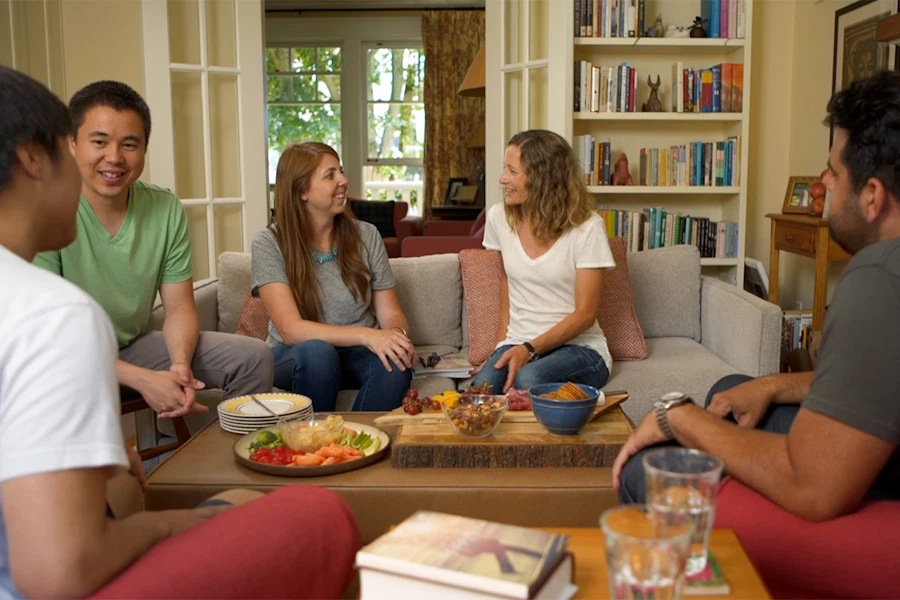

Designed for Groups
Below, you'll find helpful information, resources, and tips for leading a ReFrame group. We've compiled a number of suggestions based on feedback from groups around the world, but you know your group best. Feel free to explore and experiment to discover what works best in your context.
Getting Started
ReFrame is designed so that anyone comfortable leading a group discussion can run the course. The videos and accompanying participant and leader guides contain everything necessary to lead and follow along.
Here are some ways you can help create a great experience for participants:
- Familiarize yourself with the course materials (especially the videos and guidebooks) before you start the course.
- Looking at the time you have available and the makeup of your group, decide whether you want to go with ReFrame's standard format or make some modifications. (But feel free to adjust as needed after you start!)
- Review some tips for leaders based on other groups' experiences.
- Consider the how you can support the members of your group on this journey.
- Create a hospitable environment where people can have honest, challenging conversations.
- Set expectations for participants so everyone's on the same page.
Course Materials
ReFrame is available for no cost on Vimeo and YouTube. The Leader Guide and Participant Guide books suggest reflection and discussion questions, along with other resources to facilitate your group experience. The Episode Guide sheets offer much of the same information in a shorter, more print-friendly format.
- Leader Guide (PDF, 4.4 MB)
- Participant Guide (PDF, 4.3 MB)
- Episode Guides (PDF, 0.5 MB)
Standard Format
If you have 10 two-hour sessions to work with and ReFrame seems like an obvious match for your group, you're ready to go! Simply play the videos, follow the standard two-hour format below and follow the discussion plan for each session.
If you want to customize your experience by modifying the course or session length, trying a different setting, or adjusting the contents to better suit your group's needs, you can find a few suggestions below.
1. Introduce the Session (15 minutes): Each session begins with a recap of the previous session and a reflection question. The central topic of the session is then introduced, along with a Scripture passage to read aloud. You’ll then enter into a short time of prayer before beginning the video.
2. Watch the Episode (40 minutes): Each 40-minute ReFrame episode is a mixture of talks, interviews, and stories all related to the central topic of the session. A professor from Regent College provides a talk, which is interspersed with commentary from Christian thought leaders. Ordinary people also share their experiences of how the full narrative of Scripture has impacted their personal story. Outlines of each episode’s central topics are provided in the guides, together with space for your own notes.
3. Reflect and Journal (5 minutes): This portion of ReFrame is a devotional and reflective space, where participants are invited to discern what God is saying to them through a time of silence, prayer, and journaling. It draws on the story of the disciples on the Emmaus road (Luke 24:13-35) and is designed to create space for participants to encounter Jesus. If appropriate for your group, participants may be invited to share their reflections together. Space is provided within the guide for journaling, with additional space for notes and reflection in the back. Participants may also wish to bring their own journals.
Break (5 minutes)
4. Discuss the Episode (40 minutes): Questions are provided for the group to discuss the main themes of the episode. The goal of this time is to deepen understanding, so don’t feel pressured to cover everything. If you are having trouble getting the conversation going, consider asking one or more of the following:
- What was new or significant for you?
- What did you find helpful?
- Were you surprised by anything?
- Was anything confusing?
- What questions were raised for you?
- Was there anything that specifically connected with your life?
5. Engage Through Activity and Prayer (15 minutes): Each session is designed to be self-contained, with no preparation required of the participants. However, every session includes an activity, some of which can be completed during the session itself, while others are optional and can be completed before the next session. Where activities are optional, spend the time explaining the activity and answering any questions the participants may have. The sessions end with an invitation to pray together about the key themes and any specific prayer requests that arise. In addition, a historical prayer is provided as a reminder of the church’s rich heritage and as an encouragement for us today. The prayers are collected in the Prayers Throughout the Ages segment in the back of the guide.
Customize Your Experience
Study groups have adapted ReFrame for their contexts in many creative ways. Every group is different, and the standard time (two hours) and group size (6–12 participants) are just recommendations. You can adjust both of these as you see fit.
Adjust the Setting
Here are some examples that have worked well.
- Watch and discuss the videos in a home over a meal.
- Watch in a large group and then break up into table groups for discussion.
- Watch the videos on your own and then get together to discuss them.
Adjust Session Length
If two hours per session doesn't work for your group, here are some suggestions for shorter formats.
90 Minutes
- Introduce | 5 min
- Watch | 40 min
- Reflect | 5 min
- Discuss | 30 min
- Engage & Pray | 10 min
40 Minutes
- Watch | 40 min
- Discuss | 15 min
- Pray | 5 min
Adjust Course Length
Struggling to fit 10 weeks of ReFrame into a church calendar year? Here are some creative ways churches have used the material:
- One session per month (e.g., September–June)
- One session per week for 7 weeks + Saturday retreat with 3 sessions
- Two weekend retreats + homework
- Three-day intensive retreat
Adjust the Content
You're always free to tailor your discussions, activities, and other parts of your ReFrame experience to meet the needs of your group.
Customize Discussion Questions: You can write your own discussion questions tailored to your group. You might find our one-page episode guides (PDF) helpful.
Target Your Discussion: If your group members fit into a particular demographic (e.g., students, retirees), vocational stage (e.g., early career), or context (e.g., coworkers within an organization), you can think about how to adjust your initial or follow-up questions to suit group member's unique perspectives. For example:
- For student groups, consider re-orienting your discussion to connect with the lives of students, the subjects they are studying, and the occupations they hope to enter.
- For older adults or retirees, think about how you can encourage group members to reflect on their accomplishments so far and imagine how their vocation might be evolving.
Spread Out the Video Content: If the videos are too long for your group to take in all at once, you can adjust your approach to make the content more manageable. Here are a few ideas.
- Divide each episode into two parts and extend the course to 20 weeks.
- Add a discussion or stretch break part-way through each video.
- Just watch the lecture portion of the videos.
- Allow group members to watch the videos at their own page during the week, and focus your time together on discussion.
Tips for Leaders
Tips for Leaders
Pray: Pray for your group and your time together.
Prepare: Get ready for each session by watching the video beforehand and preparing for the activity as necessary. Notes to help you prepare are provided at the beginning of each session.
Customize: Every group is different. The standard time (two hours) and group size (6-12 participants) are recommendations. Adjust both of these as you see fit.
Focus: Try to keep the session and discussion tightly focused. Use the recap and intro to focus the group but don’t get stuck here; try to get to the video within the time suggested.
Conversation: As a leader, facilitating conversation is a big part of your role. You do not have to have all the answers; rather, your task is to help people engage and wrestle with their questions. Life is complex and so is living out God’s story, so try to avoid easy answers.
Questions: Having honest discussions about difficult questions is an important part of learning in ReFrame. With that in mind, don’t feel pressured to cover all the questions listed for each session. Equally, feel free to follow people’s curiosity and the questions that naturally emerge.
Listen: Every good conversation involves listening. Guide the discussion and help participants listen well to one another. Remind the participants that they are all encouraged to contribute each week.
Hospitality: ReFrame tries to follow the natural rhythms of a group: time to gather, connect, discuss, reflect, and take breaks. The typical two-hour model does not include space for a meal, although feel free to provide refreshments. If you wish to share a meal together, set aside additional time.
Support Your Group
Challenges
ReFrame is going to challenge your group to take their faith into their ordinary lives in fresh ways. It will challenge:
- their minds as they encounter the Bible as a story that makes sense of all of life;
- their hearts as they encounter Christ;
- their actions as they begin to imagine what it means to be an ambassador for Christ in the places he has called them.
In addition, while the material in this series is generally quite accessible, some participants may the teaching format, vocabulary level, or other aspects of the presentation challenging. You can reassure them that they're not alone, and encourage them to ask questions and reflect on what they're hearing. (After all, the chances are good that if one person struggled with a particular concept or segment of the video, others did too!) Their participation will enrich the experience for everyone.
Preparation and Encouragement
Here are some ways you can prepare your group and help them through the challenge:
Create a Map: Make an ongoing visual map of where you’ve been and where you are going, and keep track of the questions that arise.
Give Access: Provide links to the videos for those who miss a session or want to watch the material multiple times.
Put Episodes in Context: You may find that your whole group struggles with some episodes more than others, or that different members of your group have divergent preferences. For example, some people find Episode 2 a little abstract and "heady." Some find Episodes 3 and 4 a bit dry. Prepare your group for this, and remind them that there are multiple speakers throughout the course with different teaching styles.
Encourage Group Members: This course will stretch some participants, but they may be surprised by their appetite for challenging material. If some participants feel overwhelmed, encourage them to stick with it, keep showing up and asking questions, and focus on taking one thing away from each week's session. They don't need to understand everything in every video to have a rich experience!
Cultivate Community: ReFrame gets at questions of meaning that often lead to rich, honest, and deep conversations. Embrace this—it's an important part of the experience.
