Note: This article is adapted from the chapter “C. S. Lewis: From Self-Obsession to Plerosis,” published in Sources of the Christian Self: A Cultural History of Christian Identity, edited by James M. Houston and Jens Zimmermann (Eerdmans, 2018), and originally appeared in CRUX, Vol. 54, No. 3 (Fall 2018).
C. S. Lewis addressed the topic of identity so often that one critic, James Como, has said that Lewis should have written a book on the self because he talked about little else. While I cannot agree that Lewis talked about little else—he talked about an incredible amount else—I will argue in this essay that Lewis had a lifelong interest in the self and that his understanding was one that developed throughout his life. This article will set out the development in his thinking on the self and, in particular, will pay attention to what he wrote in the somewhat overlooked Till We Have Faces, a late book that is essentially about personhood and the nature of the self. Reference will also be made to another late book, Prayer: Letters to Malcolm, as well as Lewis's own life—the crucible in which he explored identity.
From Self-Obsession to Self-Negation
Even as a teenager, Lewis was interested in the topic of the self. His thoughts on identity were probably influenced by his reading of Hegel, whereby self is understood through self-reflection, and through the awareness of others' perceptions about oneself. While his tutor, William T. Kirkpatrick, ensured that he engaged with philosophical ideas, and not just imaginative worlds, it is clear from his letters and writings that he was somewhat introspective, even self-obsessed. As he later wrote in a long letter to his life-long friend Arthur Greeves, "One out of every three is a thought of self-admiration."1 Living an isolated life, without any duty and few relationships, allowed him to live in a world of ideas and dreams. Kirkpatrick wrote that in his late teens, Lewis had "singularly little desire to mingle with mankind, or study human nature. His interests lie in a totally different direction—in the past, in the realm of creative imagination, in a world which the common mind would call unreal but which is to him the only real one."2
Although Lewis was still an atheist in his teens and twenties, the poems he was writing suggest that he yearned to be freed from his self-interest and to find the transcendence that he was reading about in the mystics (as was so fashionable in the early twentieth century). In "Tu Ne Quaesieris" (pub. 1918) we find him articulating the limitations of his introspective approach to date:
Yet what were endless lives to me
If still my narrow self I be
And hope and fail and struggle still,
And break my will against God's will,
To play for stakes of pleasure and pain
And hope and fail and hope again.
Deluded, thwarted, striving elf,
That through the window of myself
As through a dark glass scarce can see
A warped and masked reality?3
In his twenties, Lewis concluded that he needed to relinquish the will, "which as everyone has told us is the only thing to do."4 And increasingly he realized that he must reject his habitual introspection: "The only healthy or happy or eternal life is to look so steadily on the World that the representation 'me' fades away. Its appearance at all in the field of consciousness is a mark of inferiority in the state where it appears. Its claiming a central position is disease."5
But while Lewis recognized that he needed to eliminate desire for public praise and all other means by which he might seek to buoy up his sense of self, at this stage he was still unsure what the "cure" was to be "except for the sort of violent, surgical cure which Reality itself may be preparing for me."6 Philosophy had been a significant aspect of Lewis's journey to this stance. His reading of Samuel Alexander's Space, Time and Deity forced him to conclude that attempting to discern truth through introspection leads only to a falsification of consciousness, a conclusion that played into his rejection of stream of consciousness works by modernist writers. For philosophy was not just a study of ideologies for Lewis. His philosophical studies and companions had led him to see philosophy as a way of life that involved action. Lewis conveys this in Till We Have Faces when he has Orual say, "But if I practiced true philosophy, as Socrates meant it, I should change my ugly soul into a fair one. And this, the gods helping me, I would do."7
It was inevitable then that Lewis's conversion to theism and then to Christianity around the age of thirty-three was going to be accompanied by changes in his life. He had reached his philosophical basis for living, and he knew that it would have practical implications.8 Interestingly, Lewis's thoughts continued to hold to the path of self-abnegation, albeit with some adjustments. He continued to develop his philosophy that attention to himself was an obstacle to his spiritual growth, although he now saw this as being in line with Christian teachings. In one sense, his thinking in this respect had indeed moved much closer to a New Testament understanding of the self, whereby the old self must be put off in order for a new and transformed self to be put on (Col. 3:9-10). But his ideas had a particular emphasis that were subtly different. It is possible that his ideas were heavily influenced by George MacDonald, who had played a significant role in his conversion and whom he considered his "master."⁸ Lewis created an anthology of quotations from MacDonald's work, and one-sixth of those are about the self, with many emphasizing the need to deny the self. For example:
The self is given to us that we may sacrifice it: it is ours, that we, like Christ, may have somewhat to offer—not that we should torment it, but that we should deny it; not that we should cross it, but that we should abandon it utterly: then it can no more be vexed. "What can this mean?—we are not to thwart, but to abandon?" . . . It means this: we must refuse, abandon, deny self altogether as a ruling, or determining, or originating element in us. It is to be no longer the regent of our action. We are no more to think "What should I like to do?" but "What would the Living One have me do?"9
Although he stops short of saying that we should utterly put to death the self, MacDonald speaks of abandoning it and refusing it. He stresses the need to watch out for the cunning and deceitful self, prone primarily to self-worship and self-regard.10 "Self! I deny you, and will do my best every day to leave you behind."11
Lewis similarly seemed to see the self as set in opposition to God. "From the moment a creature becomes aware of God as God and of itself as self, the terrible alternative of choosing God or self is opened to it."12 He summarizes Augustine by portraying this opposition as pride, "the movement whereby a creature (that is an essentially dependent being whose principle of existence lies not in itself but in another) tries to set up on its own, to exist for itself."13 In "Two Ways with the Self" Lewis sets out his basic thesis:
Now the self can be regarded in two ways. On the one hand, it is God's creature, an occasion of love and rejoicing: now, indeed, hateful in condition, but to be pitied and healed. On the other hand, it is that one self of all others which is called I and me, and which on that ground puts forward an irrational claim to preference. This claim is to be not only hated, but simply killed; "never," as George MacDonald says, "to be allowed a moment's respite from eternal death." The Christian must wage endless war against the clamour of the ego as ego; but he loves and approves selves as such, though not their sins. The very self-love which he has to reject is to him a specimen of how he ought to feel to all selves; and he may hope that when he has truly learned (which will hardly be in this life) to love his neighbour as himself, he may then be able to love himself as his neighbour: that is, with charity instead of partiality.14
For MacDonald and Lewis, the self comes second; love of God and neighbour comes first. Throughout his thirties Lewis worked diligently at this, as we see clearly in his letters of that time. For example, in a letter that he wrote to Arthur Greeves in August 1930, he speaks very clearly about needing to relinquish the desire to have literary success. Writing from his own experience, he urged Greeves to regard his inability to find a publisher as an opportunity to learn to die to the self: "The only thing for you to do is absolutely kill the part of you that wants success." But, he says, "such disappointments, if accepted as death, and therefore the beginning of new life, are infinitely valuable."15
As a theist, Lewis found that this inattention to the self was easier than it had been as an atheist, as he had the help of God in doing so: "One of the first results of my Theistic conversion was a marked decrease of the fussy attentiveness which I had so long paid to the progress of my own opinions and the states of my mind. . . . To believe and to pray were the beginning of extroversion. I had been, as they say, 'taken out of myself.'"16 So for the newly converted Lewis, God cooperates in enabling the forgetting of the self. Indeed, Lewis felt that one way or another, God can be actively involved in an almost surgical procedure, cauterizing the inflated ego of the Christian. In Till We Have Faces we find that the gods perform surgery on Orual in stripping away the masks behind which she has hidden. And in Mere Christianity we are told that Christ will come and interfere with our self, killing the old natural self and replacing it with the kind of self he has.17
His emphasis upon such self-denial was an extreme position, but it was shaped by a number of factors besides MacDonald. Firstly, there was a recognition of his own need to counteract his tendency to self-absorption. Secondly, there was his awareness that self-aggrandizement or self-centredness is not in line with the teachings of Christ. Finally, he had a strong reaction against the Modernist turn to interiority, and although Lewis disliked the use of such "isms" and certainly did not fit neatly into any single category, nevertheless he strongly resisted the trend to write in any form of internal monologue (such as stream of consciousness). For these reasons, perhaps, an emphasis upon self-denial remained in his work for the next twenty years or so, alongside a strong sense that identity can only be found in God. The human cannot achieve any selfhood by his or her own efforts; the Existentialists, he later said, feel Angst because of their belief in solitary self-creation.18 One's soul is not one's own, he believed. In writing about Adam and Eve, Lewis says: "They wanted, as we say, to 'call their souls their own.' But that means to live a lie, for our souls are not, in fact, our own."19
For mid-life Lewis, identity is something given and not made; human freedom is responsive first and foremost. To refuse to receive is to turn back in toward oneself.20 One becomes a self through a life constantly given back to God, and Lewis argued for a determined self-discipline. "Some tendencies in each natural man may have to be simply rejected. Our Lord speaks of eyes being plucked out and hands lopped off—a frankly Procrustean method of adaptation."21 To fail to seek God first in this respect is to fail to become a person. Mark Studdock in That Hideous Strength is in danger of losing any sense of personal identity at all because he has let others mould and manipulate him and his desires. He has not learned to die to the standards of the fallen world.
De-emphasizing the Subject
Academically, Lewis argued for this in a literary debate with E. M. W. Tillyard, in a series of articles collected and known as The Personal Heresy. There he argued against the contemporary emphasis in literary criticism upon the personality or character of a writer. A writer (or poet, to use the old term as Lewis used it) should not focus on the personal but on the public, the impersonal, and the common; the reader is to look with the poet's eyes, not at him. To do otherwise, he argued, was to pervert the role of the poet into a kind of poetolatry. Tillyard tried unsuccessfully to shift him from this stance in the exchange that followed, arguing that in the process of self-surrender, the poet may end up being all the more unmistakably him- or herself.
Lewis continued to be a determined apologist for the importance of objectivity, as opposed to subjectivism. He perceived around him an ongoing transfer of emphasis from the external "object" to the "subject" and targeted this, not least in The Abolition of Man. In The Discarded Image, he spoke of "that great movement of internalisation, and that consequent aggrandisement of man and dessication of the outer universe."22 He believed that this emphasis would paradoxically but inevitably lead to the emptying of the person:
In this great change something has been won and something lost. I take it to be part and parcel of the same great process of Internalisation which has turned genius from an attendant daemon into a quality of the mind. Always, century by century, item after item is transferred from the object's side of the account to the subject's. And now, in some extreme forms of Behaviourism the subject himself is discounted as merely subjective; we only think that we think. Having eaten up everything else, he eats himself up too. And where we "go from that" is a dark question.23
Lewis's high value of the objective tradition led to an emphasis upon objectivity in his own writing; books from this mid-life period include The Problem of Pain (1940), Mere Christianity (written throughout the 1940s), and The Abolition of Man (1943). These books emphasize the value of orthodox Christianity and the value of common morals; they exclude that which is individualistic or idiosyncratic or subjective.
This de-emphasizing of the subject and inattention to the "I" was also seen in Lewis's life to an extreme degree. He lived sacrificially, both with his energies and with his money. He replied to all letters, neglected his appearance, and allowed himself to be endlessly interrupted when working at the home he had made with Janie Moore, his dead friend's mother. But even beyond that, he seems to have determined to focus on the objective to such an extent that there was little room for any personal attention to the self, not even in relation to others. Strikingly, those who knew him testify that his manner was impersonal. Even his friends felt that they knew very little about him personally, and some spoke of his having a persona. His good friend, Owen Barfield, put it this way:
What I think is true is that at a certain stage in his life he deliberately ceased to take any interest in himself except as a kind of spiritual alumnus taking his moral finals. . . . I suggest that what had begun as a deliberate choice became at length (as he had no doubt always intended it should) an ingrained and effortless habit of the soul. Self-knowledge, for him, had come to mean recognition of his own weaknesses and shortcomings and nothing more. Anything beyond that he sharply suspected, both in himself and in others, as a symptom of spiritual megalomania. At best, there was so much else in letters and in life, that he found much more interesting!24
As Stephen Medcalf has pointed out, Lewis set aside the persona of his early life, that of the introspective writer, in order to adopt a mid-life persona of spokesperson for mainstream Christianity.25 But that mid-life persona too came to be set aside as Lewis approached his fifties, and re-thought some of his emphases upon the self.
Unveiling a Sense of Self
This re-envisioning of the self appears in rather veiled forms in his later work: he made no overt statement that would have indicated his changing attitude, nor does he explicitly restate his theses on identity. But it seems as if Lewis came to realize that his attack on encroaching subjectivism was such that he was in danger of eliminating the subject. For one thing, we find that he begins to allow for a lot more of himself to come into his writings; no longer is he striving so much for objectivity. An overview of his works is one key to this. From the late 1940s onward we find that Lewis is no longer writing the objective books that he wrote in the 1930s and '40s. In Mere Christianity, Lewis had articulated that human souls who are taken into God will be very much more themselves than they were before.26 But it is only in the later books that we begin to see that trajectory playing out in Lewis's own work, as his work became both more creative and more obviously personal. His later books are still strong statements of his faith, but they are either fictional presentations of his beliefs, or they are personal, rather than written with any attempt to be objective. A Grief Observed (1961) was so personal that he had to publish it under a pseudonym. Prayer: Letters to Malcolm (1964) seems to consist entirely of material drawn straight from his own life.
But in my opinion, it is in Till We Have Faces (1956) that we find the most complete, albeit hidden, statement of the changes that had taken place in him. The novel is a tale of a soul that buries itself in duty and in stoic functionalism to the detriment of its spiritual growth, all the while being very productive and efficient.
The story stands in very clear contrast to the cosmic sweep of Lewis's earlier fiction, both the science fiction trilogy and the Narnia stories. And it points toward a more nuanced understanding of Christian identity than can be found in his previous work. It was a story that Lewis had been composing for decades. Since an undergraduate, he had been fascinated by Metamorphoses, the myth of Cupid and Psyche, as told by Apuleius. The story itself developed in his mind, he said, until the themes suddenly interlocked in his fifties, turning a pagan myth into one with profound Christian reverberations.
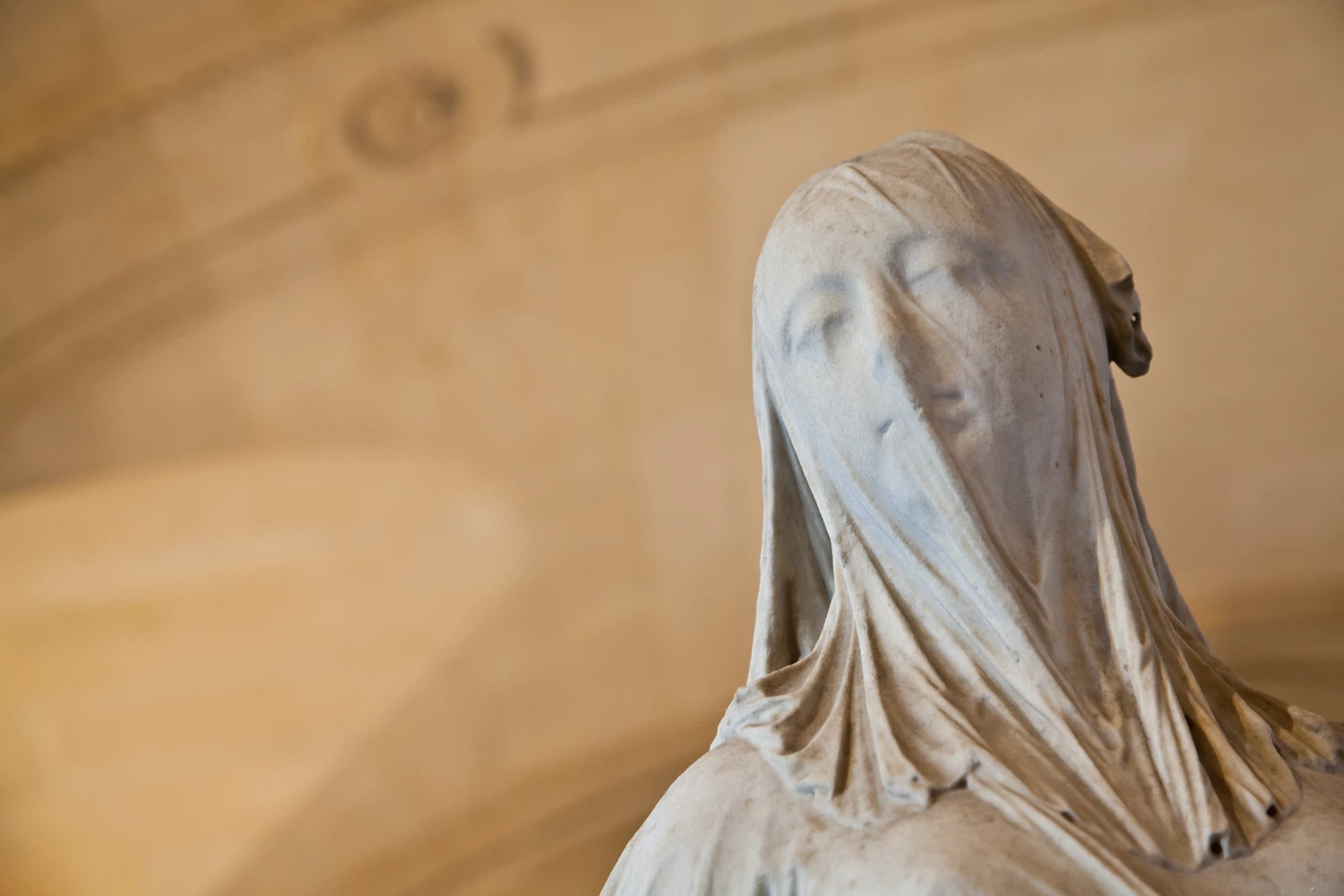
The plot details are as follows. A king in an ancient country has three daughters: Orual, Psyche, and Redival. Psyche's beauty is such that she is sacrificed to appease the gods. Orual is jealous that Psyche is content to have been translated to become the bride of a god, and therefore denies the gods' existence, despite the clear testimony of her sister Psyche and her own glimpse of their palace. Thereafter, she chooses to veil herself, in an act that suggests a disconnection from the rest of the world. In the following years, as a veiled queen, she builds up the country to a state of success and efficiency, but at great cost to those around her, and to herself. Desensitized by jealousy and hurtful to those who are most loyal to her, she is also limited in her own growth. She becomes "the queen," effectively locking up inside herself the person that she used to be. But she becomes more and more troubled by her own trapped and diminished self, and, eventually provoked to action by a series of events, she takes a complaint to the gods. In response, she finds that they take her on a journey into a long and complex process of deconstruction. Dreams, conversations, stories, and events all combine to force her to see the truth that she has for so long been denying to herself. For the truth is that she has veiled herself because she does not want to face the gods, and that in doing so, she has been living not only in denial of her own behaviour but in isolation from the relationships (with the gods and with others) that would have drawn her out of her long interior exile. Her stoic outlook is portrayed with striking clarity:
I did and I did and I did. . . and does it matter what I did? I cared for all these things only as a man cares for a hunt or a game, which fills the mind and seems of some moment while it lasts, but then the beast's killed or the king's mated, and now who cares? It was so with me almost every evening of my life; one little stairway led me from feast or council, all the bustle and skill and glory of queenship, to my own chamber, to be alone with myself; that is, with a nothingness.27
Orual's materialistic and self-enclosed approach has diminished her greatly. Her act of wilful rejection of the divine, caused by jealousy of her sister, has contributed to a concomitant lack of self-knowledge. She has not acknowledged the reasons why she has adopted the veil, nor the consequences of her behaviour, and this long trajectory has led her to a place where she ultimately has no personhood. She is a gap, she says.28 And yet, despite all of this, Orual must still learn to die to herself. The gods tell her to "die before you die."29 But she has not succeeded. "It was as if I were dead already, but not as the god, or Socrates, bade me die."30 If she had truly died to herself, she would have had a better sense of self; Lewis remained resolute on this point. But his understanding of that paradox is no longer the same as it had been.
It takes a complex series of actions to bring Orual to a point of metanoia, of true repentance, and to enable her to see her failings. In the end, she is able to speak to those around her directly and truthfully because she learns to accept the divine truths and submit to them. Orual is probably drawn from many sources, but in certain respects, she seems to be drawn directly from Lewis's own experience. In his determined rejection of attention to the self, he had, on some levels, forced himself into the same position as Orual. He had confused introspection with self-knowledge and, in doing so, had diminished his ability to know himself and others' ability to know him. But as Calvin and so many others in the Christian spiritual tradition point out, knowledge of self is tied to knowledge of God. As Orual puts it: "How can they [the gods] meet us face to face till we have faces?"31
Only a deep level of honesty with oneself can call forth a response from the divine. In one sense, Lewis still adhered to his emphasis upon setting aside oneself in order to submit to God. He continued to believe that this was essential to the spiritual life. But he came to understand in his own life that this should not negate the particularity of his soul. He, like Orual, came to see that he could only address the divine with his own particular voice.
Lewis did explain this in a letter to one correspondent—perhaps the closest he got to really indicating what Till We Have Faces is about. "The idea was that a human being must become real, must be speaking with its own voice (not one of its borrowed voices), expressing its actual desires (not what it imagines it desires), being for good or ill itself, not any mask, veil or persona."32 The image of unveiling obviously struck a chord with Lewis so much so that he chose to use it again in Prayer: Letters to Malcolm. As he put it there, when we assent with our will to be known by God, we have unveiled: "Instead of merely being known, we show, we tell, we offer ourselves to view. . . . By unveiling. . . we assume the high rank of persons before Him. And He, descending, becomes a Person to us."33 The inability to be open and vulnerable limits spiritual progress. "God is in some measure to a man as that man is to God."34 To assume "the high rank of persons" involves a willingness to allow God to engage with the particular person he has made.
By the end of the book, Orual has no will, no pride, and no jealousy left in her. She is "unmade." And yet it is then that she catches a glimpse of herself as beautiful. Her refusal to face the truth about herself has taken her on a long and unnecessary journey. In contrast, her sister Psyche (whom Lewis referred to as an anima naturaliter Christiana, or natural Christian soul) has unerringly followed the promptings of her pure soul, having always longed for heaven and the presence of the gods. Human longing, or "Joy" as Lewis called it, is rooted in God's longing for humans, and is intended to draw us to him. Unlike "joy" (lowercased), Joy has a bittersweet nature that points us toward our origins in God. Psyche instinctively understands this and follows it to find the divine. Love is the basis for her self-denial. There is no stoical self-abnegation. Rather, the emphasis is upon going beyond the self for love of others and love of the divine. As she puts it, "To leave your home. . . to lose one's maidenhead—to bear a child—they are all deaths."35 But they are also actions that bring new life. Orual comes to resemble Psyche because she learns that self-abandonment (true ekstasis) is relational, and that following Psyche's way of self-sacrifice is a way that leads to freedom and fulfilment. Psyche becomes "a thousand times more her very self than she had been before the Offering."36
Prayer, Love, and Plerosis
We get another glimpse of this gentler approach in Lewis's last book, Prayer: Letters to Malcolm (published posthumously in 1964). The (unnamed) letter writer, markedly like Lewis himself in a host of ways, articulates something of his mature thinking on the topic of the self. And now prayer has become a vital aspect of his sense of self. Prayer is presented to us as the hinge between God and the self, a way of moving toward a union of the human will with the divine will. Because God is the ground of our being and the source of all human agency and identity, as we engage with him through prayer we gain a deep sense of self. "The deeper the level within us from which our prayer, or any other act, wells up, the more it is His, but not at all the less ours. Rather most ours when most His."37 The revealing of oneself to God and being vulnerable—unveiling is an important element of this. "Only God can let the bucket down to the depths of us," Lewis believed.38 But first we must ask God for his help. We should pray before all other prayers, "May it be the real I who speaks. May it be the real Thou that I speak to."39
There are limitations to this. For Lewis, the earthly life of prayer is also the means by which one is reminded that in this life we can easily make the mistake of falling into the belief that the "I" as I perceive myself is an ultimate reality. Most of us, Lewis says, hide behind veils, living with what he called a "phantasmal self," a façade that he likened to a character played by an actor. Psychologists such as Freud, he believed, have introduced us to a sense of the depth of the soul, but they have still underestimated the real depth and variety. To a large extent, we cannot understand the soul in this life—just as God, too, will remain in large part an unknown, even a "bright blur,"40 and just as even in prayer the real "I" struggles to address the real God. So self-knowledge here and now will only ever be partial, and Lewis presumed that we should not try to seek total self-knowledge in this life. "I sometimes pray not for self-knowledge in general but for just so much self-knowledge at the moment as I can bear and use at the moment; the little daily dose. Have we any reason to suppose that total self-knowledge, if it were given us, would be for our good?"41 In this life there is no possible sense of completion. There will always be more.
Although pre-glory transformation can also be seen in his earlier fiction (especially Perelandra and That Hideous Strength), Till We Have Faces portrays the two extremes of Christian transformation by contrasting the two sisters. The correct understanding of longing and love that marked Psyche's soul on earth draws her straight toward that glorious fulfilment, in contrast to the roundabout and anguished humiliation that Orual must endure before she eventually finds herself reaching the same understanding. Psyche, like Ransom in the cosmic trilogy, exhibits traits of the Christian saint—sacrificial, joyous, seer-like, and capable of existing in both the earthly and the heavenly sphere concurrently. The novel points us toward this high rank, the utmost "fullness of being," or plerosis, as something to be lived toward, but only partially experienced in this life.
This fullness is not, in Lewis's world, something that happens in isolation. Just as Ransom is in the community of St. Anne's, so too Orual is connected to others at the end, if in a mystical fashion. By the conclusion of Till We Have Faces, Orual is Psyche, we are told; she too has become a Christian soul. Psyche has in part taken some of her suffering—such is the interconnectedness of people in the great divine economy. As the Fox puts it, "We're all limbs and part of one Whole. Hence, of each other. Men, and gods, flow in and out and mingle."42 The self participates not only in the life of God (see Lewis's essay "Transpositions") but also in the lives of other Christians.43
These thoroughly supernatural dimensions of the self—or the soul (Lewis nowhere differentiates between the two words)—had been central to Lewis's thinking all his life. The self/soul will always remain a created being, but by divine grace, humans can become what God is by nature. These long-held ideas of Lewis's are very close to a full doctrine of deification—the theosis of the church fathers. For example, in Mere Christianity Lewis expresses confidence in the idea that humans could become "gods":
He said (in the Bible) that we were "gods" and He is going to make good his words. If we let Him—for we can prevent Him, if we choose—He will make the feeblest and filthiest of us into a god or goddess, a dazzling, radiant, immortal creature, pulsating all through with such energy and joy and wisdom and love as we cannot now imagine.44
When Orual sees Psyche after her sacrificial death, she says of her, "I had never seen a real woman before."45 At the end of Till We Have Faces, Orual too realizes that, like Psyche, she has come to the utmost fullness of being that the human soul can contain. But unlike Psyche, her journey has been long and arduous because she did not understand the true nature of sacrifice. Whereas Psyche's sacrifice has been carried out for love, Orual has put herself to death out of fear and jealousy and the inability to see things as they are. In the end she must accept that she has put herself to death in the wrong way—in a way that has left her locked up inside. It is only by the end of the trial, when the divine perspective has helped her to see with the eyes of love for Psyche and for herself, that she finds that in giving up her own desires in practising kenosis she has found herself filled—plerosis. It is very much in line with the teaching of Gregory of Nyssa: "For the participation in the divine good is such that it makes anyone into whom it enters greater and more receptive. As it is taken up it increases the power and magnitude of the recipient, so that the person who is nourished always grows and never ceases from growth."46 In contrast, Orual's stoic self-denial was not participation in the divine good. Whereas Psyche is marked by love, joy, and peace from the outset, so Orual learns it all in a rush at the end of her life—love for the gods, love for others, love for self.
Like Orual, it seems that Lewis came late to a personal grasp of the extent to which transformation is rooted in love rather than personal asceticism, and in a willing engagement with the Triune God so that each person can become that "dazzling, radiant, immortal creature," pulsating with "energy and joy and wisdom and love." Where Lewis had rigorously set himself aside out of love for God, he came to love himself for God's sake, as Bernard of Clairvaux would have us learn. In the later works we see Lewis's mature understanding of self-transcendence as motivated by love, rather than a stoical self-denial. It would seem that he was at last able to grasp the biblical emphasis of putting away the old self in order to take up the new self, rather than the determined emphasis upon denying the self absolutely. Comments in Letters to Malcolm indicate this. For example, Lewis points out that Alexander Whyte advocated permanent horror at one's own inner corruption and that the Christian should daily scrutinize this filth, in order to be repulsed by it. But Lewis rejects this:
Can he be right? It sounds so very unlike the New Testament fruits of the spirit—love, joy, peace. And very unlike the Pauline programme; "forgetting those things which are behind and reaching forth unto those things which are before." And very unlike St François de Sales' green, dewy chapter on la douceur towards one's self.47
There may be a time to be repulsed, Lewis ponders, but a "regular diet of emetics"48 is not the way to spiritual health either.
The Pauline verses that inform the primary image of Till We Have Faces in 2 Corinthians 3:18 suggest only one side of the picture, "And we all, who with unveiled faces reflect the Lord's glory, are being transformed into his image with ever increasing glory, which comes from the Lord, who is the Spirit" (NIV). There are other Pauline verses that echo the connectedness between love and fullness of self that can be heard in Lewis's later work, and they reflect many of Lewis's themes:
Out of [the Father's] infinite glory, may he give you the power through his Spirit for your hidden self to grow strong, so that Christ may live in your hearts through faith, and then, planted in love and built on love, you will with all the saints have the strength to grasp the breadth and the length, the height and the depth; until, knowing the love of Christ, which is beyond all knowledge (gnōseōs), you are filled with the utter fullness of God (pleroma tou theou).49
Here in Ephesians, we find that God's glory is a strong self, rooted in Christ and planted in the love that is beyond all knowledge. And so, holding both emphases together, Lewis's mature thought shows that identity is to be found in engaging with the Triune God—but in a participatory way. Such engagement is not only about humans reflecting back the divine face (rather than seeking to gain one that is solely their own) but it is also about God reflecting back to humans the selves that they present to him.
Orual, like Lewis, learns the nature of a love that does not self-seek, but does not self-efface. Of Psyche, she realizes, "I loved her as I would once have thought it impossible to love; would have died any death for her. And yet, it was not, not now, she that really counted. Or if she counted (and oh, gloriously she did) it was for another's sake. The earth and stars and sun, all that was or will be, existed for his sake."50 Till We Have Faces and Letters to Malcolm strongly suggest that Lewis was beginning to grasp, not just intellectually, but also emotionally and spiritually, that the Triune God's upbuilding of the self is rooted in a love that calls the human person out of their narrow limitations toward a spiritual fullness that is beyond human reasoning. His journey from self-obsessed teenager was far from complete—the eschaton still beckoned—but his life-long journey was one that had been profoundly shifted away from self-obsession and self-denial toward a hidden self made strong and full with divine fullness.