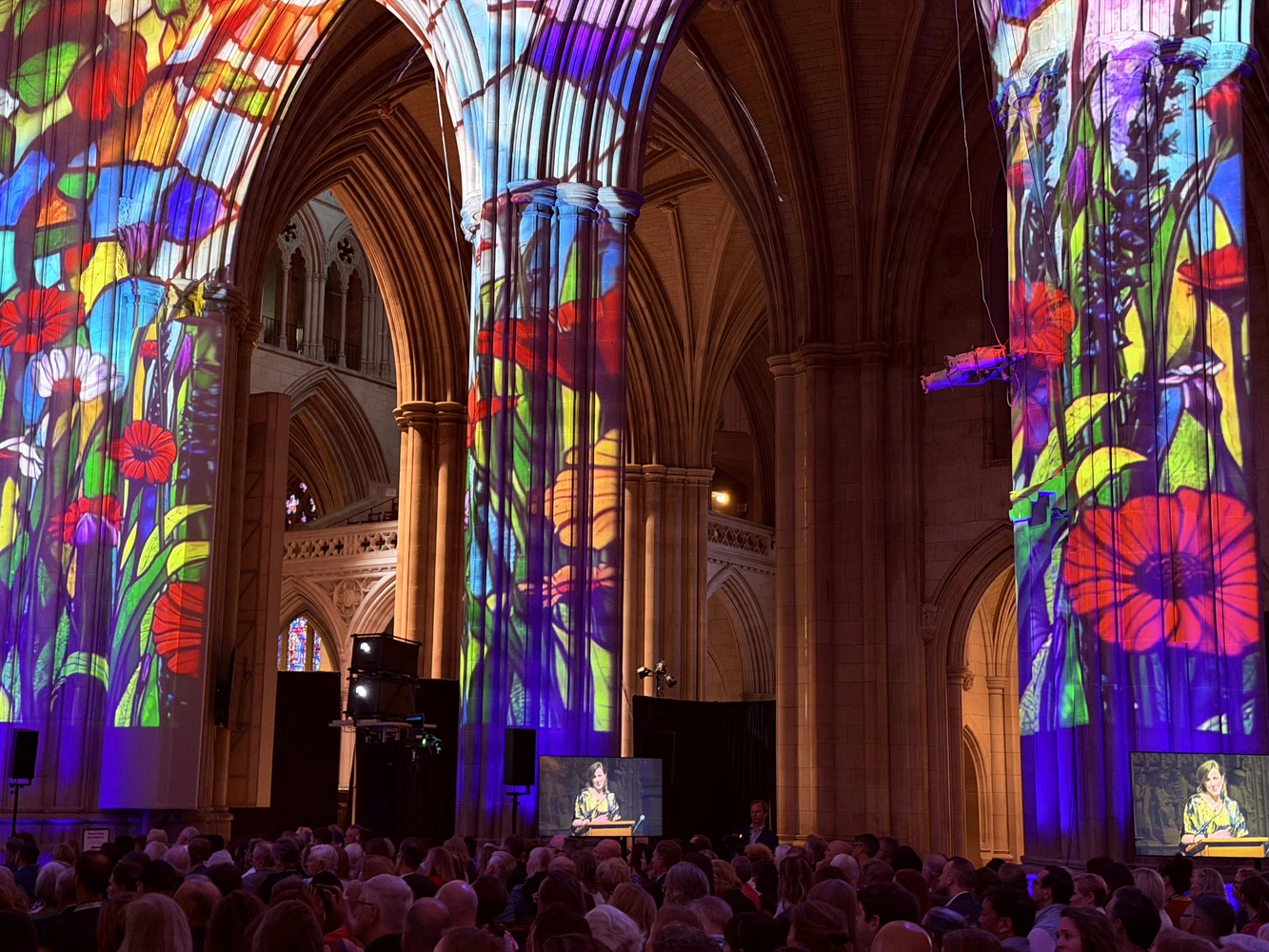
Editor’s note: The Regent Vine’s Managing Editor, Yare Vargas, attended Comment Magazine’s Understory Festival on behalf of The Vine. The festival, held at the Washington National Cathedral in Washington, DC, on May 28–30, 2026, was intended to be what Comment called a “civic and spiritual gathering to rehumanize our common life.” Regent College was proud to sponsor this event, and Yare was joined by several faculty members, including President Paul Spilsbury, in attendance. Here, we are grateful to share Yare’s reflections on the Understory Festival and its relationship both to her own story and to our larger cultural moment.
"What is struggling to be born?"
The question lingered with me long after it was first asked.
I have been trying to write about my experience at Comment's Understory Festival in Washington, DC, but every attempt felt unsatisfactory. A descriptive account seemed inadequate; the most important things happened beneath the surface. A critique felt equally misplaced. What stayed with me was not whether every panel succeeded or every argument convinced. What stayed with me was a question.
What is struggling to be born?
Perhaps the reason the question unsettled me is because I arrived carrying my own uncertainties.
I almost did not make the trip.
A few months earlier, I had been turned away at the US border while attempting to attend another conference. I was told I lacked the proper documents, despite having entered the country before with those same documents. The experience left me shaken. Stories of immigration raids and deportations only amplified my anxiety. As a brown-skinned Latina, crossing the border from Canada to the US no longer felt routine.
There were deeper fears too.
I grew up in a family and a country deeply suspicious of empire. The United States often existed in my imagination less as a place than as a symbol. It represented power, intervention, and a long history of political and economic influence over Latin America. Some of those concerns were justified; others had hardened into assumptions.
I carried all of this with me: legitimate concerns, inherited narratives, and assumptions I had rarely examined closely.
Yet I also knew that places are more than symbols. Countries are made up of people. If I wanted to understand, I had to encounter reality rather than my own ideas about it.
So I went.
One of the recurring images throughout the gathering was that of the understory: the dense world that grows beneath the forest canopy. It receives little attention and even less light, yet it is full of life. Roots intertwine. Organisms depend on one another. Growth happens quietly, often invisibly.
The image felt strangely comforting.
We live in a culture obsessed with what is loud, visible, and immediate. Social media rewards certainty. Politics rewards outrage. Public discourse often rewards those who can dominate attention. Yet most of life happens elsewhere.
It happens in conversations no one records. It happens in acts of care no one notices. It happens in friendships, communities, and commitments that rarely make headlines.
The understory reminded me that the most important forms of growth are often hidden from view.
And perhaps that is why another realization surprised me.
The people I encountered did not fit the stories I had inherited.
Again and again, strangers approached me with curiosity and kindness. They asked meaningful questions and, more importantly, they listened. Not everyone agreed. Not everyone saw the world in the same way. Yet there was a generosity in those conversations, a willingness to remain at the table together. In just a few days, connections were formed that I suspect will reverberate through my life for years to come.
In a time when so much seems to push us toward suspicion, certainty, and division, that willingness felt precious. Especially now.
Yet the image of the understory also raised questions for me. If we are seeking the hidden forms of wisdom that sustain our common life, whose voices are still missing from the conversation? I found myself wondering about Indigenous perspectives on land and belonging, and about communities from the Global South whose experiences often remain at the margins of Western cultural discussions. If the understory teaches us to pay attention to what grows beneath the canopy, then perhaps it also invites us to listen more carefully to voices we too easily overlook.
As I was leaving the festival, another question entered the room.
My grandmother was dying.
The news arrived without warning, collapsing distance in an instant. Suddenly my attention was divided between conversations about faith, culture, politics, and the future, and the impending loss of a woman whose life embodied love, resilience, and faith.
My grandmother lived a simple life. A hard life. A life marked by both tenderness and injustice. Many years ago, her family was forced from their land under the promise that the state would compensate them. Police arrived with dogs and guns. Homes were destroyed. Crops were uprooted. The land was handed over to powerful companies, and its value grew exponentially. More than eighty years later, despite legal victories, the compensation never came. The heirs are still waiting.
What has remained with me is not only the injustice itself, but the person my grandmother became in the midst of it. She carried hardship without allowing it to extinguish her capacity for love. She remained generous. She remained faithful.
And so I find myself asking: What was struggling to be born in her story?
What would she have said if someone had asked her that question?
I do not know.
Perhaps only those of us who outlive her can begin to answer it. Her legacy will continue in the lives she shaped. It will live in the kindness she showed, in the faith she carried through suffering, and in the memory of a life that, by most standards, would appear ordinary.
Yet perhaps this is precisely how the understory works.
The most important things often grow unnoticed. Beauty and chaos. Hope and grief. Birth and death. All at once.
I wonder whether this is what the understory actually looks like.
Not optimism. Not progress. Not the comforting belief that everything is getting better.
Instead, a stubborn form of life that persists amid uncertainty, poverty, and even death.
The understory does not deny decay; it grows through it. The forest floor is filled with things dying and things being born at the same time. Perhaps that is also true of us.
But I came home convinced of something else. There is more life beneath the surface than we realize.
There are people quietly cultivating beauty and justice. There are communities learning how to listen. There are relationships forming across boundaries we assume are impassable. There are roots growing beneath the soil even when we cannot see them.
The question remains: what is struggling to be born?
I do not know.
But for the first time in a long while, I believe there is enough life in the soil for something new to emerge.