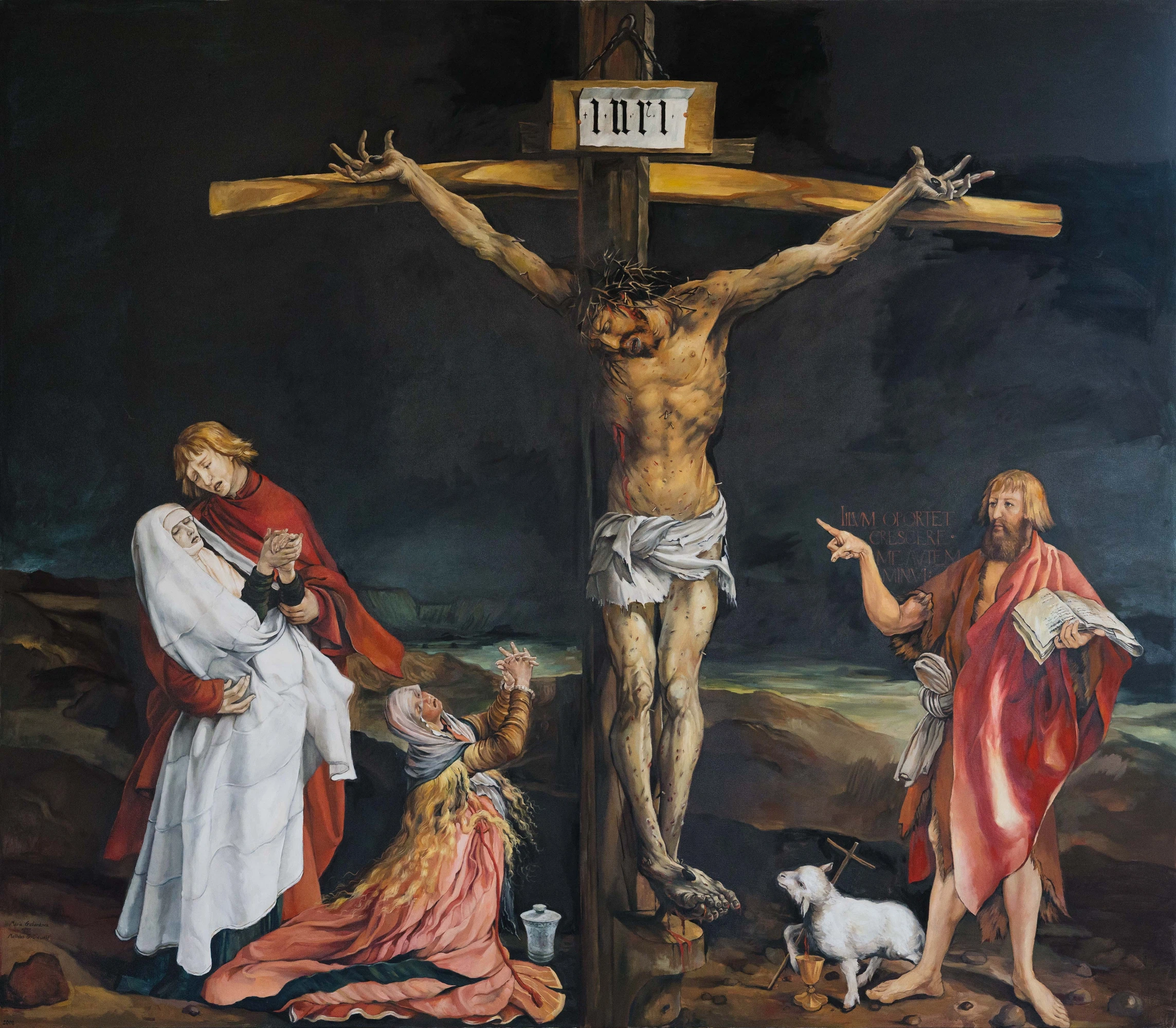
The Crucifixion (after Grünewald), 2007
Czechoslovakian-born Canadian, based in Toronto, Ontario
oil on canvas, 94 × 108 in. (238.8 × 274.3 cm)
Gift of the Westminster Foundation
This large painting is a (slightly smaller) copy of the central exterior panel of Matthias Grünewald’s famous Isenheim Altarpiece (1512–16). The original was painted for the Monastery of Saint Anthony in Isenheim, near Colmar (then Germany, now France). The Antonine monks of the monastery devoted themselves to hospital care, especially for those suffering skin diseases such as ergotism, the symptoms of which are visible throughout the giant, anguished body of Grünewald’s Christ.
The people to the left of Christ are commonly included in Crucifixion imagery: John the Evangelist holds and comforts Mary, mother of Jesus, and Mary Magdalene kneels and mourns near the foot of the cross. Unusually, however, Grünewald includes John the Baptist (who died years before the crucifixion) to the right of Christ. The Latin inscription in the crook of his arm, Illum oportet crescere me autem minui, is the Vulgate translation of John 3:30: “He must increase; I must decrease.” Karl Barth, who kept a reproduction of this image over his writing desk for fifty years, repeatedly drew attention to this figure: “Witnessing means pointing in a specific direction beyond the self and on to another... In this connection one might recall John the Baptist in Grünewald’s Crucifixion, especially his prodigious index finger. Could anyone point away from himself more impressively and completely?” (Church Dogmatics I/1, 111–12).
Gabankova was commissioned by the Biblical Museum of Canada in Vancouver, BC, to make this painting to mark the death of Fred Metzger. It was later gifted to Regent College by the Westminster Foundation.
-

- Art Collection
- Art Didactics
- The Crucifixion (after Grünewald)
-
- Art Collection
- Art Didactics
- The Crucifixion (after Grünewald)