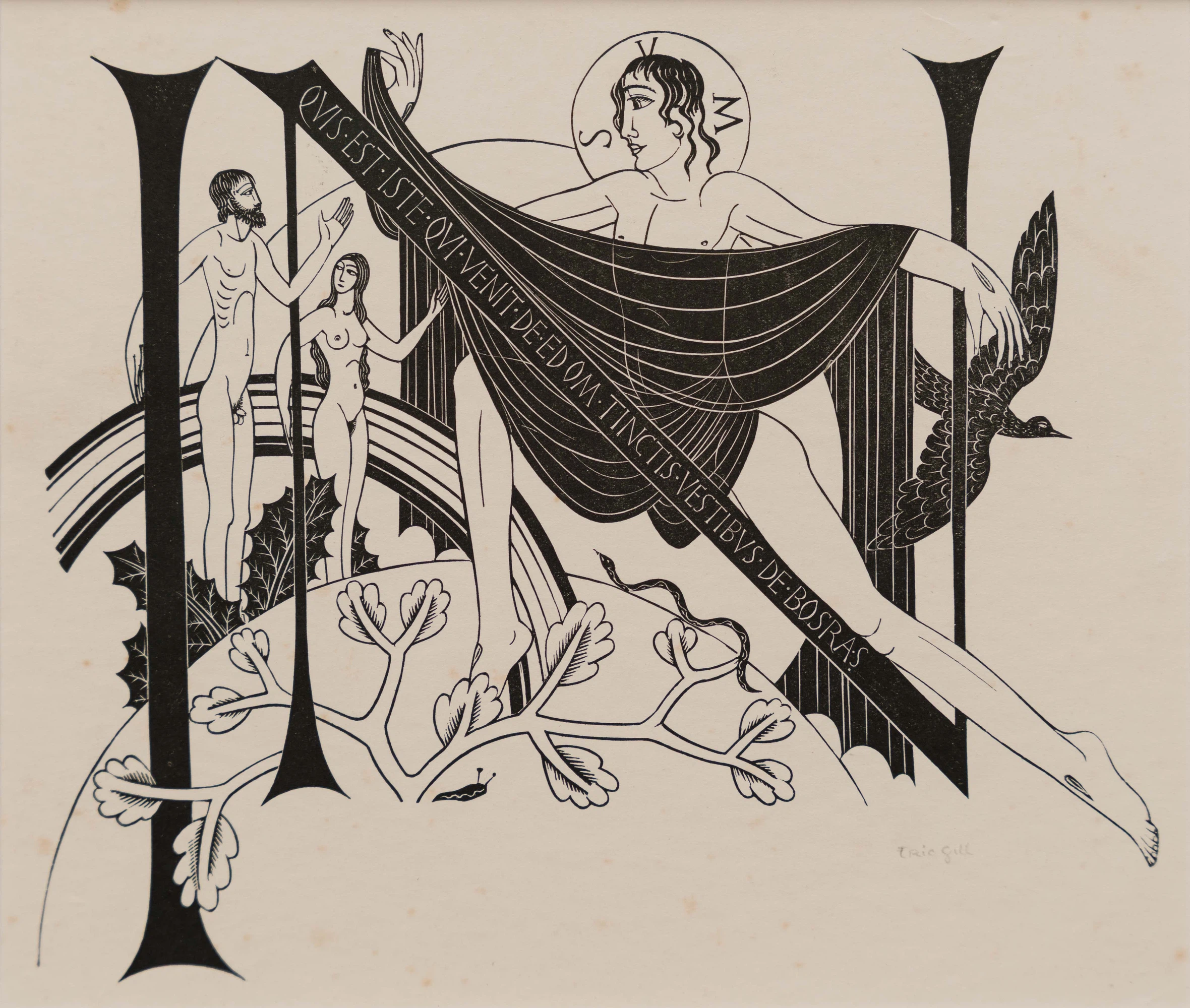
In the Beginning (John 1:1-5), 1931
English, 1882–1940
wood engraving on hand-made paper (Physick 791), 6 ¾ × 7 ¾ in. (17 × 19.5 cm)
Gift of Ward and Laurel Gasque
In 1931, Golden Cockerel Press published a King James translation of The Four Gospels of the Lord Jesus Christ, intricately designed by Eric Gill. Gill created a typeface for the edition along with 65 wood-engraved illuminated words at the beginning of key sections, intended as a modern homage to the tradition of illuminated manuscripts. This work is a print proof of Gill’s design for the first word of the Gospel of John—“IN” immediately below which the text continued down the first page of the Gospel: “[In] the beginning was the Word, and the Word was with God, and the Word was God . . . [continuing through verse 5] . . . and the darkness comprehended it not.” Interwoven with this “IN” is a figural image of the Word of God striding forward, creating time, space, sun, earth, vegetation, animals of land and sky, and man and woman. Importantly, this Word is explicitly depicted as Christ, the Word made flesh (John 1:14), who already bears crucifixion wounds in his hands (cf. Rev 13:8) and has the Latin word SUM, “I AM,” inscribed in his halo (cf. John 6:35-51, 8:12–9:5, 10:7-14, 11:25-27, 14:6-7, 15:1-5, 18:4-9).
Strikingly, the diagonal stroke of the letter N bears a Latin translation of Isaiah 63:1: Quis estiste qui venit de Edom tinctis vestibus de Bosras? (“Who is this who comes from Edom, in [red] stained garments from Bozrah?”). While the surrounding imagery intertextually links John 1 to Genesis 1–2, this quotation forges a highly provocative intertextual link to Isaiah’s announcement of God achieving decisive victory over his enemies by going alone into the winepress of judgment. The presence of the serpent directly below tinctis vestibus (“red-stained garments”) alludes to the satanic enemy overthrown in the winepress of Christ’s death and resurrection.
-

- Art Collection
- Art Didactics
- In the Beginning (John 1:1-5)
-
- Art Collection
- Art Didactics
- In the Beginning (John 1:1-5)