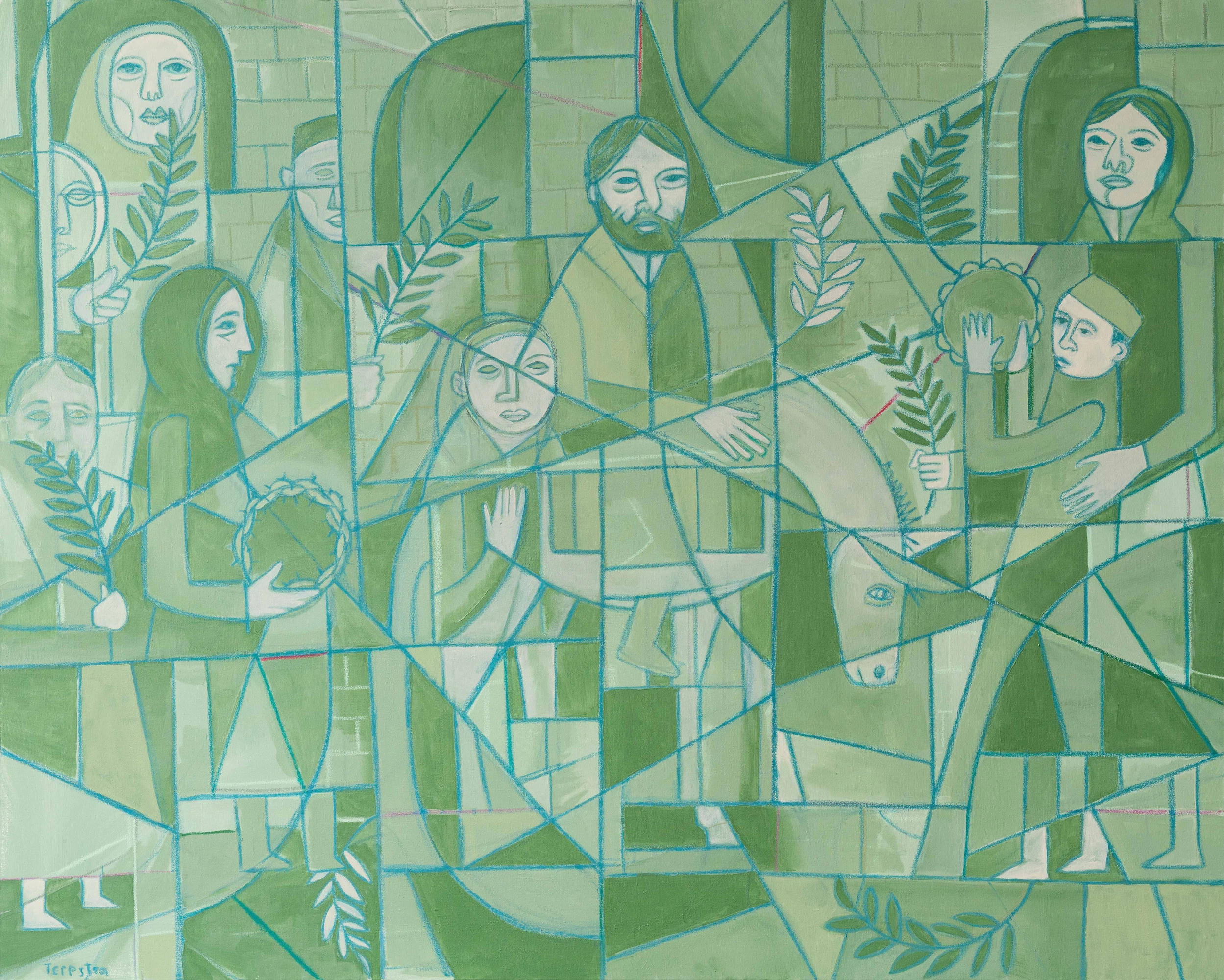
Hosanna, 2019
American, based in Bellingham, Washington
oil and pastel on canvas, 48 × 60 in. (122 × 152.5 cm)
Gift from a private collection
Hosanna presents the “Triumphal Entry” of Christ into Jerusalem in a way that comingles celebration and a sense of foreboding. At the center of the composition, Christ rides a humble donkey (rather than a triumphal war horse) as celebratory palm branches appear throughout the scene, including two that have dropped to the ground. Indeed, the monochromatic greenness of the image subtly identifies the painting itself as a kind of palm branch visually declaring Hosanna (“save us!”). To the right, a boy welcomes Christ into the city with a festive tambourine, which is mirrored in size, shape, and counterbalancing placement by a crown of thorns on the left. The crown is held prophetically by a woman who follows Christ into the city. This mirroring of tambourine and thorns is further emphasized by a diagonal line cutting across the center of the image, directly connecting the two. Similar lines run throughout the surface of the image, breaking the visual space into a multiplicity of moments and perspectives, thereby further accentuating the difficulty of perceiving the implications of this event.
Terpstra is influenced by René Girard’s insights into the Gospels, especially regarding the dynamics of crowds, scapegoating, and socioreligious violence. Hosanna hails Christ as both king and scapegoat, recognizing the crowd’s desire for safety, protection, and belonging as a source of both hope and cruelty. As the artist says, at the centre of this Triumphal Entry is the “loving and self-giving Christ returning to us, fracturing the logic of the lynch mob and freeing us to create a new community around his broken and resurrected body.”
-

- Art Collection
- Art Didactics
- Hosanna
-
- Art Collection
- Art Didactics
- Hosanna