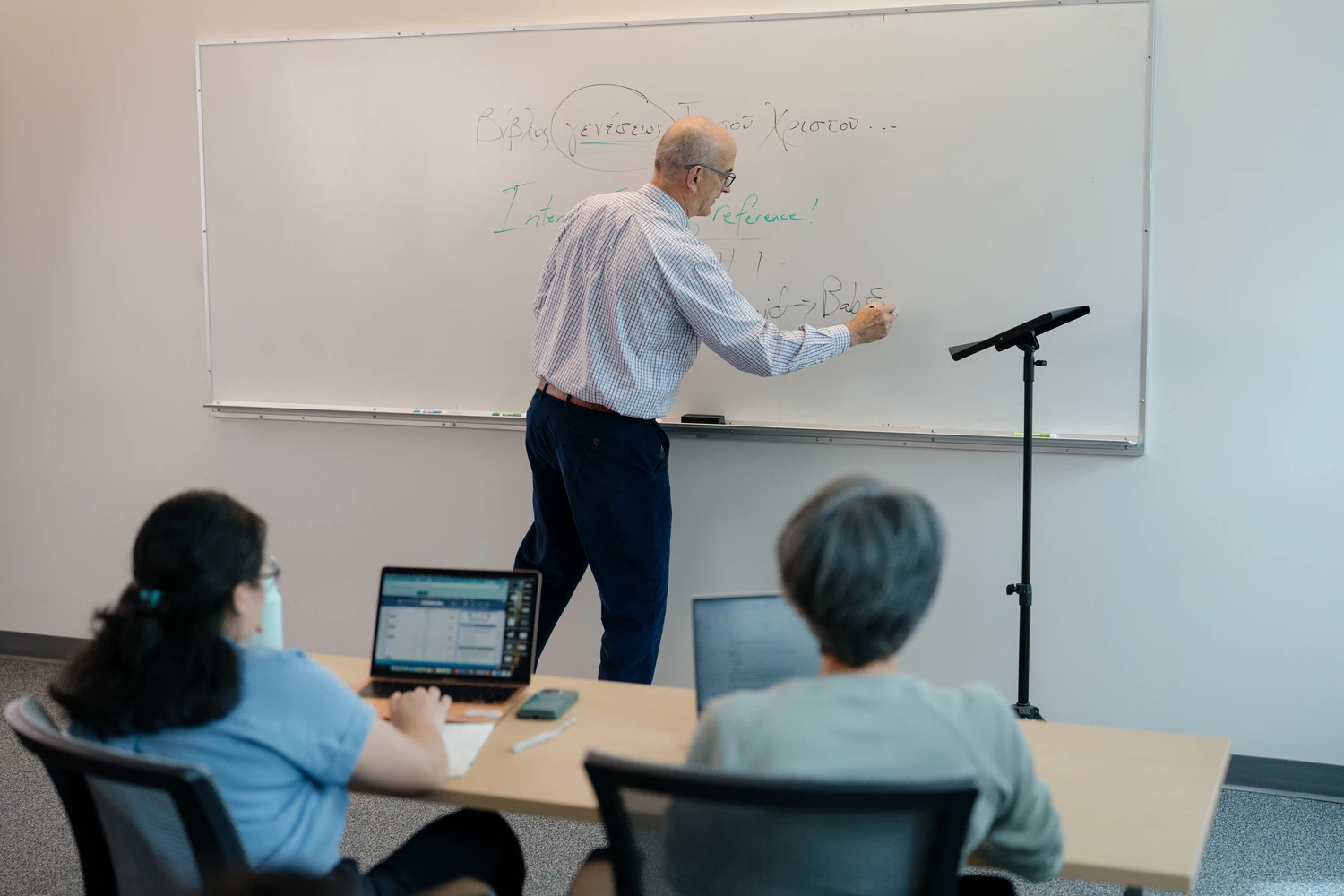
Editor's Note: This essay has been adapted from George H. Guthrie's "The Study of Holy Scripture in Christian Higher Education," in Christian Higher Education: Faith, Teaching, and Learning in the Evangelical Tradition, ed. David S. Dockery and Christopher W. Morgan (Wheaton, IL: Crossway, 2018).
It was originally published in CRUX 56, no. 1 (Spring 2020).
There are days when the study of Scripture, in a classroom with a band of eager students, feels like flying, the teacher a lead goose at the head of a “V” racing for wide-open, promise-filled horizons. We soar on the winds of a special form of community, fresh readings of the text, and the grandeur of great things. There are other days when the study of Scripture, in a classroom choked with fatigue and time constraints and dullness and the necessity of grades, feels like falling down into nether regions of anti-magic, where the book seems closed, my students seem comatose, and I have the amazing capacity to transform the wine of the gospel into water. On most days I feel somewhere in between, leaning out on the edge of a precipice, trying to keep my balance in this dancing bears act we call teaching, and waiting for the winds either to bear us skyward or send me plummeting. The study of holy Scripture in an academic context can be exhilarating or terrifying, but it is always a work that needs grace, both common and not-so-common, and we encounter both forms of grace as we attempt to take up and read.
Borrowing a phrase from Rainer Maria Rilke,1 Parker Palmer speaks of the “grace of great things,” things that call a community of learning together, which beckon us “to know, to teach, to learn.”2 Long in the history of education in the West, the Christian Scriptures, which invite us to the consideration of very great things indeed, have formed a particular foundation stone of academic thought and life, and for the time being it remains a foundation in a variety of academic contexts. The wonderful challenge of studying and teaching the Christian Scripture in an academic context proceeds along two lines: the study of holy Scripture as a scholar-teacher, and how a scholar-teacher can study holy Scripture in community with students, via classroom teaching, or in one-on-one encounters. My hope is that in the face of both of these challenges I can offer some stimulating reflections for those who seek to study and teach Scripture as an integrated call of Christian discipleship.
The Foundation of Biblical Scholarship
Holy Scripture cannot be truly studied in any classroom of higher education without ongoing learning by the scholar-teacher. Teaching must flow from a posture of personal growth in knowledge and skills. The best biblical studies teaching occurs in deep dialogue with the text of Scripture, in dialogue with other scholars of the biblical texts (most often with their books), and in dialogue with our students (who always have things to teach us).
If the biblical studies classroom is to flourish, the scholar must contribute from a place of having learned skills or content that can benefit the student. But if the teacher stops learning—stops growing, stops honing skills and being interested in the world of ideas—real teaching slowly dies. The notes developed twenty years ago which have grown stale, never infused with new life from new discovery, will not do. Teaching Scripture in an academic context must flow from a love of learning and a love for things learned, and this demands an ongoing engagement with both the text and various scholarly communities.
One of the surprises of commentary writing over the past two decades has been the degree to which ongoing discovery is not only possible but needed. We commentary writers can fall into deep ruts of interpretation, carved by those who have come before us. Yet, going back to the text itself, probing issues of grammar, background, lexicology, and intertextuality, at times rewards the researcher with something to offer the broader conversation on a passage, and there is great joy in bringing fresh insights to the classroom! When students are given the power of a new insight on the text, one that opens the text more clearly to understanding, the classroom comes alive!
The Work of Scholarship
Thus, this process of learning, at its most basic, involves a deep study of the text of Scripture itself, and for the scholar, a deep study of Scripture calls for the hard work of biblical studies research. Any person attempting biblical scholarship knows what a wonderfully complex field he or she engages. Most of us specialize in particular parts of the canon, but we must be familiar with the whole—how else can one deal with occurrences of intertextuality, for instance, or grasp the narrative structure of the Bible? And the whole involves a body of literature written over centuries by numerous persons of profoundly diverse cultures, and offers a wide array of emphases.
To begin, we must engage the biblical languages with competence, as well as modern languages that facilitate our dialogue with others in the field. The study of the history of both the ancient Near East and the Roman Empire, as well as a wide variety of cultural backgrounds, is mandatory. Since we are dealing with texts in a world of other texts, the ability to access and analyze ancient Near Eastern literature for Old Testament scholars, or Second Temple Jewish literature and Greco-Roman literature for those studying the New Testament, is critical, and increasingly, various aspects of modern linguistic theory play a part in our work as well.
In order to understand and enter into dialogue with others in the field, we also must have some familiarity with the dizzying array of “criticisms,” both higher and lower, in the history of investigation of the biblical literature. Since texts are always interpreted, we need an awareness of what is going on in the areas of philosophical hermeneutics and biblical theology. On top of all of this, we must keep up with developments in our own areas of focus—and bibliography has become daunting in almost all specializations.
All of these aspects of our discipline shape a framework for ongoing study of the primary text of Scripture itself. How else could such scholarship be called biblical? And yet, for the Christian scholar, such hard work forms a foundational aspect of vocatio, “the place where your deep gladness and the world’s deep hunger meet,” as Frederick Buechner has put it so memorably.3 The “gladness,” of course, often comes after the hard work is done, when an article or book hits the shelves or a classroom moment ignites, but there are spaces of deep, deep gladness in the process of discovery while “all in it,” and there are various ways of staying “in it” as we shape a life of study.
We should read broadly, which is not as easy as it sounds due to the pressing matters of everyday life in our institutions, in the contexts of family and church and community involvement. We should, from time to time, develop new courses, which will push us to new levels in our thinking and our learning. Publishing articles in scholarly journals and book contracts encourage us in growth, as do professional meetings, which provide wonderfully stimulating times of engagement, as the scholar presents or listens to papers, participates in steering committees, interacts with publishers, and meets informally with colleagues. All of these activities can contribute to an ongoing dance with the text of Scripture and personal growth in understanding and applying it.
Scholarship and the Biblical Studies Guild
We should also pause to consider participation in the broader biblical studies guild, since such involvement by those teaching at “confessing” institutions such as Regent College has been called into question of late in works such as Philip R. Davies’s Whose Bible Is It Anyway? Davies’s proposal is that “confessional biblical studies” should be relegated to the domain of the religious, particularly the church, while secular “biblical studies” suits the domain of the academy.4 The basic idea is that secular biblical studies as a discipline has the ability to be “objective” with the data, while “confessional biblical studies,” or “biblical theology” generally, skews the data, presupposing all outcomes, thus disallowing meaningful scholarly dialogue. Confessional biblical scholars do work simply to affirm the biblical text as “Bible,” the reasoning goes, not to analyze it seriously. Yet, this assumption that scholars from confessing contexts cannot be self-critical, as well as analyze the data gathered in relation to the biblical text with integrity, is a false assumption and ends up being a caricature, as we will see below.5 I give space to this issue, for my conviction is that the study of Scripture in Christian higher education needs insights from the broader guild, and the guild needs so-called “confessional” scholars contributing to the ongoing work of biblical studies.
First, concerning the concept of “objectivity,” if we have learned anything from discussions on “scientific” paradigms and interpretation during the past half century, it is that, as I have written elsewhere,
there is no completely objective science, all of us are influenced by social and psychological factors in the way we approach our disciplines, in our cultures and eras. As one scholar has put it, “there is no such thing as an ‘immaculate perception.’” Our Vorverstsändnis, our “preunderstanding,” plays an important role in our interpretations of data and our interpretations of others’ interpretations of data.6
Accordingly, every biblical scholar does work from the vantage point of that scholar’s personal history and motives, interpersonal relationships, psychological experiences, religious or non-religious story, philosophical commitments, scholarly and institutional communities, and educational background.7 And every scholar does his or her work for particular reasons, from a variety of motives, and to particular ends. The fact is that biblical studies generally has become a diverse and fragmented area of study, one often politicized; even within the secular academy, one would have to ask, “Whose version of objectivity?” Consequently, to foster scholarly dialogue, all of us should do our best to “bracket” our presuppositions, and we should be open to following the data where it leads, even if it corrects our presuppositions. As we approach the text of Scripture for study, our presuppositions are inescapable as a part of who we are; none of us are completely objective.
Since we are dealing with ancient texts, there exists much biblical studies work that can be done by people of very different sets of philosophical presuppositions or views of the world, and this is one reason that confessional and secular scholars have a great deal that they can discuss fruitfully. The combination of commonality and difference in academic community can be a powerful and profitable mix. In terms of commonality between “secular” and “confessional” scholars, to begin with, we are dealing with texts made up of words in Hebrew, Aramaic, and Greek.8 Regardless of one’s worldview, we must deal with lexicology, grammar, semantics, and pragmatics. We can discuss how discourses work, based on literary and linguistic dynamics.
The biblical texts express a network of ideas, and they often use ideas in rhetorical ways, meant to persuade, encourage, or warn. We can discuss the backgrounds for concepts in the text, as well as the meaning and functions of the content in a biblical book. When Luke presents the healing of the man lame from birth in Acts 3:1–10, the account can be debated from a literary or rhetorical standpoint, regardless of whether the scholar believes such a miracle could actually happen.9
Francis Watson has pointed out that one of the problems with banishing any discussion of theology from the academy is that our texts often are presenting theological discourses that should be addressed; that’s what these texts do. How, then, can we not treat thoughtfully what the texts themselves are discussing, regardless of whether or not we actually believe what they are proposing? To separate out theology from academic dialogue is to act violently toward the authors and messages themselves, silencing their voices. In his article “The Bible and the Common Good,” Mark Hamilton states, “Whether one accepts the views of the Bible or not, it is simply bad scholarship to ignore the fact that its authors were wrestling precisely with religious questions. . . . Therefore, an appreciative reading of their texts will try to understand their religious claims.”10 In denying theology a voice in the academy, secular biblical studies would be in danger of becoming what it had earlier resisted—a philosophically driven institution of control, an “alternate religion,” that silences voices not remaining in step with its worldview.11
The fact is that important work, in a wide variety of biblical studies sub-disciplines, has been done by so-called confessional scholars in the past, is being done in the present, and should be done in the future. In terms of the past, who can deny the importance of the foundational work on textual criticism by J. A. Bengel, for instance, or the Greek grammatical work of an A. T. Robertson?12 In the present era, one only need scan the primary Old or New Testament Studies monograph series, such as Novum Testamentum Supplements., Wissenschaftliche Untersuchungen zum Neuen Testament, or Forschungen zum Alten Testament, to see that some volumes over the past three decades or so have been authored by evangelical or Catholic “confessional” scholars.13 Evangelicals and Catholics also publish regularly in peer-reviewed journals, contribute essays published in books by major academic publishers, or present papers at Society of Biblical Literature conferences. They function well in going back and forth between the two domains of the church and the academy, while being functioning members of both and contributing significantly to both.14 Thus it may be suggested that confessional scholars are productive within the guild and needed by the guild, for not only do they draw from it, they also contribute to it, both “plundering and profiting the Egyptians.”
Scholarship as a Work of Service: Inside and Outside the University
Biblical studies scholarship should be seen as an act of service, for, in addition to the guild of scholarship, our work profits other communities, including the institutions in which we work and the broader communities in which we live. Christian institutions of higher learning need the best of biblical studies scholarship as a foundation for shaping a Christian worldview in their faculty, staff, and students. Scholars Beers and Beers write,
The foundational authority, or the worldview, model states that the major contribution of the Bible to our academic pursuits is that it gives us a worldview foundation from which to do our studies in science, social science, and the arts. This worldview approach acknowledges that beliefs do make a difference in academic pursuits. One’s faith or worldview does matter when one engages in the learning process.15
The shaping of worldview begins with the premise that every person has a way of looking at the world that shape one’s perspective. Christians believe that God has spoken via the words of Scripture,16 and thus the Bible serves as a foundation for understanding reality and is relevant regardless of one’s academic discipline. At the same time, there are good ways and bad ways of reading Scripture, and thus a biblical studies faculty can be key to the ongoing learning of the Bible by the institutional community.
Second, therefore, the work of biblical studies plays a key role in the integration of faith and learning, helping ourselves and our colleagues think through the ways a biblical worldview and Christian spirituality might be brought to bear on the theoretical and applicational frameworks of our disciplines. This program lies at the root of the development of academic life and work, especially in the humanities, in the Western world.17 Through helping ourselves and our colleagues grasp the implications of the grand narrative of Scripture, we can offer the community a worthy Story18 in which to live and move and have our being, and thus help resist the crass commodification of the educational process, raising the bar to higher concerns as central.19
We should begin by working through the integration of Christian piety to our work and service of biblical study and teaching, following the Lord Christ into all dimensions of our lives and work, even as we are shaped by our relationship with him and his mission. Rather than detracting from serious scholarship, this can enhance it, shaping us to be integrated people who love Christ and his church, love our colleagues and students, and love the process of academic life and learning.20
One may think that such integration stands as an outlier in academic contexts, but extensive research conducted in the Faculty Beliefs and Values Survey in 2012 indicates that integration of spiritual and professional life is common in all types of universities, not just those that are “Christian.” The majority of faculty in religious colleges, private universities, nonsectarian colleges, public colleges, and public universities are open to some form of spiritual dimension to a faculty person’s life being integrated with their work.21 Even Christian faculty at non-religious, private, or public institutions need the benefit of sound biblical studies work as a foundation for personal integration of their faith with their professional work.
Third, biblical studies scholars, along with their colleagues in other disciplines across the university, can extend the impact of the university through publications such as books and articles. Biblical studies writings for the broader culture and the church can be pedagogical, teaching people about the body of literature we call the “Bible.” They can address issues of interpretation, helping the broader culture or the church understand aspects of the Bible’s message, and they can speak prophetically to the culture or the church. Biblical studies scholars can write commentaries, biblical reference tools, and articles, which can help teachers and preachers carry out their tasks in the church with excellence. Scholars can play a role as a significant resource in relation to the functioning of the church in the world.
The Art of Teaching the Bible
A primary role of the biblical scholar in the university or theological graduate school is to teach, and this is the other key aspect of the study of Scripture in Christian higher education, bringing us to the second main movement of this essay. The scholar, having studied the text of Scripture, has the privilege of leading students to the text of Scripture for rigorous study. Trying to capture the essence of good biblical studies teaching, however, is like attempting to bottle a smell.22 There are objective aspects of good teaching—preparation, communication, content, strategy, clarity of purpose—but virtues like community, discovery, engagement, mutual respect, critical thinking, humility, commitment, integrity, and passion are not so easy to objectify. Right from the start, a number of practical considerations present themselves.
For instance, in introductory surveys, what should we do in terms of translations used for the course? Will the students be encouraged to use digital copies of the Bible and other resources, including Bible study software?23 Which textbooks will we use, or will we forego a textbook and draw on other sources? Will we have the students, many of whom have never done sustained reading of any kind, read the whole of the Old or New Testament in the course, or just portions?
What will our basic methods of pedagogy be? How will the students’ knowledge and skills be assessed? Perhaps most importantly, how will we draw the students into a dynamic engagement with the text of Scripture, not just for the duration of the course, but in a way that will have an enduring impact in their lives? In lower-level courses, how will we introduce the intricacies of interpretation to novices, even while we cover a great deal of ground in terms of content?
For more advanced courses, whether undergraduate or graduate, a host of other issues present themselves, such as how to address a class with some students who are trained in various levels of the biblical languages and others who are not. Or what length might a research paper be? Or which topics are fair game in a thesis-oriented paper?
These practical questions must be addressed and will be addressed variously depending on the context and the educational level of the students in a given course. What I would like to focus on in the balance of this essay, however, are four guiding principles for enhancing teaching of the Bible in diverse contexts of Christian higher education.
1. Biblical studies teaching should be content rich and framework oriented.
Born between 1980 and the early 2000s, many Millennial college and graduate students often enter our classrooms fundamentally illiterate when it comes to the content of the Bible. About 50 percent never read the Bible, and only 6 percent read it on a daily basis. Among conservative Protestants, these figures adjust to 31 percent and 10 percent respectively, which gives more cause for concern than for joy.24 For students to be considered biblically literate in the English-speaking world, they need to have at least a basic understanding of the Bible’s content, and, of course, Christian students need to know the content of the Bible as a beginning place for understanding their faith. This is the baseline at which we must begin.25 But immediately we are faced with a daunting challenge. The student is “coming to the professor to receive the best knowledge of the subject that human inquiry has produced to date,” 26 and in a semester, or perhaps two, we are to cover the whole of the Old Testament or the whole of the New Testament (in some universities and graduate schools, both!), collections of books that are complex in terms of genre, background issues, and sheer volume of content! The task can be overwhelming, and if we are not careful, we will spend all of our time providing the backdrop or “setup” for reading and understanding the text of Scripture, without ever drawing the students into discovery in the text itself. Since we may have our undergraduate majors or graduate students in biblical studies over a period of years, this challenge, of course, is most difficult in relation to our general survey students, who may sit before us for one or two classes on the Bible. But even with graduate students, their grasp of the overarching narrative and the basic content of the Bible may have significant gaps.
In my final years of teaching at my former institution, I took two steps that seem to have helped my entry-level undergraduate students a great deal. First, in my New Testament Survey class, I experimented with “flipping” the classroom, creating videos of parts of my lectures, which the students watched outside of class (and this replaces extensive reading in a textbook) 27 in conjunction with the reading of large portions of the New Testament. This freed up time in class for settling into parts of the text for analysis and discussion. I still lectured a great deal, and I took time to make sure the students understood the material delivered in the video lectures. But settling more deeply into parts of the New Testament text offered an opportunity to draw the students into the “music” of the literature, even as we plumbed rich insights from background issues, word studies, and theological motifs. This also exposed the students to my joy in the text, which invited them to experience that joy as well.
Second, I took a “framework” approach to teaching New Testament Survey, which said in effect, “I can’t teach these students everything; so how might I teach them a biblical literacy ‘scaffolding’ that will serve them well as they engage the text in the future?” Thus, I introduced the class to basic background issues for each book of the New Testament (e.g., Author, Date, Purpose, Destination, etc.), and I sought to give students the narrative arc for the New Testament story, beginning with placing the New Testament in relation to the overarching story of the Bible as a whole. Along the way, we learned the key characters and events that shape the backbone of that story, we dove down into exemplar passages, and we talked about the implications of specific texts.
To assess the students’ learning, each week we had a quiz over the content covered in the previous week, and, beforehand, I gave them a study sheet of questions that might appear on that quiz. Over the course of a semester, the students learned the material for the weekly quizzes, that material was reiterated for the sectional exams, and finally it formed the basis for the comprehensive exam at the end of the term. Student retention and satisfaction increased tremendously, and the students left the course with a framework for further growth in biblical literacy.
This principle applies to both advanced undergraduate and graduate courses. Even in a graduate course on a biblical book like Hebrews, we very quickly feel the time constraints. So, we must address what content is most vital and how we can build a framework for continued learning. The applications of these principles will vary widely, but the approach can be fruitful.
2. Biblical studies teaching should involve various forms of “active learning” and resource awareness.
I believe in the power and effectiveness of a good lecture, but I also believe it is just one aspect of a holistic approach to teaching the Bible. In recent years there has been increased emphasis on “active learning” by which students are engaged in and responsible for the process of their own education. One writer on effective teaching states,
In its briefest form, the paradigm that has governed our colleges is this: A college is an institution that exists to provide instruction . . . . Now, however, we are beginning to recognize that our dominant paradigm mistakes a means for an end. It takes the means or method—called “instruction” or “teaching”—and makes it the college’s end or purpose. To say that the purpose of colleges is to provide instruction is like saying that General Motors’ business is to operate assembly lines or that the purpose of medical care is to fill hospital beds. We see now that our mission is not instruction, but rather that of producing learning with every student by whatever means works best.28
In other words, we want to shape life-long learners, and to do so we must get students involved in the learning process.
The process of learning seems obvious, of course, as we teach students Greek and Hebrew, for instance. One of the great benefits of language courses, beyond the obvious payoff of a student being able to read the Scripture in the original languages, is advanced training in the art of learning and the perseverance demanded by the process. In survey courses, on the other hand, we should engage students in analyzing passages of Scripture in terms of content, logic, or literary devices. We can give them assignments for interpreting the relevance of background information for a passage, or in class invite them to discuss the implications of certain texts.
Some classes can be more geared to skill development. For example, my advanced (third-year) Greek class at the undergraduate level focused on the methods and tools for a thorough process of exegesis, the students taking texts all the way from initial translation to communication of the text (how might you teach this?). Similarly, my Advanced Greek Readings and Advanced New Testament Exegesis courses at Regent College focus a great deal on skill development. In the past I have taught a lower-level Introduction to Bible Study that focuses on basic skills of analyzing, interpreting, and applying passages of a variety of biblical genres. The last five weeks of the course consisted of “labs” during which we process together the Bible study work the students have done outside of class. The “final exam,” rather than assessing information, involved a final project, completed over the final week or so of the term, taking a passage all the way from an initial close read of the text to how the passage might be taught to others. The focus was on skill development, and the growth of the students in the course of a term was amazing. Why? In part because we put a significant part of the learning process in the hands of the students. They became very active learners.
In biblical studies, when teaching and mentoring students, they need to be made aware of rich resources available for their ongoing study of the Bible. A great library (like the one we have at Regent College) becomes a lab where students learn to use the best commentaries and other biblical studies resources for entry-level or advanced study of the text. We also need to expose students to high-impact digital tools, which may include powerful Bible study software like Accordance or Logos, or rich online resources like the Perseus Digital Library. The objective is that as we teach students to study Scripture in Christian higher education we should offer them skills and resources that will serve them well in the future.
3. Biblical studies teaching should engage the student in critical thinking.
One of the most important skills a student can learn involves critical thinking, and this is increasingly important given both the state of critical thought and public dialogue in the West, as well as the lack of teaching on biblical hermeneutics in the church generally.29 Students often come to us with the ability to share their opinions or impressions of what the text of Scripture may mean to them, based on their life experiences, but with little ability to hear the text speak on it own terms, in a way that might invade the narrow confines of those experiences and the students’ expectations.
Biblical studies education, therefore, should teach the student to think well about and with the text of Scripture. Students should be taught to listen well to the text—“not on the basis of uncritical acceptance of what someone has written or what some denomination has proclaimed, but through evaluating and re-evaluating ideas.”30 Education means that students must grapple with ideas. They can be led in that grappling. They can be given safe contexts in which to explore the world of ideas, but they must learn to grapple nonetheless. One scholar, reflecting on the process of educating biblical studies students, suggests,
Biblical studies has little future in our universities unless we engage precisely in complex talk that takes seriously both our sources and our students and aims at helping students to read and master complex talk and to engage in complex talk themselves—because the world they’re stepping out into ain’t simple. To steal a line from Spinoza, “All that is excellent is as difficult as it is rare.”31
The biblical literature is accessible on many different levels. One does not need an advanced degree to “take up and read.” But it is not simple, and there is great benefit for our students, and thus for our institutions, our communities, our churches, and the world, as those students learn to think well about and with the Bible. This will never happen if we only ever tell them what to think through our lectures. We must lead them in the process of learning to think critically themselves.
This does not mean that we, or our students, stand over the text, treating it as an object, but rather that we teach them how to listen to the text. Critical thinking, grounded in sound methods of reading and study, can lay a foundation for sound and religious reading. Thus, in Christian higher education, critical thinking can be integrated with religious reading, as one scholar describes:
Religious reading depends on a relationship with the text that allows the text to address, to question and to challenge the reader, and at the same time it adopts an attitude of reverence and obedience towards the text. Rather than standing in authority over it, interrogating it with critical tools, deferring commitment, questioning its authenticity, the religious reader stands under or in the light of the text. A religious reading is willing to be vulnerable to the message contained in a text, to submit to its power, to trust its source, to inhabit its ambience, to carry out its instructions, to belong to the community which treasures it.32
This brings us to a final point for the practice of teaching the Bible in a Christian, academic context.
4. Biblical studies teaching should aim for integration of the Bible with life and in community.
Good teaching models integration, and this offers a fitting place for our subject to culminate. Teachers should play a significant part in preparing students for living well, as persons and in community. In teaching biblical studies, there should be fluid movement from the “that” of Bible content to the question of how that content is relevant to life. We should follow Christ as Lord into the details of course content and skill development, and the teacher should model for the student the move from information that lights up the text to application of the truth to areas of life and ministry. Even as we deal with the nature of syntax and semantics of a Greek or Hebrew sentence, we should help students think through the process of integrating the message of that sentence with the broader context of the book in which it is found, with the theological network of ideas to which it relates in the canon, and to the nitty-gritty aspects of faithful discipleship in the church, the academy, and the world.
Since the biblical text was born in ancient communities of faith, we may suggest that biblical studies teaching is best done in in the context of “wisdom communities,” communities of strategic mentoring and training, communities of support and encouragement, and communities that care about the character and the future impact of the student.33
In engagement with the biblical text, students are invited into a consideration of something much bigger than themselves, and they can see that something embodied in healthy academic communities of faith. Teaching and learning can take place through the pages of a book, but texts need some form of community context. The deepest learning often takes place when presentation mixes with life-on-life interaction. One description of university life in the early years of Harvard recounts that
university learning apart from college life was not worth having; and the humblest resident tutor was accounted a more suitable teacher than the most eminent community lecturer. Book learning alone might be got by lectures and reading; but it was only by studying and disputing, eating and drinking, playing and praying as members of the same collegiate community, in close and constant association with each other and with their tutors, that the priceless gift of character could be imparted to young men.34
In Christian community, teachers of the Bible can foster in their students discovery, engagement, mutual respect, humility, commitment, integrity, and passion not only for the advancement of the academic process, but also for the gospel of Christ.
Thus, the ultimate goal of the study of Scripture in Christian higher education—both for ourselves as scholars and for our students—is transformation rather than information, though the latter plays a significant role in the former. Especially in Christian community, content is never an end in itself but,
rather, a means of discipleship, the embodiment of truth and a growth in grace. Education generally draws on common grace and plays a role in the manifestation of common grace. But the study of the Bible in Christian higher education has an ultimate end: to advance the kingdom of God through thinking and living Christianly in and about the world. Faithful teaching should lead to faithful being, both for the teacher and the student in Christian higher education.