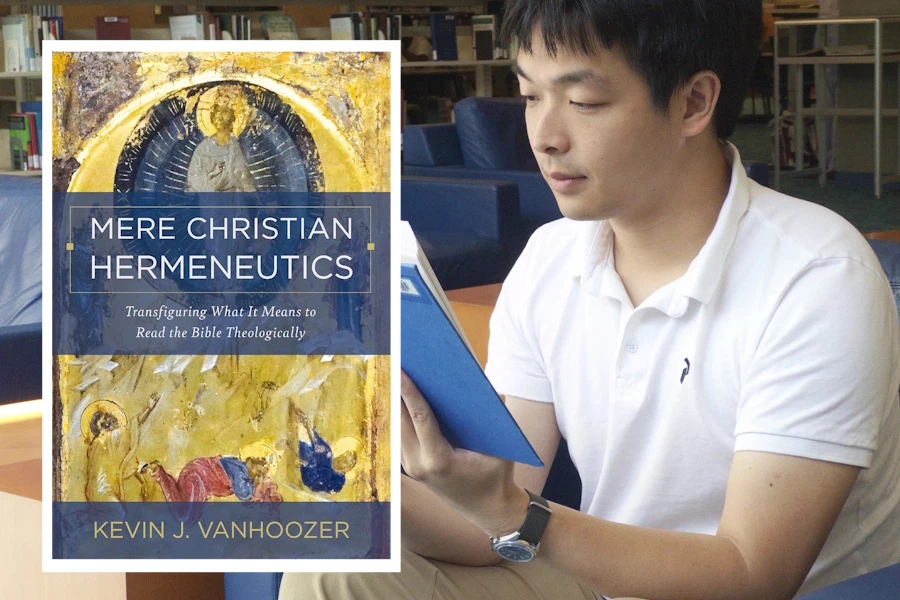
Kevin Vanhoozer, Mere Christian Hermeneutics: Transfiguring What it Means to Read the Bible Theologically (Zondervan, 2024).
Kevin Vanhoozer’s Mere Christian Hermeneutics draws its inspiration from C. S. Lewis’s Mere Christianity, and sits alongside other “mere-focused” attempts at ecumenical small “o” orthodox engagements with the faith, including N. T. Wright’s Simply Christian, Alister McGrath’s Mere Apologetics and Mere Discipleship, and Vanhoozer’s own co-authored book with Daniel Treier, Theology and the Mirror of Scripture: A Mere Evangelical Account. In Mere Christian Hermeneutics, Vanhoozer sets his sights on an account of hermeneutics that accommodates “large swaths of the historic Christian tradition—from premodern to modern, East to West, and Protestant and Roman Catholic” (369). For Vanhoozer, the transfiguration of Jesus articulates an impulse that these traditions hold in common, namely, that “by attending to the body of the biblical text (the letter), readers who have been illuminated by the Spirit with unveiled faces will behold the glory of the knowledge of God in Jesus’ face (the light of Christ)” (370). Though ambitious, the book is also humble. It doesn’t set forth an exegetical method or set of hermeneutical steps to yield the light of Christ. As Vanhoozer puts it, “It takes many bands on the spectrum of reading cultures to see the white light of Christ” (370).
In my reflections on this inspiring and wide-ranging book, I highlight several of the book’s contributions and consider areas where the book could be strengthened by Old Testament considerations.
Contributions
Vanhoozer's Thesis
First, Vanhoozer offers a compelling thesis. The tone of Mere Christian Hermeneutics is conciliatory, but without trying to “merely” draw ingredients from the best of every tradition to concoct a bland hermeneutical meal. Instead, the book advances a thesis, namely, that a “trans-figural” reading of Scripture offers the most fruitful, ecumenically plausible, and scripturally rooted form of interpretation available. A trans-figural reading attends carefully to the text itself—the “way that words go.” In that sense, it involves “luxuriating in the letter” of Scripture (113). This is the literal or historical sense. But that sense is itself extended because texts are embedded in the canon. So it also involves following the meaning of words horizontally across Scripture “to the realities those figures [or texts] foreshadow and anticipate” (169). Hence, Scripture’s words possess a “more than” quality “when read in canonical context with an eschatological frame of reference” (179). Texts in the Old Testament, for instance, are transfigured in the light of Christ, who is their ultimate destination. While texts remain “themselves,” so to speak, any given text “announces something other than itself” in the broader economy of Scripture (159). So, “God’s trans-figurative intent makes words go the second mile, enabling them to signify not simply lambs and tabernacles, but the sacrificial death of Jesus Christ” (175).
Reading Horizontally
Second, Vanhoozer offers a helpful critique of allegorical readings that still accounts for Scripture’s “spiritual” sense. The figural connectedness of Scripture features prominently in Vanhoozer’s analysis. Texts are related horizontally across Scripture, not vertically to an untethered spiritual reality.1 The glory of God that emanated from Sinai, the Tabernacle, and the Temple is related figurally to the light of the Word made flesh who tabernacled among us. For Vanhoozer, our readerly frame of reference should be shaped by Scripture’s own way of framing matters. His critique of allegorical interpretation is that it envisions meanings for texts via a “disconnected external realm” (162) or “higher system of ideas” (269) that is “untethered or external to the story of which it is a part” (162). By contrast, the “more than” quality of textual meaning is discerned eschatologically. “Types anticipate—or prefigure—in the same flow of history” (161–62). So the literal and spiritual are parts of the same horizontal reality, since the trans-figural “is the eschatological fullness of the literal sense” (179).2
Cultures of Reading
Third, Vanhoozer’s attention to reading cultures bears consideration. As a biblical scholar, I was challenged by his argument that “the kind of exegesis we do depends on the nature of the reading culture into which we have been socialized” (45). The social context of our reading, along with the habits of mind and practice that we pursue, has a major impact on the kinds of readers—indeed, the kind of people—that we become. I have long pondered the spiritual impact of bracketing out and excluding certain kinds of questions within my own discipline of biblical studies (e.g., metaphysical questions, spiritually relevant questions). To that end, and no matter which disciplinary focus we bring to this book, Vanhoozer invites us to ask, “Into what kind of reading culture have we been, or are we being socialized?” (74).
Spiritual but Not Ahistorical
Fourth, Vanhoozer’s account of the “spiritual sense” retains the dignity of the historical or literal sense. Here it is worth noting his emphasis on the transfiguration as a framework for interpretation. The Mount of Transfiguration is literarily and theologically related to Sinai, where God’s glory emanated from the cloud and was reflected in the face of Moses. Jesus himself shone in the transfiguration, but unlike Moses, he did not reflect divine glory. Glory emanated from Jesus himself. In that sense, Jesus’s transfiguration didn’t involve his transformation from one thing into another (232). Instead, it was an epiphanic event, a “revelation of present status” (237). It was an apocalypse.
Vanhoozer uses this as an analogy for interpreting Scripture and understanding its spiritual sense. Reading the literal for the spiritual shouldn’t involve bypass surgery, where the literal is circumvented to reach the spiritual. Instead, transfigural reading attends to the glory that is already present. In that sense, reading is “epiphanic” because it attends to the “spiritual” glory of the text and it is “eschatological” because it figurally anticipates a future glory (244, 260). This is a welcome insight. I have always been uneasy with hermeneutical approaches that treat the literal meaning as a doorway to something else. This amounts to a kind of hermeneutical Nestorianism, where the bodily (or literal) and spiritual fail to communicate and act as two distinct entities. Instead, for Vanhoozer, the literal is the site of spiritual insight and significance. The material reality of the text is no mere chaff to be sifted. Instead, “the glory of Christ is in the letter of the text, a glory that was always there, though veiled” (306; cf. 64–65, 314).
Reflections on Vanhoozer’s Approach to the Old Testament
While reading Mere Christian Hermeneutics, I was especially keen to understand Vanhoozer’s approach to the Old Testament. Several questions arose as I read.
The Risk of Eclipse
First, I have emphasized how helpful I found the framing of the “spiritual” sense of Scripture. As I already quoted, “the glory of Christ is in the letter of the text,” emanating from within rather than lying behind or above the text. Yet Vanhoozer occasionally makes suggestions that seem at odds with this idea of emanating glory. Perhaps it is the byproduct of an ecumenical spirit that at times Vanhoozer seemed to concede too much ground. For instance, when discussing Origen he takes from him the “necessity of going beyond the letter to Spirit in nonarbitrary fashion” (62).3 In another place where he discusses prophecy, Vanhoozer notes that “when prophets say more than they can know, they are not talking nonsense, even if they cannot identify the future referent. In a canonical context, what they were really talking about all along comes into focus” (176). He calls this the totus sensus or the “whole meaning of the divine author, including the figural and trans-figural intent” (175–76).
Then, toward the end of the book, Vanhoozer writes that “the Spirit opens readers’ eyes to the truth of the Mosaic law, enabling them to see past its letter to discern what it is about, the mystery of Christ” (343).4 He goes on to qualify the point that we’re still attending “to what God is speaking by means of the text” (343). But why should we see past? The language reminds me of those times when I think I’m waving in response to a greeting only to realize that the person I'm waving “back” to is waving at the person behind me. The language of “beyond,” “what they were really talking about,” and “see[ing] past” suggests the obsolescence of earlier meanings, such that the Old Testament text has utility insofar as it points to Christ but, having played that role, its light is fully eclipsed.
Ongoing Ambiguity
Second, does the language of "veiled" still apply to a Christian reading of the OT? I suspect that Vanhoozer would say no. For Vanhoozer, “Jesus’ transfiguration is God’s own spiritual interpretation of the story of Scripture, as it were: God’s own unveiling of the glory of the Old Testament’s literal sense” (283). So, what does that involve? Well, when speaking of Isaiah 53, Vanhoozer notes that “it is difficult to identify someone who fits this description within Isaiah’s own historical frame of reference,” and he observes that “biblical critics scoff at the suggestion that Isaiah could speak of things beyond his own frame of reference” (136). He then argues (with 1 Pet 1:11) that “the prophets knew what they were saying, but they did not know exactly what, or whom, they were speaking about” (137). Presumably, for the Christian, the veil has now lifted such that we “know” that Isaiah 53 is about Christ.
I’m reminded here of a conversation I had as an undergrad with a shopkeeper in Israel who said to me, “I bet you wonder how Jews can read Isaiah 53 and not see Jesus.” I did wonder, and I was astonished to hear a compelling case that at least some Jews read the passage in relation to the suffering remnant community in exile. The text of Isaiah 53 does not demand a Christological reading. This is even the case in Christian interpretation. I’m reminded of Ross Wagner’s argument that Paul saw himself taking up the vocation of the servant in his own ministry (Rom 10:17 and 15:20; see also Isa 49 in 2 Cor 6 and Gal 1).5 Are we also to wonder how one can read Isaiah 53 and not see Paul? I wonder if, for Vanhoozer, that Jewish reading is “veiled” and the application to Jesus “unveiled.” Or, differently, is the ambiguity of Isaiah 53’s referent in context now gone, or does it have ongoing, productive ambiguity even as its culminating embodiment has occurred in Christ? Regarding the application to Paul’s ministry, how would his appropriation of the servant vocation fit with the idea that Jesus is the ultimate referent of Isaiah 53?
Transfiguration and Confusion
Third, if transfiguration is the appropriate lens for the hermeneutical endeavor, what do we do with the disciples’ failure to understand? Having been on the mountain, Peter’s ignorance is implied twice. First, according to Mark and Matthew, Peter wants to build three shelters, apparently not knowing what to say (Mark 9:6).6 Perhaps he was “shelter shocked”? Mark tells us that this ignorant response was born of fear at the events that had just transpired. Also, according to Matthew, soon after the events at the Mount of Transfiguration, the disciples are grieved when Jesus said he would suffer and die (17:22–23). In fact, the events at Tabor are flanked by two accounts of the disciples’ ignorance regarding Jesus’s suffering, death, and resurrection. In Matthew 16, Peter rebukes Jesus for saying he would die. These events, coupled with the confusion and fear over the transfiguration, indicate that the experience provoked further confusion. Matthew seems to frame the transfiguration by two-fold ignorance to say that the disciples failed to grasp the relationship between the Mount of Transfiguration (Tabor or Meron) and Golgotha.7
So, my question is, if transfiguration is a lens for the interpretive experience, is there a sense in which encountering the glory of Christ in Scripture invites further confusion? According to Luke, the disciples were sleepy (9:32), anticipating their later drowsiness in Gethsemane (22:39–53). Confusion and lack of understanding on both fronts! While unveiled access to divine glory is clearly part of the scenery here at the transfiguration, what of the disciples’ ongoing confusion and need for something else (namely, a post-resurrection frame of reference)?
Does Matter Matter?
Fourth, when it gets down to the nuts and bolts of reading transfigurally, challenges arise. For instance, if, as Vanhoozer suggests, figures like Cyrus and David in the Old Testament refer literally to those figures but (trans)figurally to Christ (185), what of the “remainder” that doesn’t carry forward (e.g., their sins, ignorance of God, etc.)? Furthermore, are all texts in the Old Testament involved in the business of prefigurement? If so, that’s a tall order. Yet for Vanhoozer, it seems that the stakes really are that high: “To focus only on the letter . . . Is to fail to do justice to the letter” (368).8
Relatedly, Vanhoozer writes of Song of Songs that Christ is ultimately what the book is about. Are there ways of reading with a broad Christological framework that don’t make Christ the primary referent? To pose a question, what do we lose if we say that the book is ultimately about bodily physical and relational love between a man and woman?
Vanhoozer argues that interpretation is “incomplete unless and until we read it christoscopically, aware that the Bible’s historical meaning is oriented toward an eschatological goal” (367). Do we always have to hit that target that way?9 What if reading Christologically takes its cue from the incarnation (by analogy!) that matter matters to God and therefore we don’t need to feel incomplete if we don’t transcend that material reality, whether vertically or eschatologically? Must the experience of intimate love—or, to take another example, the powerful communion with God discerned in the reading of Exodus 40 at the moment where God’s glory fills the Tabernacle—be deemed incomplete?10 Is Scripture’s narrative frame so strong that its innumerable non-narrative components must submit to its eschatological pull?
Reading Forward and Recognizing Jesus
Finally, when discussing various approaches to the relation between the testaments, Vanhoozer notes the option of reading “forward” (from the OT toward the NT) or “backward” (the OT in the light of the NT). After noting the benefits and drawbacks to each, he proposes doing both (see 283). He rejects a forward-reading “Jewish literalism that refused to recognize Christ or a Marcionite literalism that refused to recognize the validity of the Old Testament” (306). I wonder if Vanhoozer’s depiction of Jewish interpretation adequately accounts for actual Jewish interpretation. The modes of reading both forward and backward certainly exist within the Jewish tradition (and the Christian tradition).11 But my specific question has to do with whether the fruits of forward-facing interpretation always fall short.
While I recognize that a forward reading does not necessarily yield the exact profile of Jesus, some New Testament texts imply that there was enough information available in a careful reading of the Old Testament to recognize Jesus when he came. In the parable of the rich man and Lazarus, Abraham tells Lazarus, who wants to warn his neighbors of impending torment, “They have Moses and the Prophets; let them listen to them” (Luke 16:29). Then Abraham says that "if they do not respond to Moses and the prophets, they will not be convinced even if someone rises from the dead" (16:31). Or, in John 5:46, Jesus says, “If you believed Moses, you would believe me, because he wrote about me.” Jesus seems to assume that his contemporaries had the resources in Scripture to recognize him, and that there were enough forward-facing clues to help with Messianic identification. Now, one might further argue that the illumination of the Spirit is necessary, and that such forward-facing recognition is possible only in conjunction with Jesus’s signs.12 Perhaps so, and Gary Schnittjer’s proposed “retrospective prospectivity” might provide a way of naming the dynamics of Scripture that Jesus advocates.13 Specifically, encountering Jesus should ring a bell of familiarity that this is what Scripture has been talking about all along. A good reading of Moses should prime the pump for correct identification.
This mere review hardly scratches the surface of a book that deserves deeper reflection and study, and which will continue to help students of Scripture more faithfully attend to “the way words run.”