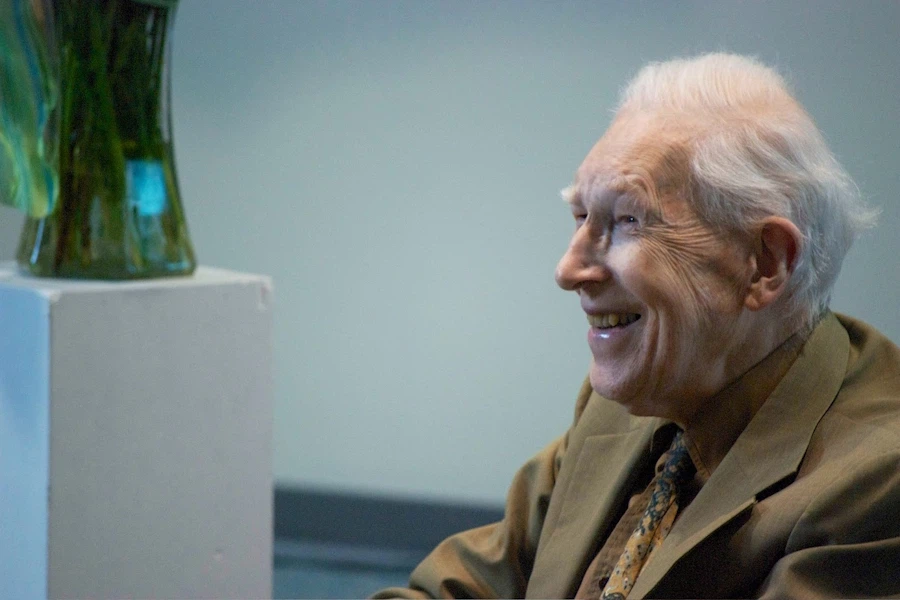
Editor's Note: This article is adapted from the inaugural lecture delivered by J.I. Packer on December 11, 1989, upon his installation as the first Sangwoo Youtong Chee Professor of Theology at Regent College.
This piece was originally published in in March 1990 in CRUX (Vol. 26, No. 1). We re-publish it in July 2026 in recognition of Dr. Packer's 100th birthday and in gratitude for his life and work.
Speaking from a newly founded Chair, I find myself freed from one embarrassment only to fall into another. I have no great predecessors to overshadow me; on the other hand, I must try (as the theatrical people say) to 'create the part.' The responsibility is heavy. If I miscarry, the University may come to regret not only my election—an error which, at worst, can be left to the great healer—but even, what matters very much more, the foundation of the Chair itself.1
Thus C.S. Lewis began his inaugural lecture in Cambridge, in 1954, as the University's first Professor of Medieval and Renaissance literature; and I would make his words my own, merely substituting "Regent College" for "the University," as I launch out on this, my own inaugural discourse as your first Sangwoo Youtong Chee Professor of Theology. I, too, have a part to create. Lewis' next sentence was: "That is why I have thought it best to take the bull by the horns and devote this lecture to explaining as clearly as I can the way in which I approach my work." With that also I identify; I propose in what follows to sketch out my own approach to my future work in the Chee Professorship; and I hope you will not take it amiss if I start anecdotally, for I think I can get furthest fastest by doing that.
I
Molière was the Alan Ayckbourn of his day, and in one of his comedies a character discovers that he has been talking prose all his life, and never knew it. When he makes the discovery he is as pleased as Punch. Some years ago I made a similar discovery. A man said to me: "These books of yours, they're all spirituality, aren't they?" Up to that moment I had never thought so; all my books had been commissioned for didactic, apologetic, evangelistic, or controversial purposes, as their titles show. (Fundamentalism and the Word of God, Evangelism and the Sovereignty of God, God has Spoken, God's Words, do not sound like the titles of devotional books, do they?) But when he said it I realized that he was right, and rejoiced accordingly. I should have known all along that I was writing spirituality, for the Puritan passion for application got into my blood quite early; I have always conceived theology, ethics, and apologetics as truth for people, and have never felt free to leave unapplied any truth that I taught, whether orally or on paper; and to speak of the application of truth to life is to look at life as itself a relationship with God; and when one does that, one is talking spirituality. So the man spoke the truth, and I remain grateful to him for helping me to appreciate what I was actually up to.
A definition of spirituality will help us at this point. I am using the word in its twentieth-century Christian sense, according to which it means, in the words of Henry Rack, "enquiry into the whole Christian enterprise of pursuing, achieving, and cultivating communion with God, which includes both public worship and private devotion, and the results of these in actual Christian life."2 By spirituality, therefore, I mean the study of what Henry Scougal, in the title of his book which so helped George Whitefield, called "The Life of God in the Soul of Man"; or, putting it another way, the study of godliness in its root and in its fruit. Prior to this century, spirituality went under a number of names: Roman Catholics called it ascetic theology, from the Greek askeo, which means to practise some discipline or routine; the Puritans called it "practical divinity," and also "casuistical divinity," because so much of it had to do with "cases," that is, specific problems and anxieties, of conscience; mainstream Anglicans, from the seventeenth century onward, called it "moral" or "devotional" theology; the Orthodox have called it "spiritual theology" or "mystical theology" or, quite simply, "spiritual life."3 Today, it is a field of specialist academic interest, with its own journals, books, editions of key texts, and professional conferences. It is also a focus of ecumenical pastoral and devotional interest at lay level, hence the retreats, retreat centres, schools of prayer, and writings on the inner life that abound at the present time. All branches of the church are involved, and a great deal of wisdom is currently breaking surface. These may be lean days for some other of the church's endeavours, but they are good days for spirituality.
Back, now, to anecdote. When I came to join the Regent faculty in 1979 I was delighted to discover that my old friend Dr. Houston, who when he approached me about the job in 1976 had been Professor of Interdisciplinary and Environmental Studies, had shifted his field of interest, was in process of becoming Professor of Spiritual Theology, as he is now, and had started teaching the courses on spirituality and prayer that he teaches today. I had come prepared to offer Regent my own foundation course on the theology of the Christian life that I had been teaching in a British theological college since 1970, but now there was no need. It is a pleasure to contemplate, and celebrate, Dr. Houston's achievements in this field—his series of Classics of Faith and Devotion;4 his recent book, The Transforming Friendship;5 and the enormous influence that his classes and counselling have had on successive generations of Regent students. Regent has, in fact, set an example to other theological teaching institutions by its emphasis on spirituality, and its unwillingness that theology should ever be taught and learned in a way that, however much it enriches the head, impoverishes the heart. When people ask me, as they sometimes do, why I feel I belong at Regent, this emphasis on spirituality always bulks large in my answer.
What gives spirituality its special importance in the educational organism offered by Regent College? Regent is committed to two principles that mesh together—first, every-member ministry in the body of Christ; second, the priority of person over function (in other words, that what you are matters more than what you do and does in fact determine and delimit what you can do in ministry). Therefore, Regent people need wisdom and insight in the realm of spirituality for the following reasons at least:
First, as ministering servants of Jesus Christ we are required to be promoters and guardians of health and humanness among God's people, and we need spirituality for that. Let me explain.
When I say "health," I am thinking of spiritual health, and when I describe us as its promoters and guardians I am remembering the Puritan pastors, who saw their calling precisely as that of "physicians of the soul." Now, a would-be physician is set at an early stage to study physiology, so that she will understand the healthy functioning of the marvellously complex unit that we call the human body, and so become fit to move on to pathology, where she learns of the many ways in which a body that is diseased, debilitated, or wounded can malfunction, and how to diagnose and treat these malfunctionings. A moment's thought makes it obvious that it has to be this way round. She cannot become competent in treating bad health till she knows what constitutes good health, and can plot a route for recovery of good health from the sick state in which she found her patient. In the same way, we cannot function well as counsellors, spiritual directors, and guides to birth, growth, and maturity in Christ, unless we are clear as to what constitutes spiritual well-being as opposed to spiritual lassitude and exhaustion, and to stunted and deformed spiritual development. It thus appears that the study of spirituality is just as necessary for us who hope to minister in the gospel as is the study of physiology for the medical trainee; it is something that we cannot really manage without.
What has to be said about the need for spirituality in order that we may fulfil our calling as promoters and guardians of humanness is similar.6 North American culture effectively lost God two generations ago; now, by inevitable consequence, it is in the process of losing man. What does it mean to be truly and fully human? The post-Christian world around us no longer knows, and is being sucked down into deep cultural decadence for lack of this knowledge. Biblical Christianity, however, still has the answer, if anyone is still willing to listen. The Bible proclaims that humanness is more than just having a mind and a body; it is essentially a personal and relational ideal, the ideal of living in the image of God, which means being like Jesus Christ in creative love and service to our Father in heaven and our fellowmen on earth. When Scripture speaks of man as made in God's image and thus as being God's image-bearer, what it means is that each human individual is set apart from the animal creation by being equipped with the personal make-up, the conscious selfhood, feelings, brains, and capacity for love-relationships, without which Christ-like holiness would be impossible; as it is impossible, for instance, for cats and dogs. But Scripture also speaks of the new creation of believing sinners, and defines this as the motivational and dispositional renewing of us in Christ by the Holy Spirit, and assures us that it is only through new creation that Christlike holiness ever becomes actual.
We may state the matter this way: structurally, God's image in us is a natural given fact, consisting of the rational powers of the human self, as such; substantively, however, God's image in us is an ongoing moral process, the fruit and expression of a supernatural character-change from self-centredness to God-centredness and from acquisitive pride to outgoing love—a change that only Christians undergo. So the conclusion of the matter is that the true and full image of God is precisely godliness—communion with God, and creativity under God, in the relational rationality and righteousness that spring from faith, and gratitude to one's Saviour, and the desire to please and honour God and to be a means of helping others; and the true goal of life is to know and receive and cooperate with God's grace in Christ, through which our potential for Christlikeness may be realized.
But who nowadays knows this? Secular humanism, which pretty much controls the chief opinion-making institutions in our culture—the media, the press, the educational establishment, the arbiters of taste and fashion, all in fact except the church itself—does not know it; secular humanism may tolerate religion as a quaint private hobby for those who still want it, but deep down it rejects religion in any form as dehumanizing, a debilitating crutch that ideally no one would need because we would all be able to stand on our own feet without it. The challenge to Christians, and particularly perhaps to Regent people, with our announced concern for integration of all life under God, is to show that Christianity—yes, old-fashioned, self-denying, God-fearing, sin-hating, Christ-honouring, Bible-believing, altruistic, monogamous, frugal Christianity—is the true humanism, making for the authentic fulfilment and contentment of human individuals.7 But the making of this case is precisely a venture in spirituality, and without some study of spirituality we are not likely to do our job very well.
And then, secondly, in addition to needing some understanding of spirituality—that is, of how God draws people into deeper fellowship with himself—in order that we can fulfil our purpose of witness and ministry, we need it also for our own spiritual well-being. Not since ancient Sparta have any people in any era shown such an obsessive concern for physical well-being as I observe on the West Coast of North America today. Have you, I wonder, been circularized as yet with a request to subscribe to The Wellness Letter, put out from California's Berkeley campus? Don't worry, friends, you will be, I am sure, before very long; I have been, thrice, already. The Wellness Letter, which is all about physical and mental health, is a typical product of our times. Now, should not we who are Christians be as concerned about the quality of our relationship with God as the world is about the quality of its digestion and muscle tone? Surely the question answers itself: of course we should! But the resources we need for pursuing that concern are those provided by the study of spirituality.
It appears, then, that all Regent College's characteristic interests do in fact converge here; and for myself, as I have already indicated, I greatly value Regent's pioneer role in setting spirituality at the centre of the Christian curriculum, where it belongs.
II
"But wait a minute," says someone; "your praise of spirituality is all very well, and it's nice to hear, but are you not a theologian?" (Well, yes, that is what I am supposed to be.) "And have you not been employed at Regent these past ten years as a teacher of historical and systematic theology?" (Yes, I have.) "And is it not in your capacity as a theologian that you have been appointed to the Chee Chair, which has attached to it a trust deed requiring you to (this is a quotation) 'specialize within the area of systematic, philosophical, historical, or ethical theology'? and is not this your inaugural lecture in that Chair?" (Yes, yes, it's all true.) "Well then," says my questioner, "haven't you rather wandered off the point?"
Have I? Let me tell you a story. Cricket, as you know, is England's national game, and the phrase, "the wars of the Roses," is kept alive in England to describe the intense rivalry that marks the annual games between the counties of Lancashire and Yorkshire. At one of these encounters an enthusiast from the South of England was watching Lancashire bat well before a Yorkshire crowd. He applauded several scoring shots, with cries of "Well played," "Good stroke," and so forth, oblivious of the stony silence around him. Then he felt a tap on his shoulder, and the shoulder-tapper said: "Art tha Lancashire?" "No," said he. "Art tha Yorkshire?" "No, I'm from London." "Then, lad, this is nowt to do wi' thee: shut up." Have I, like the man from London, strayed into a world of concern where I have no business to be, and where my expressions of enthusiasm do not belong? Should I, as a theologian, keep clear of spirituality? Frankly, I do not think so, and the next stage in my argument requires me to tell you why. In order to make my point, however, I need now to don my professional theologian's hat in an explicit way, and back up a bit.
What is the subject-matter of systematic theology, and what is the proper method for studying it? My argument requires that I now block in my position on this pair of questions with some exactness; and the best way, I think, for me to do that is to review with you at the level of principle the two views on the subject that are most commonly met in North American Protestantism.
The first view, stated in terms of principle, is this: the proper subject-matter of systematic theology is Christian feelings and ideas about God, and the proper way of studying this material is threefold. It is partly exegetical, treating the New Testament in particular as the earliest example of Christian feelings and ideas; it is partly historical, tracing the forms that Christian feelings and ideas have taken down the centuries; and it is partly critical, letting present-day beliefs and belief-systems call in question thoughts and attitudes that belong to the Christian tradition and to suggest alternatives. This has been the generic view of Protestant subjectivists for two centuries, from the historical mysticism of Schleiermacher to the individualistic existentialism of Bultmann and the process theologians' mythology of God the poor struggler. Its basis is the belief that God's revelation, whatever else may be true of it, has no cognitive content. Bible teaching may trigger off some awareness of God, understood in more or less impersonal terms as the immanence of the transcendent and the transcendence of the immanent, and also some veneration for the more or less misty figure of Jesus; but no part of the Bible is in any sense the uttered Word of our Creator telling us things about himself and us. All theologies are therefore necessarily relative, depending for their thrust and content on the private mind-set and selective preferences of the theologians who put them together, and we may expect as many different systematic theologies to emerge in the church as there are theologians to think them up. Theological pluralism, on this view, argues theological health.
As you can see, this view trivializes theology, reducing it to a learned exercise of the religious imagination which no one is the worse for not bothering with. However, my reason for rejecting it is not that it is trivial, but that it is false. With Karl Barth, I affirm against it the reality of the God who speaks to us in and through Jesus Christ, using the words of Holy Scripture as his instrument. I go beyond Barth in affirming that the Bible is the Word of God intrinsically as well as instrumentally, and I insist that the authority of Bible teaching—the authority, that is, of the Holy Spirit speaking in the Scripture, as the Westminster Confession puts it—is the authority of God himself, and specifically of Jesus Christ the Lord in person. And, though I do not join Barth in his denial of general revelation through the created order, I further affirm, as he also did, the total inability of the fallen human mind to think correctly about God, and gain true knowledge about him, apart from the instruction of Holy Scripture mediated by the illumination of the Holy Spirit. The first fact to be reckoned with, so I maintain, is the reality of the self-revealed, self-revealing God who in and through the Scriptures has spoken and still speaks to make himself known, and all accounts of the content and method of systematic theology that fail to do justice to this fact are to be rejected. Discard, therefore, view number one.
View number two is that the proper subject-matter of systematic theology is revealed truth about the works, ways, and will of God, and that the proper method of studying it is twofold. The first task is exegetical. Treating the biblical material as God's own didactic witness to himself, given in the form of the didactic witness to him of the Bible writers, we are to draw from the canonical text everything we can find relating to the Creator, and receive it as pure truth from God's own mouth. This view and use of Scripture, the historic mainstream view of the Christian church,8 comes to us directly from Christ and his apostles, who, as has often been shown, both modelled and taught it,9 and its claims on our assent, as Christ's disciples, are just the same, and just as strong, as are the claims of any other teaching that was demonstrably given by the Master. Let me say, up to this point I am in comfortable agreement with this second view, and I hope you are too.
The second task for students, on this view, is synthetic. All the data about God that exegesis has established must be brought together in a single coherent scheme, just as a historian schematizes all his facts into a single flowing narrative, or scientists observing the love-life of frogs (or, shall I say, Masters and Johnson studying human sexual behaviour in the manner of scientists observing the love-life of frogs)10 schematize their findings into a single analytical report. This, essentially, was what medieval theologians were doing with their data before the Reformation; this, essentially, is what the Protestant scholastics of the 17th century did, and it is what most of the theology teachers of the evangelical theological renaissance of the past half-century have done. The massive theological systems inherited from the Protestant past bear impressive witness to the thoroughness of these endeavours, and similar productions, written for textbook purposes, are still emerging.11
"Well," says someone, "you are called an evangelical theologian; do you not go along with this passion for system-building?" To a large degree, I do, though I think that the older descriptions of the method of doing it were over-simplified; but I demur at one rather basic point. When Protestant scholastics of the older type insist that the didactic content of Scripture must be thought into a unity and seen as a whole, and when they refuse to allow contradictions, paradoxes, dialectical thought-forms, or any other mode of rational incoherence into their systematic syntheses, I am with them one hundred per cent; I think this is the only reverent, wise, and docile way to go. But I question the adequacy of conceptualizing the subject-matter of systematic theology as simply revealed truths about God, and I challenge the assumption that has usually accompanied this form of statement, that the material, like other scientific data, is best studied in cool and clinical detachment. Detachment from what, you ask? Why, from the relational activity of trusting, loving, worshipping, obeying, serving, and glorifying God: the activity that results from realizing that one is actually in God's presence, actually being addressed by him, every time one opens the Bible or reflects on any divine truth whatsoever. This second stage in theological method, as commonly practised, separates the questions of truth from those of discipleship; it proceeds as if doctrinal study would only be muddied by introducing devotional concerns; it drives a wedge between theology and doxology, between orthodoxy and orthopraxy, between knowing true notions about God and knowing the true God himself, between one's thinking and one's worshipping. Done this way, theology induces spiritual pride and produces spiritual sleep (physical sleep, too, sometimes). Thus the noblest study in the world gets cheapened. I cannot applaud this.
So now for my own view, which is a re-angling, small perhaps but (I think) significant, of the second position that we have reviewed. I put it to you that the proper subject-matter of systematic theology is God actively relating in and through all created things to human beings; God, about whom those biblically revealed truths teach us, and to whom they point us; God, who lives, loves, rules, speaks, and saves sinners; God, who calls us who study him to relate to him through penitence and faith and worship as we study, so that our thinking about him becomes an exercise of homage to him. From this basis (if one accepts it) it follows that the proper state of mind for us as we come to synthesize the exegeted teaching of Scripture will be one not of detachment but of commitment, whereby we bring to our theologizing the attitude not of a critic but of a disciple; not of one who merely observes God, but of one who actively worships him. Then we shall be in less danger of speculative extrapolations that go beyond Scripture, which it is almost impossible to keep out of theologies that the detached intellect, often (be it said) aided by Aristotle, puts together. We shall be in less danger of forgetting the transcendent mystery of God's being and action, and of putting him in a box constructed out of our own concepts, which the detached intellect, longing to master that which it studies, is very prone to do. We shall be in less danger of the irreverence of treating God as if he were an impersonal object below us, frozen fast by us for the purposes of our study, and of failing to remember that he is the great personal Subject, far above us, apart from whose ongoing life we should not exist at all. And we shall be shielded from the further irreverence of allowing ourselves to grade God's work in connection with the sovereign mysteries of predestination and evil, and to conclude that if we ourselves were God we could do a better job. "Your thoughts of God are too human," said Luther to Erasmus.12 He might have said, your theology has too little worship in it; whichever he had said, the point would have been the same. In short, we are called to make our study of theology a devotional discipline, a verifying in experience of Aquinas's beautiful remark that theology is taught by God, teaches God, and takes us to God.13 So may it be, for all of us.
III
Now do you see what I have been driving at all this time? I want to arrange a marriage. I want our systematic theology to be practised as an element in our spirituality, and I want our spirituality to be viewed as an implicate and expression of our systematic theology, just as ethics is already viewed, at least by the discerning. The current framework in ecumenical spirituality studies seems to me to need more biblical and theological control; too often the perspective remains egocentric, and the inward journey, with its rhythms of time and place and its alternations of desert and oasis, feast and fast, solitude and fellowship, is expounded from the experience of saints, in whatever pattern of significance impresses the expositor, without any theological assessments being directly made. Spirituality books are written that contain no application of Scripture, just as theological tomes are written that contain no application of truth to life. As I want to see theological study done as an aspect and means of our relating to God, so I want to see spirituality studied within an evaluative theological frame; that is why I want to arrange a marriage, with explicit exchange of vows and mutual commitments, between spirituality and theology, or (if you would rather hear it put this way) between systematic and spiritual theology. That is what my lecture title was pointing to. Given the marriage, both our theologizing and our devotional explorations will become systematic spirituality, exercises in (allow me to say it) knowing God; and we shall all be the richer as a result.
Maybe you have already had enough theology for one lecture; but I thought I ought to illustrate my concern by giving an example of how the spirituality of some would benefit from more solid, Bible-based theological controls. Here then is my example: Sound spirituality needs to be thoroughly Trinitarian. In our fellowship with God we must learn to do full justice to all three Persons and the part that each plays in the team job (please allow me that bold phrase) of saving us from sin, restoring our ruined humanness, and bringing us finally to glory. Neglect the Son, lose your focus on his mediation and blood atonement and heavenly intercession, and you slip back into the legalism that is fallen man's natural religion, the treadmill religion of works. Few evangelicals, perhaps, need to be reminded of this, but some do. Again, neglect the Spirit, lose your focus on the fellowship with Christ that he creates, the renewing of nature that he effects, the assurance and joy that he evokes, and the enabling for service that he bestows, and you slip back into orthodoxism and formalism, the religion of aspiration and perspiration without either inspiration or transformation, the religion of low expectations, deep ruts, and grooves that become graves. More evangelicals, I think, need reminders here. Finally, neglect the Father, lose your focus on the tasks he prescribes and the discipline he inflicts, and you become a mushy, soft-centred, self-indulgent, unsteady, lazy spoiled child in the divine family, making very heavy weather of any troubles and setbacks that come. This loss of focus is surely a widespread weakness in these days, and very many of us need to be admonished about it.14
That is my example; and now I will bring this discourse to an end.
From all of that I have said you can, I trust, form some idea of what to expect from the first occupant of the Chee Chair (which, I take it, is what you wanted to know, for why else would you be reading this?). Strengthening every way I can the links between spirituality and systematic theology will certainly be high on my agenda. I do not think I shall cramp Dr. Houston's style; what I do will be more in the nature of digging out foundations and putting in drains, leaving the air clear for him to fly in, as at present. So now you know!
At the close of the inaugural lecture from which I quoted when I began, C.S. Lewis described himself as a cultural dinosaur, and begged his hearers, even if they disagreed with his old-fashioned approach to literature, to value him as a specimen of a vanishing breed. "Use your specimens while you can," he said. "There are not going to be many more dinosaurs." My theology, I know, is old-fashioned enough to be described as dinosauric in some quarters, and sociologists like Jeffrey Hunter are sure that such theology cannot survive; but I wonder. Does God change with the passing years? If the Bible is his Word for the world, will it ever go out of date? Will its meaning change with the culture? Will the human heart change with technological advance? Will the gospel change as the world's religions talk to each other? And are the inward exercises of godliness essentially any different from what they were one, two, five, ten, fifteen centuries ago? Some things do not change; and it is out of the conviction that God and godliness are among them, and are in fact to be classed among what Carlyle called the "eternities and immensities," that I do my work in the way I do. The day will declare it; meantime, let us all labour to do what, as we see it, needs to be done.