Editor's Note: The following letter and commentary are taken from Volume 1 of Letters of the Faith Through the Seasons, an anthology of letters written throughout the history of the church. Compiled, edited, abridged, and annotated by Jim Houston and organized according to the church calendar, the selections for December through May trace the unfolding of the Christian faith as it has been received, articulated, and handed down within the life of the church.
Shaped by the theological witness of the early Fathers and the context of the church councils, these letters invite us to encounter a faith that is deeply historical and communal. They bear witness to the story at the heart of Christianity: the birth, life, death, resurrection, and ascension of Christ, and the gift of the Holy Spirit. In reading them, we are drawn into a living tradition that continues to form and sustain the church today.
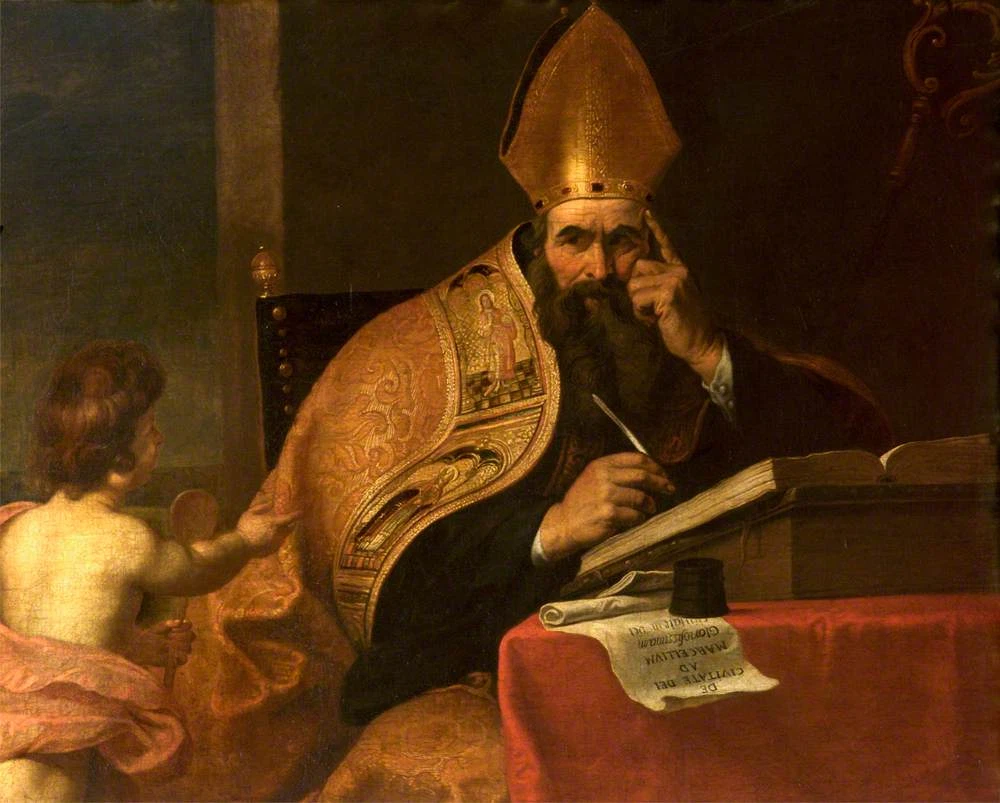
Augustine of Hippo (354–430), bishop of Hippo, preacher, controversialist, and teacher, often regarded as the most influential of the Latin Church Fathers, wrote two letters to Januarius, who is otherwise unknown. These letters, later brought together, form a response explaining why Easter is understood as a sacramental celebration, whereas Christmas day is not.
It is vital to realize that our Lord Jesus Christ, as he states in the gospel, put us under an easy yoke and a light burden. So he put his new people together, under only a few sacraments, easy to celebrate, and yet so rich in meaning. Such is baptism, celebrated in the name of the Trinity, and the Eucharist, celebrating his blood and body given for us; and there are a few others prescribed in the Scriptures. But God's ancient people were in servitude to many more, needed perhaps because of the state of their hearts, described in the five books of Moses, and whose abused practices the prophets later denounced.
Also, there are events we celebrate universally by tradition, unwritten, yet preserved by the apostles, and promoted by the plenary councils of the Church. Such are: the Lord's passion, his resurrection, his ascension into heaven, and the coming of the Holy Spirit from heaven, celebrated every year with special solemnity. . . . Other practices have evolved in diverse times, places, and ethnically, such as some fasting on Saturday, receiving communion every day, or offering daily Mass, or doing both only on Saturday and Sunday, or only on Sunday, etc. . . . My advice then, would be that you follow the practice of the local church wherever you happen to be . . . as I was advised by my own wise mentor, Ambrose, of blessed memory. . . .
But you also ask me why the annual remembrance of the Lord's passion doesn't fall on the same day every year (like Christmas) . . . this is because the day of our Lord's birth is not celebrated as a sacrament, but as a festal day. Whereas a sacrament is present in a celebration when the commemoration of the event is personally significant and applied to one-self. When we celebrate Pasch, or what we now call Easter, we are not just recalling the event itself, that Christ died then rose again, but that this event has become eventful and actualizing for us. As the apostle puts it: Christ "died for our trespasses and rose for our justification." Easter we may say is when we experience our own passing from death into life, in the light of our Lord's passion and resurrection.
The meaning of Pasch further brings this out. It is not a Greek word, nor does it mean "passion" or "to suffer" as popularly assumed. It is a Hebrew word Pesach, or Aramaic Pascha, meaning to "pass over" or Passover. The apostle emphasizes this, by saying: "When Jesus saw that his hour was come, that he should depart (lit. "Pass over") from this world to the Father . . ." then Jesus gave them the sacramental meal. For as Jesus was "passing over" from this life into the next, so too his disciples are to pass from death into life eternal. By faith then, this "passing over" continues in the faith experience of every believer, for now "the just shall live by faith," and "faith works by love," and our old self has been crucified with him." . . . God too, has "raised us up with Christ, and made us sit with him in the heavenly places." . . . So we are "to seek the things which are above, where Christ is seated at the right hand of God . . . and to set our minds on things that are above, not on the things which are on earth." . . . For now we are body of our Lord Jesus Christ, “the first-born from the dead,“ since the body of which he is the head is nothing else than the Church.
Scripture Meditation
Christ, our Passover lamb, has been sacrificed for us. Therefore let us keep the festival.
—1 Corinthians 5:7
Thought of the Day
This world in its present form is passing away (1 Cor. 7:31). How then does Easter help us to not be engrossed in this passing world?
Prayer
Father, the time has come. Glorify your Son, that your Son may glorify you.
—John 17:1