We often hear it said that “every Sunday is Easter Sunday.” Or we hear the call to “practice resurrection” as a way to both celebrate the triumph over death and live in this reality. Yet even the call to practice assumes the pivotal place of Easter Sunday in the church calendar. We know the backstory: within the Christian religious tradition, the Lord’s Day is Sunday rather than Saturday because Christ arose on Sunday. We choose to affirm that Good Friday does not have the last word, and we move with confidence to Easter. Many Christians do not even show up for Good Friday, assuming that there is no point given that Easter is coming, a happy day. This is where we want to live; this is our reference point. The gospel is not so much Good Friday, but rather that the crucified one is risen and risen indeed. And on Easter Sunday we proclaim that this is the high point in the church calendar.
This is the standard message. Where I worshiped this most recent Easter Sunday, this was the message in the worship leaflet: “Easter Day is our most important celebration and the peak of the liturgical year, because it commemorates the very event that catalyzed and propelled the Christian religion itself—the resurrection of Jesus Christ.”
But consider another possibility. Easter, however significant it was and is, was a prelude to the ultimate triumph of the crucified and risen Lord: the Ascension. Consider that perhaps now our focus and our confidence is specifically that Christ Jesus is the ascended high priest and cosmic Lord, seated at the right hand of the Father. Consider that perhaps what catalyzed and still propels the Christian mission is the wonder and reality that Christ is now the ascended high priest and Lord of the cosmos.
Easter is terribly important; there is no faith without the triumph over death. And yet, what defines us is not so much that death is defeated as that everything about us is in reference to the Ascension.
This is our focus—the Apostle insists that our hearts and minds are hidden in and with the ascended Christ (Col. 3:2–3). Or, from the perspective of the book of Hebrews, the great testimony to the Ascension, we look to Jesus who now is at “the right hand of the throne of God” (Heb. 12:2).
What most defines us—as Christians and as the church—is the Ascension. In our prayer and in our worship, the ascended Christ is our focus. Our deep confidence is not so much the triumph over death but, wait for it, that now in Christ we have access to the Father, our high priest. And now in Christ we know that all things are being reconciled to the Father. All things: literally the full scope of the created order.
We do not for a moment take anything away from Easter Sunday. It is the culmination of Holy Week, and it is fitting that in some traditions there is an Easter vigil where those coming to faith in Christ are initiated into the family of God. All good! And yet, consider that perhaps nothing so shapes the rhythms and routines of our lives as the Ascension. If we practice anything, it is surely that we live each day with the Ascension as our reference point.
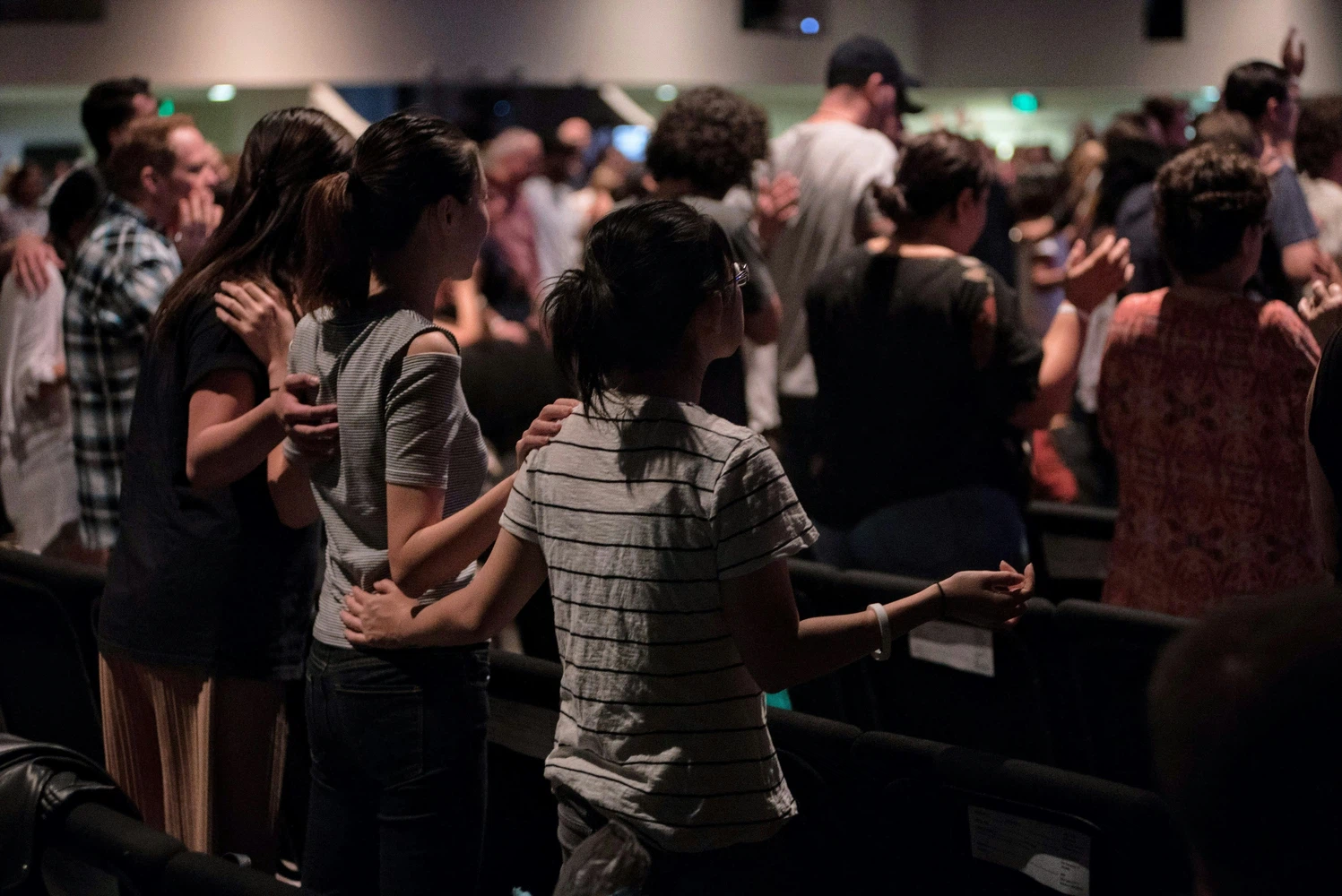
The Ascension means that each week we meet Christ in real time in the gathering for the liturgy, our shared worship. Each week we come into the presence of the ascended Lord, in whom and through whom we are brought into the presence of the Triune God. This is worship: we do not merely speak or sing about Jesus; we are with Jesus, the ascended One. We do not merely celebrate the resurrection; we now meet, in real time, with the risen Lord. We speak with him and to him; our songs of praise are offered, in the Spirit, to Christ himself. Thus every Sunday is Ascension Sunday. The Word is read and preached, and it is the Word of Christ that is present to us and dwells within us as we sing songs and hymns and read and sing the Psalms. And we come to the Table, week in and week out, and we meet Christ in real time: he is present to us in the elements that represent his body and blood. The ascended Lord feeds and thus sustains the body of Christ.
In our personal prayers, Christ is as present to us today as he was to the original twelve, to Mary who sat at his feet, and to the other Mary who encountered him at the garden tomb where she heard him speak her name.
But there is more. Each week we also hear the Scriptures, which empower us to fulfill the mandate of Christ in the world. And we go, not only in the name of Christ but with Christ (2 Cor. 6:1). We are not merely doing what we are called to do on his behalf. Rather, we discern where and how Christ is at work in our world, and we then hear his call on our lives and speak and act in response to this call—as those who are participants in the purposes of the reign of God in Christ in our world. We are not heroes or divas or magicians; we are not superwomen or supermen: we merely plant and water, saying and doing that which we are called to do as we trust God to do God’s work in God’s time.
And, each Sunday, this is all reaffirmed for us and in us: each Sunday we hear afresh the call of God in Christ—the invitation to speak and act as those who seek the peace of the city. We do it with great confidence that one day all will be made well. That day will come. But in the meantime we do what we are called to do—in schools, art galleries, and local businesses. We raise children; we tend gardens. We spend time with our grandchildren. All the while knowing that Christ is seated on the throne of the universe, something we reaffirm Sunday after Sunday.
This is why some of us are perplexed that Ascension Sunday actually gets very little, if any, airtime for so many congregations and church traditions. Palm Sunday gets more attention, even Mother’s Day. But could it be that the high point in the church calendar is actually not so much Easter Sunday as the day or Sunday when we celebrate the Ascension? It is therefore rather sad that so many Christians would not even notice that Ascension Day—a Thursday—has come and gone or that Ascension Sunday was a noteworthy day in the calendar.
We celebrate Advent and Christmas. But we do so with an eye to this day: when the infant of Bethlehem is revealed as king. Christmas Day and Ascension Day are therefore twinned. Christmas only makes sense when we know that Ascension Sunday is on the horizon. The magi from the East knew this. Mary knew this (witness the Magnificat). When we celebrate the incarnation on Christmas Day, we are leaning ahead in the calendar to this day, Ascension Day.
Yes, we celebrate Good Friday; we are a people who are on this journey as those who follow Christ to the cross. But we go further. We walk with him to the Mount of Olives and hear the promise that the kingdom will be fulfilled in the timing of the Father. And now, in the exquisite words of Charles Wesley, those “wounds are yet visible above.” The one whom we worship is not merely the one who died for us—past tense. The crucified one is now the slain Lamb who sits on the throne (Rev. 5:6; 13:8). Thus even Good Friday is twinned with Ascension Day. Good Friday is the necessary precursor to Ascension Day.
And Easter—fabulous! But Jesus in the garden tomb cautioned Mary that even the resurrection was a prelude. He did not come to earth merely to triumph over death. The Cross and the Resurrection broke the power of evil, but now through Christ, the ascended Lord, all things are being healed, restored, and redeemed—all things (Col. 1:20).
And then Pentecost—the essential complement to the Ascension. At the Ascension itself, Jesus told his disciples to wait for the promise that was to come (Acts 1:4). Sure enough, on Pentecost Sunday, Peter’s sermon was an Ascension sermon; even the Day of Pentecost was Ascension Sunday. The Spirit has come and been given so that the full benefit and grace of the Ascension could happen in our lives, in the church, and in the world. Pentecost is the gift that makes it possible for us to practice Ascension. With Pentecost, we can live in union with Christ in our prayer, our work, our worship, and our participation in the mission of God in the world.
And so, in the Spirit, we are looking to Jesus—the crucified and ascended Lord, through whom we offer our worship and our prayers and with whom we are participants in the kingdom purposes of God in the world.
So, rather than saying that Easter Sunday is the high point in the church calendar, the mountaintop, consider another possibility. We celebrate the triumph of Easter, for sure, but save that specific reference for forty days later when Christ is ascended and when we anticipate the outpouring of the gift of the Spirit ten days later. Let’s let the counterpoint of Ascension and Pentecost define us—both our worship and our work, both our common prayer and our participation in the mission of God in the world.
Let’s recover Ascension Day and Ascension Sunday as the high point in the church calendar with a view that every Sunday we celebrate the Ascension and every day we live and work with this vision that shapes, forms, and informs every aspect of our lives—the vision we have of the High Priest who sits at the right hand of the Father.