It's been a particularly hot week here in Cochabamba, Bolivia. After living for eight years in Canada, it still feels strange to think that Christmas is just around the corner. There's no cold weather to shelter from by a cozy fire at home. Instead of hot cocoa, we're craving ice-cold drinks or a nice helado de canela (cinnamon ice-cream).
Indeed, Christmas trees are starting to appear, and colourful lights are beginning to brighten the evenings. But for those of us living in the Southern Hemisphere, the weeks leading up to Christmas look quite different from the snowy scenes we often see in Christmas cards and movies.
When I lived in Canada, I began exploring the Christian liturgical calendar and particularly fell in love with Advent. What a special time to prepare our hearts and lives for the coming of Jesus! It made Christmas feel even more meaningful. However, I quickly noticed how much of the imagery surrounding Advent was rooted in a Northern Hemisphere experience. Long, dark days, cold weather, and the longing for light and warmth were common themes in the reflections I encountered. While beautiful, these images didn't quite fit my experience of Advent in Bolivia.
And yet, the deeper themes of Advent, hope, peace, joy, and love, are universally applicable. Perhaps we simply need to find new ways to recognize them in the context we live in.
Advent through a Bolivian lens
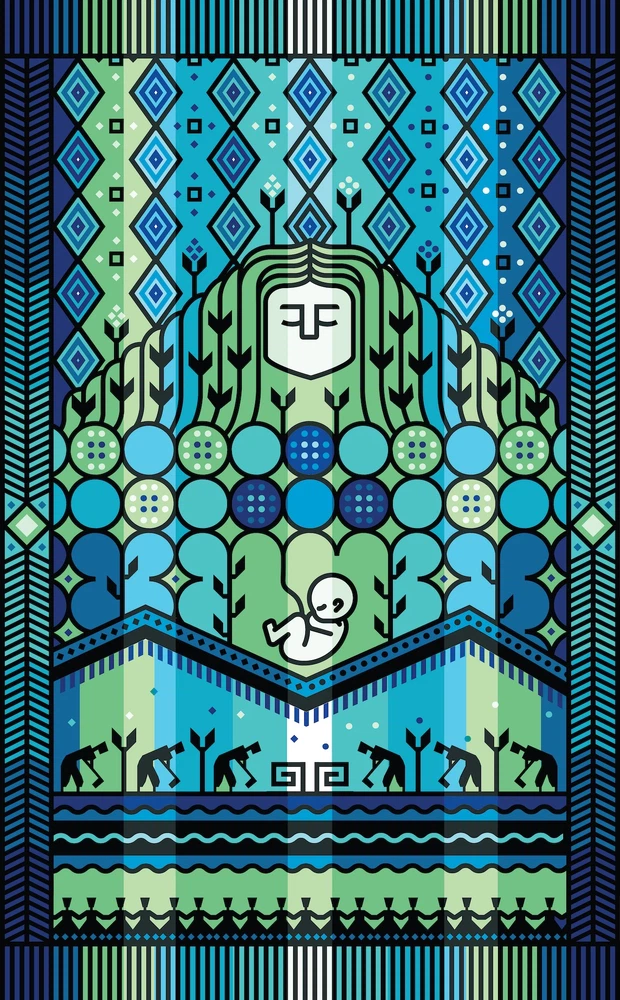
As part of my exploration of the liturgical calendar, I created a series of artworks that interpret the Christian seasons through a Bolivian lens. My Advent piece holds a particularly special place in my heart.
I remember that while working on it, I discovered I was pregnant with my first child. Suddenly, the experience of Advent took on a new meaning. I connected with Mary in a way I never had before. The anticipation of meeting this little person growing inside me brought a deeper understanding of the beautiful, mysterious, and sometimes anxious experience of waiting for new life.
It also made me look differently at the world around me.
In Bolivia, Advent falls during a season of warmth, rain, and agricultural growth. Seeds have been planted, farmers are tending their fields, and the earth is preparing to bring forth new life.
In Andean traditions, the earth is honoured as Pachamama, or Mother Earth. This deep connection to the land is also reflected in the agricultural calendar. In certain Andean traditions, the rainy season, known as Jallupacha, is considered a feminine season associated with fertility, growth, and the nurturing of new life.
I found this connection between motherhood, the earth, and the growing season simply beautiful. Just as Mary carried Jesus within her, the earth carries seeds beneath its surface. Both are reminders that new life can be growing even when we cannot yet see it.
This connection became central to my artwork.
The promise of new life
In the piece, I wanted to bring together the imagery of a mother carrying her child, the fertile Andean landscape, and the patient work of tending the earth.
The colourful geometric patterns and vivid blues and greens draw inspiration from Andean textile traditions and the natural scenery from Bolivia. The plants and growing shoots remind us that life is unfolding all around us, while the child nestled within the composition represents the precious life growing in Mary's womb.
In Isaiah 11:1, we read:
"A shoot shall come out from the stump of Jesse, and a branch shall grow out of his roots."
This passage speaks of hope emerging from what appears to be a lifeless stump. Christians have long understood this promised shoot as pointing toward Jesus, the one who brings new life, justice, and peace.
I love that image for Advent. Sometimes hope begins as something very small. A seed buried in the ground. A child growing in the womb. A tiny shoot emerging from what seemed dead.
We cannot always see what God is doing, but Advent invites us to trust that new life is possible.
The beauty of waiting
Perhaps what connects Advent in the Northern and Southern Hemispheres most deeply is the experience of waiting.
In the north, we might wait for the return of light after long winter nights. Here in Bolivia, we might wait for the seeds to sprout, for the rains to nourish the soil, or for the first crops to appear.
Neither kind of waiting is passive.
A faithful gardener doesn't simply plant a seed and walk away. They return to the garden, water the soil, remove weeds, and protect the fragile life that is beginning to grow. They continue caring for something they cannot yet see.
Amid the hectic end-of-year celebrations, Advent invites us to slow down, pay attention, and nurture the hope God has planted in our lives. We wait, we pray, and we trust. And perhaps, like a gardener eagerly looking for the first tiny leaf breaking through the soil, we can discover signs of God's renewing presence in the most ordinary moments of our lives.
An invitation to look beyond the image
I'd like to finish by inviting you to spend a few moments reflecting on my Advent artwork through a practice called Visio Divina.
Like Lectio Divina, which involves prayerfully meditating on Scripture, Visio Divina invites us to encounter God through an image.
Take a moment to look at the artwork. Allow your eyes to wander through its colours, shapes, and patterns. There's no need to rush or find the correct interpretation. Simply notice what draws your attention.
As you look, consider these questions:
- How do you feel when you look at this image?
- What parts of the artwork feel familiar to you? What feels unfamiliar?
- If you could place yourself somewhere within the image, where would you be?
- What might God be inviting you to notice or reflect on?
Spend a little time in silence with whatever thoughts or feelings arise.
As you finish, I invite you to pray about what Advent might look like for you this year, wherever you are in the world.
What seeds of hope are being planted in your life? What might need your patience, care, and attention as you wait for them to grow?
May this Advent season remind us that even when we cannot see it, God is at work, bringing new life into the world and into our hearts.