My first Bible was a Nueva Versión Internacional (the Spanish equivalent of the NIV). I loved this Bible; it was through its pages that I first fell in love with God’s word during my early twenties, and it was the first time I managed to read the Bible from cover to cover. Later, when I decided to attend Bible College, I found that the program was conducted entirely in English, so I needed to purchase an English Bible. I went to the college bookstore and asked for a King James Version (KJV), as several people had told me it was the best version for serious students of the Bible.
After purchasing a KJV, I began to read it. While I knew the Bible could be a challenging book, this version felt far more awkward than what I was accustomed to. Although I had learned English as a child, I found myself re-reading sentences multiple times just to grasp their meaning. A friend stated that the KJV feels so awkward to modern readers because it was written in archaic English.
And so, just like that, I put my KJV aside and made the New International Version (NIV) my go-to Bible for years to come. Some time later, I learned the biblical languages, specializing in the study of Koine Greek. I vividly recall a conversation in Regent’s atrium with a fellow Greek student, Adam Johnson, reflecting on the assignments for Intermediate Greek that Prof. Sven Soderlund had assigned to us. We were comparing our translations of the Greek text with modern English translations, noting differences and potential exegetical implications. Suddenly, we remembered the KJV. "How do you think the translators of the KJV managed to put this Greek into English?" we asked each other. And here began a new, curious dialogue between me, the New Testament Greek text, and the translators of the good old KJV.
The KJV Read Awkwardly Even Back Then
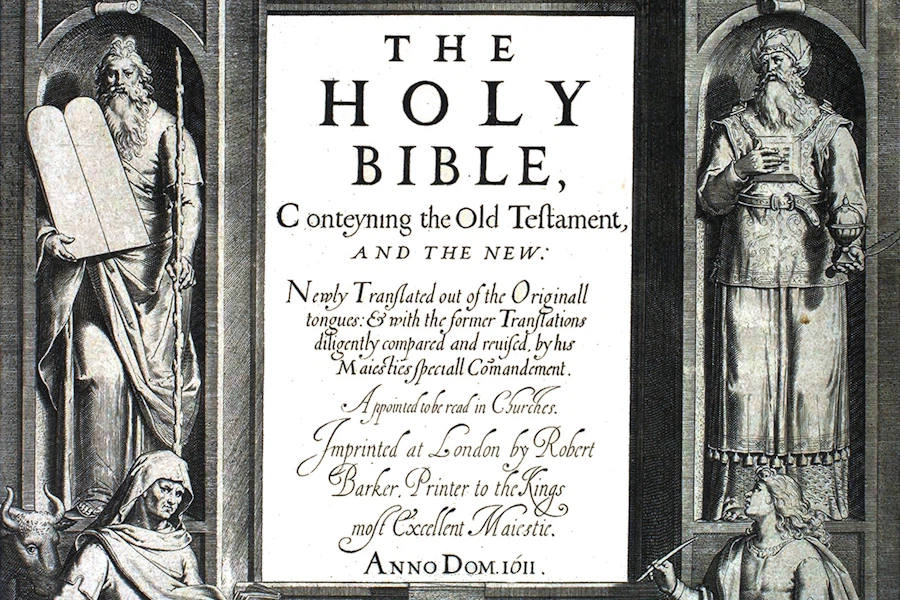
The KJV, first published in 1611, occupies a unique space in linguistic history because it didn’t strictly use the “standard” conversational English of the time. Instead, it used a particular style of “biblical English” that was intentionally conservative and slightly awkward even for its own time.1 The translators preserved archaic linguistic features—such as the distinctive “-eth” verb endings and the singular/plural distinction between “thou” and “ye”—that had already begun to fade from common speech. This intentional archaism was designed to provide a sense of liturgical solemnity and continuity with the earlier translations of William Tyndale and other works of English literary heritage.2
The Koinish KJV
There were many factors that influenced the translators of the KJV, some theological and others literary. However, the more I have compared the KJV with different Greek New Testament critical editions and manuscripts, the more I have come to appreciate the translators’ commitment to retaining, as much as possible, the sense of the biblical languages in their translation. In fact, the 1611 translators grounded their methodology in the ad fontes principle, prioritizing the original Hebrew and Greek as the “two golden pipes” and “fountains” of truth over the “muddy” streams of the Latin Vulgate or other secondary versions. By insisting that the credit of the Old Testament be “tryed by the Hebrewe” and the New by the “originall Greeke,” they established the primary texts as the ultimate authority for their work. Consequently, the fluid grammatical structure of the KJV can occasionally conflict with the more rigid, formal rules of modern English grammar that define today’s written standard and guide most contemporary Bible translations.
Below, I will provide an example where the KJV actively wrestles with the wording of the Greek text. This example is not meant to be taken as a superior translation, but rather as a sampling of the type of engagement with the primary text of the New Testament that I find helpful for making sense of the implications of the peculiarities of the Greek grammar in English. Also, it is fun to see how koinish (Koine-flavoured English) made it into this renowned translation, even when the final product was not as neat as contemporary grammarians would like.
How Should We Translate Hebrews 6:4–6?
I have taught elementary Koine Greek for the past four years. Each term, I witness students wrestling with the idea that word order in Koine is extremely fluid and not a primary means for defining the function of words as it is in English. I often remind students that saying "word order doesn’t matter in Greek" is going a bit too far. Word order does matter in Greek, but differently. The biblical authors had at their disposal an incredibly flexible language that allowed them to employ words for all sorts of rhetorical functions by placing them at different places in a sentence so that the words could be heard in very specific ways. Since word order is so essential for conveying syntax in the English language, translators have to wrestle with how to bring the Greek word order into English.
Another topic in Koine Greek that terrifies students is translating participles. New Testament grammarian Daniel Wallace, comments that “one’s exegetical skills get tested more with participles than with any other part of speech.”3 The Greek participle is perhaps one of the most versatile parts of speech the language has at its disposal, and translating its various nuances into English is serious business.
Hebrews 6:4–6 is one of the New Testament's best examples of both Greek word order that becomes awkward in English and the exegetical challenge of translating Greek participles into English. Below I will provide three versions of the text: (1) the Greek text tagged with English wording, (2) the King James Version, and (3) the Common English Bible (a contemporary translation).
| Greek Text | Line # |
|---|---|
| 4 Ἀ δύνατον | γὰρ | τοὺς | ἅπαξ | φωτισθέντας, Impossible | for | the | once | ones being enlightened, |
1 |
| γευσαμένους | τε | τῆς | δωρεᾶς | τῆς | ἐπουρανί ου ones tasting | both | of the | gift | of the | heavenly |
2 |
| καὶ | μετόχους | γενηθέντας | πνεύματος | ἁγίου and | partakers | ones made | of the spirit | holy |
3 |
| 5 καὶ | καλὸν | γευσαμένους | θεοῦ | ῥῆμα and | good | ones tasting | of God | word |
4 |
| δυνάμεις | τε | μέλλοντος | αἰῶνος power | and | about to come | age |
5 |
| 6 καὶ | παραπεσόντας, | πάλιν | ἀνακαινίζειν | εἰς | μετάνοιαν, and | falling away, | again | to renew | into | repentance, |
6 |
| ἀνασταυροῦντας | ἑαυτοῖς | τὸν υἱὸν τοῦ θεοῦ | καὶ | παραδειγματίζοντας. crucifying again | to themselves | the Son of God | and | publicly-holding-in-shame. |
7 |
| King James Version | Line # |
|---|---|
| 4 For it is impossible for those who were once enlightened, | 1 |
| and have tasted of the heavenly gift, | 2 |
| and were made partakers of the Holy Ghost, | 3 |
| 5 And have tasted the good word of God, | 4 |
| and the powers of the world to come, | 5 |
| 6 If they shall fall away, to renew them again unto repentance; | 6 |
| seeing they crucify to themselves the Son of God afresh, and put him to an open shame. | 7 |
| Common English Bible | Line # |
|---|---|
| 4 Because it’s impossible | 1b |
| to restore people to changed hearts and lives | 6b |
| who turn away once they have seen the light, | 1a, 6a |
| tasted the heavenly gift, | 2 |
| become partners with the Holy Spirit | 3 |
| 5 and tasted God's good word | 4 |
| and the powers of the coming age. | 5 |
| 6 They are crucifying God's Son all over again and exposing him to public shame. | 7 |
The Common English Bible (CEB) was designed as a “bridge” translation to provide academic accuracy in the natural, conversational language of the twenty-first century. Its purpose is to remove the linguistic barriers of archaic syntax and “churchy” terminology, making the text accessible to a broad, ecumenical audience at a grade seven reading level. By prioritizing functional equivalence, it seeks to communicate the original meaning of the biblical writers in a way that sounds like the English people actually speak today.
Within this framework, it makes a lot of sense that the CEB translators had to rearrange the word order of the Greek text to accommodate it to a more clear syntax. Their primary move is to combine Line #1a with #6b, which is technically correct since in the Greek text, functionally, these two phrases go together: “for it is impossible → to renew into repentance.” This phrase is the main verbal unit, and everything else hangs from it. The list of descriptions is together forming the object of the verbal idea: who is impossible to renew into repentance? Ah, the ones who have been [six descriptions]. So, syntactically, the CEB reflects very well the function of the Greek syntax in English.
However, even in Koine this sentence is structurally rare, rhetorically rich, and filled with suspense. The breaking of the verbal phrase in order to insert a six-fold description of its object seems like a rhetorical move meant to be orally performed. Imagine the preacher saying: “For it is impossible for those who [naming each description at a very slow pace] … to renew them again into repentance!” As much as grammatically possible, the KJV retains the Greek word order that could reinforce this rhetorical emphasis. The passage sounds clunky in the KJV, not archaic. And the reason for this is because the KJV reads koinish.
Going back to our sample text, it is also illuminating how each translation tackles the two participles in Line #7. These participles are also linked to the six descriptions of those who have fallen away. What is strange about them is that these are the only two participles that portray their subsequent condition. The CEB makes a rather strangely conservative move. Instead of wrestling with the potential exegetical nuance that these participles might have, they convert Line #7 into its own sentence, subtly separating it from the prior line and converting the participles into finite verbs. But not the translators of the KJV. In the KJV’s rendering of Hebrews 6:6, the word “seeing” functions as a logical bridge to translate the Greek present active participle ἀ νασταυροῦ ντας (crucifying again). Rather than implying physical sight, it acts as a causal marker—equivalent to “since” or “because”—to explain the underlying reason why renewal to repentance has become impossible. Notably, the translators also supplied the word "if” to introduce Line #6, transforming the Greek aorist participle παραπεσό ντας (falling away) into a conditional clause. This exegetical maneuver shifts the sentence from a descriptive statement of fact to a hypothetical warning, suggesting that the impossibility of restoration is the direct, logical consequence of a persistent and ongoing rejection of Christ.
Conclusion
While I am not entirely certain the KJV translators successfully harmonized every element in this passage, the final result demonstrates a genuine struggle with Greek grammar rather than merely archaic English. I hope this brief illustration revitalizes your appreciation for grammar as a tool for studying the Word of God. Consider adopting the KJV as an exegetical companion; in its unique way, it can challenge you to engage with the Greek text through a creative lens. When you next encounter awkward phrasing in the KJV, rather than dismissing it as archaic, ask yourself how the translators were grappling with the original Greek or Hebrew. You may find yourself entering into a truly fascinating dialogue.