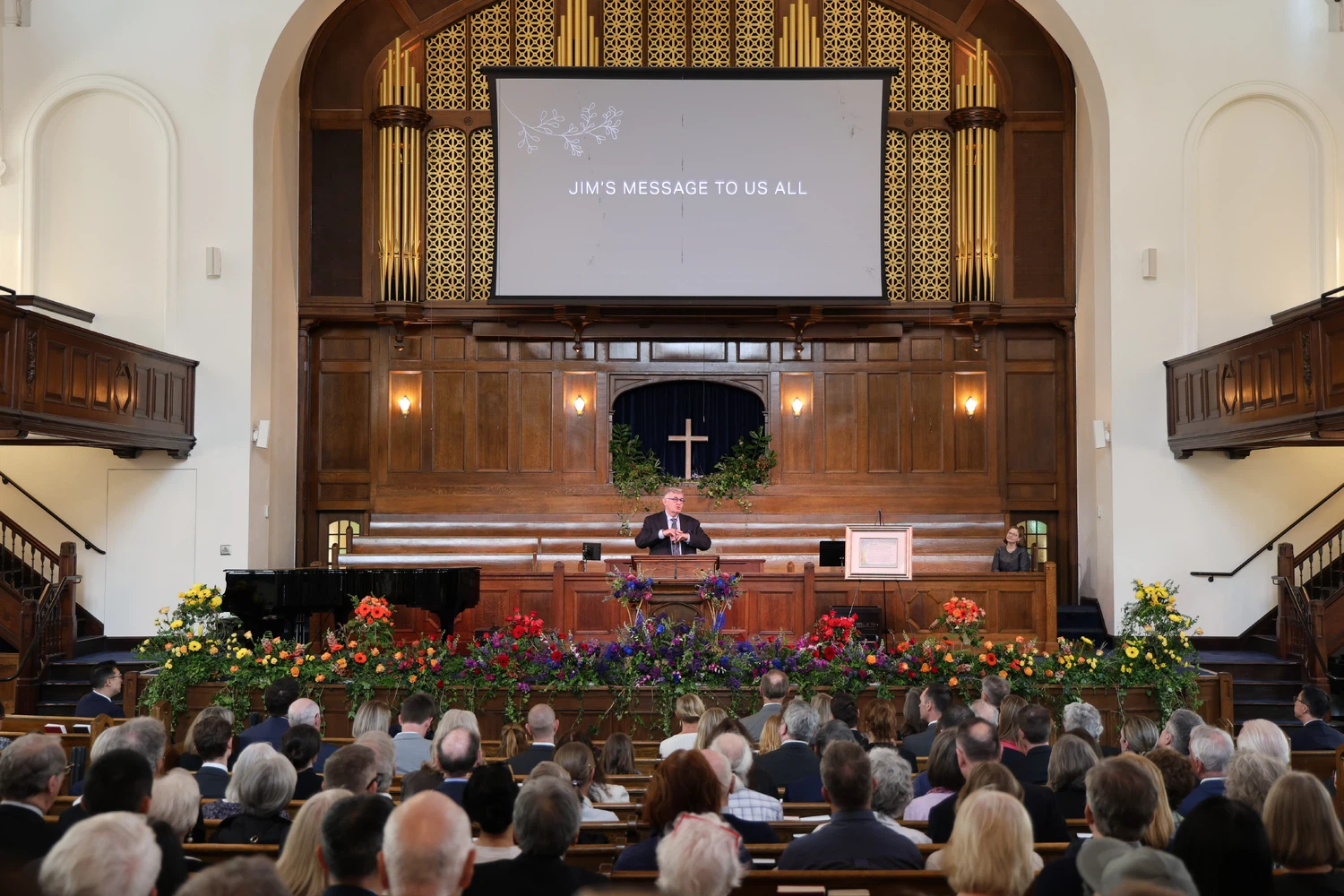
Note: This reflection was delivered at the memorial service of Jim Houston on May 2, 2026. Learn more about Jim, his life, his work at Regent, and his writing on our memorial page.
As we prepared over the past few years for a day that we knew must come, my sisters and I worked with our father to plan this service. He liked what we had done for our Mum, and asked for the same—four of us together telling stories. But he raised independent thinkers and while we have adhered to the "spirit" of his requests, my sisters asked me to represent his message. To paraphrase, I’m responding to what our Mum often said in her broad Glasgow burr, “Och Jim, what on earth are you talking about?”
Allow me to share with you what I have uncovered from a lifetime as his sometimes unwilling student.
Early in this century, I asked Dad to write for me a paper that elaborated the main points he had been making for most of his life. Like the little boy convinced there must be a pony given the size of the manure pile, I was sure that somehow the key message of his life could be discerned. It was a fool’s errand, I realize, for my stimulus led not to a paper but to a book, “Joyful Exiles,” duly published in 2006. Fifteen years later, as he turned ninety-nine, Dad had a nasty fall and believed that he was dying and must repair to the hospice, to meet his Maker. His Maker had other plans. Dad and I crafted fifty-three letters together which, with Regent’s help, I later published as Letters from a Hospital Bed. I hope you each have a copy. It was always our plan to give them away at this event. His academic colleagues declared this material “vintage Jim,” some even suggesting it was better written than anything else he had done! At last, it seemed, I had what I had always wanted: a book that captured the essence of his message. I just had to write it.
Synthesis of a century of prodigious output is challenging. My friend Jeff—composer, organist, and singer—gave me a clue: “a chord of music is like a forest of sound.” Genius composer J. S. Bach, whose organ music is our musical landscape today, created with each chord a symmetry of sound that usually revolves around a triad of elements anchored by a root, played on the organ by the bass pedal. From the root, all else flows. As I distill the cacophony of books, papers, essays, sermons, and just words from Dad’s life, I am reaching to hear the chord, that unique and resonant construction, that was his voice to us. I trust that I have been faithful to discern and echo that chord well.
Dad had a geographer’s creative mind that roamed restlessly over numerous intellectual landscapes. He was insatiably curious. If you try to follow any particular thread or theme, you will soon find yourself on some diversion, wondering how you had strayed so far. I recall attending a lecture in Singapore. Dad had his title fixed, notes in hand, PowerPoint slides safely in the hands of a confident page-turner. I cringed as he began, “by way of introduction,” and proceeded to wander off on his latest intellectual perambulations—to the desperate consternation of the projector operator, who searched diligently and most publicly through any and all of his slides for some clue as to where he was. A full thirty minutes later, Dad noticed there was a screen behind him and attempted, quite unsuccessfully, to return to his official theme. Whatever he had written even as recently as yesterday was so, well, “yesterday.”
So, how to find the notes of his chord?
To grasp Dad, you need the help of the Friendly Giant and “go up, waaaay up” to catch the patterns in the wide-ranging pathways below. From here, at altitude, some relentless shapes repeat over and over, often in the varied colours of his scholarship, but bearing the hallmarks of the rhythmic heartbeat of his God. Dad knew in his bones, with every fibre of his being, with the creativity of his curious intellect, that God befriended him, called him, and transformed him. The chord of his vibrant life was rooted and grounded upon that triad. And from these foundations, Dad looked resolutely towards the future, never backwards, always leaning into the wind of whatever God was up to next and, with almost childlike enthusiasm, simply delighted to be in on it with his Friend!
Rooted in Friendship with God
Our father spent his early years in and out of hospitals. As with his mother, childhood illness seems to have yielded longevity but also fostered loneliness and an inclination to solitude. Like his favourite prophet Jeremiah, Dad knew what it was to be lonely, to have very few deep soul friends. Perhaps that is why he became so deeply convinced that we all needed to know this very personal God and that this God who befriended the lonely Jim would also befriend each of us. He railed against the professionalization of his adopted profession. God is personal, not an abstraction. Theology is not just thought; it must be lived, inhabited, and incarnate just as its subject, the God of Abraham, Isaac, Jacob, and Jim, was incarnate and personal. He was known, and if he was known, then he was a trusted Friend. Our Dad was a friend of God.
The implications of this reality were profound for Dad. If God befriends, then how he was known by others would inform how we might also know him. Dad reached back, well past the artificial historical wall of the Reformation. As his kids, we said that most of his best friends had been dead for over a millennium! Mum found it a bit galling that the gruel of the Middle Ages seemed preferable to the soup in Dad’s bowl, but they sorted that out in their own remarkable way. Still, the loneliness of Dad’s childhood had birthed deep scars of timidity. Dad often told us of his own fearfulness with others. When he was a younger man and encountered Oxford colleagues whose competence or perhaps arrogance challenged his fragile confidence, he would cross the street to avoid them. And yet from this fearful temperament sprung a profound confidence in the character of a personal God by whom Jim was known and loved. It was the refuge of his Heavenly Father that led him to so strongly encourage so many of us to trust our very identity to "the Everlasting Arms."
To this day, I can hear my father telling me on many occasions how intimidated he felt by his own father’s prayer life. “He would pray all night!” Dad would say, as if this standard was in some way both admirable and unachievable. I have wondered often how this experience of "inadequacy" in prayer, as Dad knew it, might have shaped his urgency for both himself and the rest of us. His book, The Transforming Friendship, is perhaps one of the most important fruits of his labours, mainly because for Dad, friendship with God is not something we "engineer" through disciplines and practices, but an intimacy that emerges out of our groaning, our profound sense of inadequacy.
When I was thirteen, our mother gave birth to our brother Jonathan. Dad was here in Vancouver and flew home to be with Mum and wrestle with the medical consequences of our brother’s Down Syndrome. Johnny also had a problem swallowing nourishment, which has never been a family trait! While the surgical treatment proposed was fairly straightforward, the consequences of any decision whether to operate were not. The year was 1967, and the faint glimmers of a future Regent were already in our father’s imagination. I was awakened by the sound of him sobbing downstairs, where I found him on his knees, on the floor, with tears flowing in an anguish I had never before witnessed in him. To operate would save his son but bring unknowable medical complications into our family, who were, unbeknownst to us, perhaps on the cusp of a major change. Yet to refuse the operation would leave Johnny unable to feed and unlikely to live. We wept together in Dad’s classroom on prayer, listening intensely for the voice of the God who both hears and speaks. My parents chose to operate. Our brother’s life was short. His heart failed him. In his death, he gave each of us a life beyond our imagination. I recently returned to his grave in Oxford to say thank you to him and to the God who is so personal that he befriends us in unfathomable ways.
Called to the Edge
For Dad, the personal God who had befriended him had also called him. To this heavenly calling, Dad was resolutely not going to be unfaithful—hence the first text on the front of our program, a text he spoke often, which reflects his deep conviction that God will sustain us in his call wherever it takes us. God calls us out, sometimes out into a desert, but always with him. When I was young, Dad always tried to embolden me to take a different path than he had walked. As I turned sixty, my ninety-two-year-old father called me up and said, “You are about to embark on the most creative years of your life—what are you going to do?” I never once imagined that he meant retire!
As the Apostle Peter told a man who had been stuck for decades to “take up his bed and walk,” so Dad has called hundreds of us out of some place we were stuck. With his utter confidence in the God who befriends, he has cajoled us into both hearing and responding to the God who calls.
While Dad’s sense of call was unique to him, the impact of that call was profound. God invited his friend Jim out onto the edge where hope battles despair, wisdom meets folly, justice confounds exploitation, courage denies fear, generosity defies greed—where welcome overwhelms shyness and truth confounds lies. Because Jesus is "outside the camp," Dad exhorted us to leave our habitual hideaways—our places of emotional pain, comfortable scholarship, and ecclesiastical conformity, places of professional pride, familiar fear, and self-constructed significance—and to join him, in deep friendship with God, out on the edge. If his body could have handled the forces, Dad would have flown with God and David, pilots at the controls of the wide-bodied aircraft they flew, out on the leading edge of the wing, where, hanging on for dear life to the faithful friendship of his Heavenly Father, Dad would have braced for the 550 knot winds, enthralled at the vision of a future unfolding at the creative hands of our Loving God. From that dizzying place, Jim called us to join him, through his books, his lectures, and especially through his conversations. “Come on,” he’d say, “the view is amazing—the future is here because this is where God is working and he’s including us!” and, as he said to one fearful student, “You need a friend? I’ll be your friend!” And as so many of you have written in the many notes we have received, even just one short walk with our crazy wing walker was enough for your life to change, by God’s grace, for the better.
After he rounded the century mark, back under a full head of steam, his imagined brush with death at ninety-nine all but a faint blip in the rear-view mirror he rarely acknowledged, we, his kids, tried to encourage Dad that perhaps his capacity for endless writing was at an end. He might want to put his feet up and perhaps even coast a little. Dad would have none of it. He was relentless and, quite frankly, drove both us and his loyal friend Bill Reimer nuts, in the process of trying to keep up with his storm of book ideas that still failed to quench his lifelong passion to embolden others.
Transformed by Grace
The journey of Jim Houston from lonely young man eating his lunch alone outside the National Gallery, just off Edinburgh’s Princes Street, to loved and admired sage of one hundred and three, was a journey of transformation. From a fragile and solitary identity now grafted into his Heavenly Father’s heart, and oriented relentlessly to respond to the call of his Shepherd, Jim was slowly transformed into one whose unformed substance had been shaped before any of his long one hundred and three years began. From that embodied reality sprang a relentless conviction that such transformation was offered to all. So hungry and impatient was he to see it in others that, on occasion, he transgressed boundaries of permission as he sought to fan the God-spark in anyone he encountered. To be friends with God, to respond to his call, is as transformative in our spirits as resurrection is in our bodies.
The nature of the transformation in which our father held such confidence is mysterious and deeply personal. When we risk all and leave the sophistication of our scholarship, the comfort of our conformity, the security of our self-sufficiency—even the familiarity of our own fears—we are transformed in two fundamental ways: we embrace more of the richness of our own identity as first imagined most wonderfully by our Creator, and, as we move further out into the uncharted realms of our edge, where God works, our lives bear ever more fruit.
As we planned this service with Dad, he asked that his picture, his physical representation—his body is already on its way back to dust—should not be his facial likeness but should instead be Psalm 1. Why? The psalm is not easy. Much of its language is discordant to our post-modern ears. But at its heart is a tree, rooted in Living Water, called to bear fruit and be so transformed that its leaf does not wither. This is the triad of the chord of our father’s life. Rooted in friendship with God, faithful to a heavenly calling which inspired him to call each of us out to the edge and into our own calling and so be transformed by the creative friendship of our Heavenly Father, this chord resonates across a century of living. This chord has gone out in thousands of lectures, papers, and conversations. But this is also the "seed" that Christ reminds us must first die if it is to become more than a single seed and thus bear much fruit. For those of us who knew Jim, Dad, Grandpa, and even Great-Grandpa, that seed has been planted in each one of our hearts. Now it is our turn to let it bear its full fruit, in and out of season. The chord of my father’s life resonates because its author was not Jim—not my father. The author, the real musical genius, is our God. My God. May his name be praised! Amen.
Write to Chris Houston to share your thoughts at [email protected].