Note: This article originally appeared in the Spring 2018 issue of CRUX (Vol. 54, No. 1).
“I am the Way, the Truth, and the Life,” claimed Jesus. Those words seem particularly à propos, almost directly intended, for those of us who live in 2018. We humans live in a culture of expanding divergence in the ways we seek the meaning of life, in the truths we end up believing, and, therefore, in what we see as the “end” of life. The Heidelberg Catechism asks, “What is the chief end of man?” and answers, “To glorify God and enjoy him forever.” Christians would generally affirm that goal, but we wander widely apart in the “how” of doing it. Some reclusively reject those modern “evils” of evolution, sexual identity issues, and a profusion of “spiritualities.” Others rail at those who hold an exclusivist interpretation of Jesus’s words “Love not the world,” and yet, in some cases, twist the good news, jumping on the bandwagon of a health and wealth gospel.
If we whole-heartedly accept that radical and, to our society, unconscionable claim of Jesus, “I am the Way, the Truth, and the Life,” where do we begin some “course correction” in our lives? Where better than at two of our most significant beginnings: with stories and with children? Stories are one of the oldest tools of human speech. Children, as we nurture and guide them in the way they ought to go (Prov 22:6), are beginning their growth into the fullness of their own unique “being.”
*
The focus on children is probably the most obvious place to start. Most of us have heard some form of the adage, “Give us a child till she’s seven, and we’ll have her for life”—attributed in varying forms to Aristotle, Ignatius, and Francis Xavier. That adage probably contains more truth than we usually ascribe to it. Child psychologists agree that the early years, especially from birth to five, are the most important in the development of a child. Those are the years during which nurturing parents set patterns of deep, empathic, and loving relationships. In a Christian home, these will include a relationship to the God of relationships, whose very identity is described relationally—“God is love” (1 John 4:8). We and our children need stories that will foster a loving relationship with people, with creation, and with God. We need stories that, as Elizabeth Goudge says, “must be everywhere . . . twisting together, penetrating existence.” Stories are, she goes on to say, where “every action and every thought is a tiny thread to mar or enrich that tremendously tapestried story that man weaves on the loom that God has set up.”1
Alasdair MacIntyre tells us in his book After Virtue:
It is through hearing stories about wicked stepmothers, lost children, good but misguided kings, wolves that suckle twin boys, youngest sons who receive no inheritance but must make their own way in the world . . . that children learn or mis-learn both what a child and what a parent is, what the cast of characters may be in the drama in which they have been born and what the ways of the world are. Deprive children of stories and you leave them unscripted, anxious stutterers in their actions as in their words.2
Of course, nurturing people in relationships that are both quotidian and cosmic shouldn’t stop at age five or seven (or even seventy-five!); the pattern keeps being lived and therefore taught as long as we and our children are alive—and on to our children’s children. As Neil Postman puts it in his book The Disappearance of Childhood, “Children are the living messages we send to a time we will not see.”3
If children are messages we send to the future, stories encapsulate and demonstrate the messages we want to give to our children. As Eugene Peterson puts it in The Message, Jesus was always telling stories; that was his teaching method (Matt 13:34–35, 53; 22:1; Mark 12:1). One of the stories told about Jesus, appearing in three of the four gospels, is his strong defence of the importance of children: “Don’t push these children away. Don’t ever get between them and me. These children are at the very center of life in the kingdom” (Mark 10:14–16 MSG; see also Matt 19:14–15; Luke 18:16–17). And all of Jesus’s stories are concerned with the effects of human action—especially those seemingly insignificant “small things with great love,” as Mother Teresa might put it. The stories Jesus told were tethered firmly to the “earth” of daily life: stories of lost coins, unequal pay, the biggering of barns to hold more and more (an older equivalent of offshore accounts), and the costly gift of a poor person’s last pennies. His audience had an advantage over most of us; they and their ancestors had been listening to stories for centuries.
The Torah, in Deuteronomy 6–11, commands the Jewish people not only to tell the story of their history, but stresses that they tell it to their children: “Remember. . . . Remember. . . . Remember and do not forget. . . . Remember today that your children were not the ones who saw and experienced . . . all these great things the Lord has done. . . . Teach them to your children” (8:2, 18; 9:7 NRSV; 11:2, 7, 19 TNIV). They sang the story in the Psalms (e.g., 78, 104, 105, 106, 136); they ate the story in the Passover meal; they celebrated the story in holidays (Passover, Purim, Shavuot, Rosh Hashanah). In all these ways, story permeated the lives of the children of Israel with identity, meaning, and purpose. And stories continue to give children guidelines to faith, compassion, integrity, and all the important truths that make us fully human.
Jesus was called the “Word” made flesh. He, the Word of God to us, not only lived a story that was, in itself, good news; he also clarified the Word of God with stories. Yet he knew and declared that his stories would not be understood. The genius of Jesus as a storyteller is his recognition that telling a good story is like pointing to a door that is, at best, only slightly open. As we read or hear a story time and again, we open the door of our understanding wider and wider. Through the story of the prodigal son, for example, we learn what to do with a wayward child: look up the road every day, perhaps for years; when, at long last, we see the child approaching, run with open arms; and then have a grand “coming home” celebration. With stories, Jesus gives us a choice: we are welcome to open the door to the way, the truth, and the life incarnate in the actions of the stories, but we are not bludgeoned by Jesus into accepting a disincarnated and lifeless explanation. With very few exceptions, and those mainly as an aside to his rather dense disciples, Jesus refused to explain the “messages” of his stories.
But we concerned parents rarely follow the storytelling method of Jesus. We do a disservice to stories and to our children when we try to explain what we see as the message of a story in an effort to make sure they “get it.” We impose on them our interpretation of the story, which is a way of politicizing it with our own particular understanding of the heart of the story. We take away from children their chance to explore the story with wonder, delight, and a gradual awakening of understanding, geared to their age and stage of development. (As Robertson Davies is often quoted as saying, “A truly great [story] should be read in youth, again in maturity, and once more in old age.”) The child may well ask questions, but the desire for explanation, if it comes from the child’s own exploration, should not be used as a rationale for flooding that search with the whole range of dos and don’ts that we adults may want to convey. If a child is not ready, the child may well reject it all. The effect of a story derives from its hints and clues, its tantalizing of the imagination. Jesus, and George MacDonald, as we will see, understood the value of story for the imagination. The stories of both have been read, told, retold, and remembered far more than their sermons.
MacDonald catches well the importance of the imagination as a guide for children and for us in living life:
In very truth, a wise imagination, which is the presence of the spirit of God, is the best guide that man or woman can have; for it is not the things we see the most clearly that influence us the most powerfully; undefined yet vivid visions of something beyond, something which eye has not seen nor ear heard, have far more influence than any logical sequences whereby the same things may be demonstrated to the intellect. . . . We live by faith, and not by sight.4
We see this ability of stories to influence how we live in the parables of the prodigal son (or “the running father,” as N. T. Wright titles it) and the good Samaritan, which continue to influence those who have never opened the Bible.
*
“Moral imagination” is the term often used to describe the gift stories give us. But the word “moral,” along with the word “truth,” is increasingly considered suspect in contemporary culture. Both are seen as rejections of diversity and as an imposition on everyone else of “my truth” and “my morality”—hence the great wisdom of Jesus’s teaching through story. Truth and morality, delivered imaginatively in story form, have a rich, deep, and life-changing influence on how we will live our daily lives. Story does not explicate; it is more like show than tell. Rosemary Sutcliff, one of the greatest and most thoughtful writers of historical fiction, asserts the importance of this genre for children:
The reading child is liable to absorb ideas from books which may remain with him for the rest of his life, and even play some part in determining the kind of person that he is going to become. . . . I try to show the reader that doing the right/kind/brave/honest thing doesn’t have to result in any concrete reward (help an eccentric old lady across the road and she will send you to ballet school), and that this doesn’t matter; the reward lies in having done the right/kind/brave/honest thing, in having kept faith with one’s own integrity—and probably in being given a more difficult thing to do next time.5
For Sutcliff, stories incarnate moral virtues and truths. Story does not teach disembodied rules, but rather helps readers live them out vicariously through the lives of others.
*
There are several problems, however, with our modern storytelling. When we love a story, we often delight when it is made into a movie. That metamorphosis seems a way of both granting credence to the story and also popularizing its good news. But movie versions can strip the story of its potential cathartic effect. In movies, we are manipulated to see the story through the interpretive decisions of a director. When we read The Hobbit and The Lord of the Rings, we have our own understanding of the characters—even what they look like—which fits who we are at that time. Our understanding will grow and expand in meaningfulness as we grow. After we see a movie version, some of that understanding will be confirmed, but the characters and events will be modified by the director’s interpretation—often in subtle but substantive ways. That new view of the story is then ossified in our understanding. (We can’t even hold onto our own particular pre-movie vision of what Bilbo and Frodo look like once we have seen the movie.)
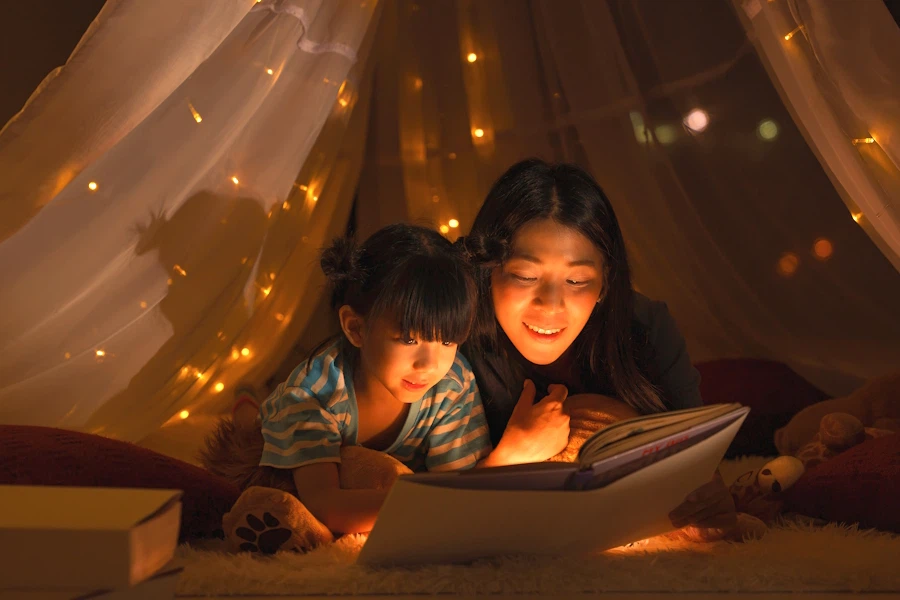
A story is a skeleton on which we hang the flesh of our own longings and experiences. What makes a story work its good is the flesh we put on its bones. Stories provide a way for us to look at our own lives through vicarious participation in the lives of others. Then, as Sutcliff points out, we are better equipped to choose the right thing to do in our particular situation. However, this view of story as skeleton brings up a problem that shows up most clearly in picture books of fairy tales. The old tales were honed by many tellings, and were told by the elders to children, preferably around the fires in the dark of night when the surroundings, and even companions, were less intrusive to the imaginations of the listeners. But today, the plethora of illustrated picture book versions of the old tales can eliminate the strength of a child’s involvement with the story itself.
Oral stories sink deep into our imagination—indeed they call forth imagination—and they have been doing so for thousands of years. Those old stories have done much of the work of making us fully human. In the last twenty-five years, however, we have been facing a new problem. Many books—especially picture books—include gimmickry. One frequent gimmicky add-on is a CD glued onto an endpaper, making it possible for parents to let it do the job of telling the story rather than reading it aloud while holding their child close. When a child hears a story in a parent’s familiar voice, all their attention goes to the story, with empathy and wonder. But when a child hears a story told in a stranger’s voice, some of the attention is diverted from the story to the storyteller. Other gimmicks offer a website link, buttons to push that give details, sounds, crafts, or recipes, or—worst of all—the opportunity to flip through pages and choose one’s own adventure sequence (limited, of course, to the options found in the book). All such gimmickry disrupts the child’s absorption in the story, thus decreasing his or her imaginative involvement.
The most serious problem is that, for many children, books are being replaced by the many devices that are proliferating in our current culture. It is all too easy to give a child a screen to sit and watch when we are busy, rather than laying aside our own concerns and reading them a story. TV used to be the emergency babysitter; now each child can have and control his or her own private screen. The screen has also taken us away from bookstores. Rarely do we see a child sitting on the floor of a bookstore immersed in a book—deciding whether to cajole a parent into buying it. Choosing and then possibly even buying a book one has fallen in love with—to have and to hold—is a great privilege. As we choose good books to read to our children, we are teaching them standards for choosing good books on their own.
Christian books are, unfortunately, some of the worst “add-on” culprits. So many Bible story picture books end with a tidy—but again, disruptive—statement clarifying the lesson to be learned. If Jesus refused to do this with his stories, we, in turn, should avoid thinning the rich cream of story with the waters of our interpretation. The illustrator Richard Jesse Watson refused to let his book The Lord’s Prayer be published until an explanation of each phrase, required by the publisher, was put in a section at the end instead of in the body of the book. But a recent board book edition puts them back in on the same page as each phrase and picture, much to Watson’s chagrin. The focus on the words of the Lord’s Prayer, important for helping a child learn it by heart, is thus obfuscated.
A book about the disruptive dangers of our many device add-ons is It’s a Book by Lane Smith.6 In it a reader (a monkey) is trying to read “just a book.” His friend (a jackass) asks, “Can it Text? Blog? Scroll? Wifi? Tweet?" “No . . . it’s a book,” the monkey responds. His friend finally grabs the book and ends up getting thoroughly lost in the story. At last the monkey gives up and trots off to the library to get another book. The story is a warning against the gimmicky devices that we, and our children, increasingly accept as normal and necessary.7
*
In contrast to these ways we misuse and abuse stories, let us take joy in some great stories: a favourite picture book by Robert McCloskey; a chapter book by Kenneth Grahame; and a modern classic by Maurice Sendak. All three have continued to be published in hardback, while many books, after a year or two, are only available in paperback, if at all. Kenneth Grahame is known mainly for Wind in the Willows, though he has also written a wonderful, less-known book, The Reluctant Dragon. Both McCloskey and Sendak have a number of books for which they are both author and illustrator (most of which are also still being published in hardback).
Robert McCloskey’s Time of Wonder may never be a child’s favourite book. It lacks the high action that the modern child expects. Published in 1957, the artwork has a ’50s feel—soft, muted colours and none of the frills of visual extravaganza. Yet when we study the book closely, we realize that McCloskey is capturing the gift of place and the wonders of creation. In the first pages, he gradually zooms in to an area of Maine, to an island, and then to a family visiting the island. The pictures show the children spending their summer joying in fiddlehead ferns, old rocks, tides, starry nights, and foggy mornings, “while one pair of eyes is watching over all.”8 When a wild storm builds up, all the people of the area—boaters, grocers, and vacationers—warn each other: “We’re going to have some weather. It’s a-comin’! She’s gonna blow. With the next shift of the tide.” When the storm begins and the wind screams, the mother reads a favourite story, and they “all sing together shouting ‘eyes have seen the glory’ . . . as loud as [they] can.”9 McCloskey unveils a particularity of person and place and time: the names of the islands, the shops, the boats, and the people are all real and still remembered by some from that area. But McCloskey has also made his story a time of wonder for all readers to share in vicariously. We, like the family at the end of the summer, are brought home rejoicing at the wonders we have seen. Reading this book aloud, over and over, helps a child explore and love the intricacies of creation. The book also serves as a fitting coda to McCloskey’s earlier books, Make Way for Ducklings (1941) and Blueberries for Sal (1948), illustrated in brown and blue before multi-coloured illustrations were common. They, too, have the same sense of place and maybe even the “eyes watching over all.”
The Wind in the Willows (1908), by Kenneth Grahame, is another book with lots of description and a fairly slow, detailed pace—except for the odd chapters describing Toad’s wild adventures. His joy in boats and caravans and motorcars woos a young listener with the thrill of hearing an exuberant Toad careen through his chapters with a succession of infatuations, one of which is described by his ecstatic praise of a new-fangled motorcar: “Glorious, stirring sight! . . . The poetry of motion! The real way to travel! The only way to travel! Here to-day—in next week to-morrow! Villages skipped, towns and cities jumped—always somebody else’s horizon! O bliss! O poop-poop! O my! O my!”10 In spite of those exciting sections, the book would probably need to be read aloud to a child (even some adults might find it rather tedious going unless it were read aloud). But then it would likely become a favourite book to come back to and savour again and again.
What makes this old book so very good can be captured by looking at three sections, each catching a different richness of the book. The first has to do with the friendship between Rat and Mole. It would be hard to find characters more polar in personality. Rat is exuberant, strong, adventurous, and socially adept. Mole is much more timorous—even getting into Rat’s boat takes immense determination and courage. What makes their relationship work is what they do for each other—Rat exposes Mole to adventure: “Believe me, my young friend, there is nothing—absolutely nothing—half so much worth doing as simply messing about in boats. Simply messing . . . messing—about—in—boats; messing—” Then when his euphoric rhapsodizing ends in an accident, Mole responds with gracious gratitude: “What a day I am having!”11 But what gives greatness to them both as characters is that their relationship is one of mutual respect, support, and love. Polarity, in their case, is not politicized; rather, it becomes a source of increased confidence and other-centred empathy.
Secondly, there is that wonderful chapter that captures the goodness of home—a favourite of many lovers of this book—Dulce Domum, “sweet home.” Here Rat, still the exuberant adventurer, finally realizes that Mole is longing for home and encourages him, literally, to follow his nose till they end up in Mole’s underground house. Mole’s deep embarrassment in welcoming Rat to his humble home climaxes when a chorus of young mice arrive to sing Christmas carols, and Mole has nothing in his larder to feed them. Rat, who had already been finding special things to praise in Mole’s humble home, takes this sad mark of Mole’s poverty in hand and shoos off some of the young mice to the store to buy nibbles for the choristers: “Fresh, mind! . . . See you get Buggins’s . . . only the best. . . . Yes, of course, homemade, no tinned stuff—well then, do the best you can!”12 After they leave, Mole and Rat settle down before the fire and enjoy memories of the day. Mole soon goes to sleep “in great joy and contentment. But ere he closed his eyes he let them wander round his old room. . . . He saw clearly how plain and simple—how narrow, even—it all was; but clearly, too, how much it all meant to him, and the special value of some such anchorage in one’s existence.”13 In this chapter, Kenneth Grahame celebrates home, friendship, and thoughtfulness as few other authors have managed to do.
Finally, in the centrepiece chapter of the book, “The Piper at the Gates of Dawn,” Grahame gives Rat and Mole—and us—the rich gift of an awe-full, though evanescent, glimpse of the mix of mystery and magic in the natural world. For some, this chapter doesn’t belong and should be thrown out (which it is, unfortunately, in one of the most beautiful of many recent, newly illustrated versions). Pan, the god of nature, is the mysterious presence that seems to permeate all that happens in the book, even though his brief appearance to Mole and Rat in this chapter is not remembered by them. Pan, and his piping, fit with the deep-down prevailing goodness in the relationships of the book—even to the end, where Toad, who wrecks caravans and motorcars through his wild escapades, is forgiven and loved in spite of hints that he has no intention of keeping his promise to live less recklessly. The title, Wind in the Willows—an image that comes up several times in the book, is also the liminal, unseen, but pervasive, wind—spirit—of Pan, who brings music and joy and beauty to the willows and reeds along the river, and to the hearts of Mole, Rat, and Badger. Some, when they listen to and look at the natural world, do sense Pan, since all creatures, at some level, have a sense of God’s “eternal power and divine nature, invisible though they are, . . . understood and seen through the things he has made” (Rom 1:20 NRSV). As G. K. Chesterton testifies,
I had always believed that the world involved magic: now I thought that perhaps it involved a magician. And this pointed [to] a profound emotion always present and sub-conscious; that this world of ours has some purpose; and that if there is a purpose, there is a person. I had always felt life first as a story: and if there is a story there is a story-teller.14
A friend who doesn’t see himself as a Christian recently said to us, “When I look at nature, I sense a great mystery—or maybe God, I don’t know.” Rat, as he and Mole listen to the wind’s music playing at the gates of dawn, whispers, “Here, in this holy place, here if anywhere, surely we shall find Him!”15
We now turn to a more recent book, Where the Wild Things Are (1963), by Maurice Sendak. Here is a book that, in contrast to the other two, is beloved, and immediately so, by any child. When it first came out, however, some critics responded to it in horror, warning parents not to read such a book, replete with parental cruelty and scary monsters, to their children, especially at bedtime. The then-prominent child psychologist, Bruno Bettelheim, without ever having opened the book, joined the uproar by asserting, in his column on child-rearing in the Ladies Home Journal, that it would frighten young children. His objections morphed into an outcry that, as we would say today, “went viral” and frightened parents. In 1969, when Bettelheim’s view was causing considerable turmoil, I asked a student, a father of three young children, to take the book home and read it to his kids. He came to the next class with the news that the children had liked the book and clearly identified the mommy and daddy monsters. So much for nightmarish fear!
If you haven’t read the story, you must. No summary could catch the effect of the brilliant symbiosis of words and pictures that Maurice Sendak has given us in this treasure. Arguably it is the best picture book ever. In it, Max refuses to do as he should and, wearing his wolf suit, makes “mischief of one kind and another.”16 So his mother calls him “Wild Thing” and banishes him to bed without his supper. Gradually his room changes into a forest (described lyrically by Sendak). Max escapes by boat, an emblem of separation from the strictures of home, to where the wild things are. There the monstrous figures threaten to eat him up, and “roared their terrible roars and gnashed their terrible teeth and rolled their terrible eyes and showed their terrible claws . . . until Max says BE STILL” and leads them through pages of “wild rumpus.” Then, wanting to be “where someone loved him best of all,” he steps back into his boat and returns home to his very own room where his supper was still waiting for him, “and [on the final page, with no picture] it was still hot.”
Loren and I have used overheads of this book when teaching a course on Christianity and literature in China. It bridged the language divide with clarity. Sendak’s story allowed us to talk about the basic shape of Story. The late Northrop Frye, professor of literature at the University of Toronto, discusses the Bible as the exemplar of story in his book The Great Code: The Bible as Literature. Max’s story follows the “great code” of literature that Frye finds in the biblical story: the disobedience, fall, wandering and despair, and restoration. Sendak’s Jewish roots play out through Max, his mother, and the wild things, paralleling the biblical story of fall and redemption. It is the story of the “running father”—or, in Sendak’s version, the “waiting smother”—full of grace and full of love, to the extent of keeping the daily-bread sustenance of supper hot and ready for when, fully forgiven, we “come home.”
A good story such as Where the Wild Things Are hints at the wonderful and generous gift of the love of God found in the everyday surprises of unexpected and unwarranted lovingkindness. We are continually “surprised by joy.”
Good stories not only tell us about what God is like, but they also tell us about ourselves. Ursula Le Guin writes,
We read books to find out who we are. What other people, real or imaginary, do and think and feel—or have done and thought and felt; or might do and think and feel—is an essential guide to our understanding of what we ourselves are and may become. . . . A person who had never listened to nor read a tale or myth or parable or story, would forever remain ignorant of his own emotional and spiritual heights and depths, would not know quite fully what it is to be human.17
The philosopher Richard Kearney goes a step further: “Telling stories is as basic to human beings as eating. More so, in fact, for while food makes us live, stories are what make our lives worth living. They are what make our condition human.”18
*
Such power of story can still come to children, if they are fortunate, in tales told by family, teachers, and librarians. But mostly, stories come to us through books. We need books, for ourselves and for our children. And to find them, we need good libraries and good bookstores. The secret of a good library is the librarian who chooses the books. The secret to finding good books in a bookstore is the bookseller. As a wise character asserts in Elizabeth Goudge’s fine book A City of Bells (in which a bookshop is one of the main settings):
A bookseller . . . is the link between mind and mind, the feeder of the hungry, very often the binder-up of wounds. There he sits, your bookseller, surrounded by a thousand minds all done up neatly in cardboard cases; beautiful minds, courageous minds, strong minds, wise minds, all sorts and conditions. And there come into him other minds, hungry for beauty, for knowledge, for truth, for love, and to the best of his ability he satisfies them all. . . . Yes. . . . It’s a great vocation.19