Graduating from university in my bedroom during the pandemic left me restless for community and travel. I signed up for a three-month Bible course on a different continent, excited to prioritize my faith and discover new parts of the world alongside others. What I didn't expect to find was how little I understood a book I’d read my whole life.
The course emphasized that meeting the people behind the pages of God's story brings it into clearer focus. The God of Scripture spent centuries interacting with real people in physical places and measurable time—engaging nomads and kings, poets and priests throughout the biblical story. What better way to get acquainted with them than by studying the Bible in the very places they lived, breathed, and even crafted portions of what would become the most influential literature of all time?
As we opened our imaginations to the perspectives of the biblical authors and their original audiences, we traced the sweeping narrative of Scripture by foot, bus, boat, and camel. With the Bible in our hands and its landscapes before us, we watched the story unfold—of YHWH drawing near to his created people, initiating a relationship of faith so they might be faithful to him.
After attending the program myself, I had the privilege of returning to guide others through its adventurous curriculum. Like me, many of our students had grown up with little knowledge about who wrote the words of Scripture and why. We had read the Bible as though it were an unmediated letter from God to us. While I wouldn’t dismiss the profound practice of listening to the Holy Spirit through Scripture, neglecting the text’s cultural and historical dimensions places interpretations on shaky ground.
I’ll always remember the first time I brought this mindset shift to Psalms. The Psalms give us language to pray, and yet they too were written by humans embedded in specific times and places. In devotional reading, I had often skimmed references to unfamiliar regions or ancient war imagery. (My most honest prayers don’t typically include words like “Zalmon” or “chariots.”) But now, before turning the words into a personal prayer, I began to dwell on the psalmist’s world: a landscape of invading armies, hand-to-hand combat, vulnerability to wild animals and the elements. Paradoxically, creating this degree of separation by stepping into the psalmist’s shoes helped me draw nearer. I was no longer trying to force the imagery into a relatable framework. Instead, considering the immediacy of these words to the author inspired a more authentic prayer.
The school leaned into an inductive approach—Bible dictionaries were encouraged; commentaries were off limits. We immersed ourselves in the text and its world in order to make discoveries of our own. Reading theological books can help us understand how other Christians see God, but excavating the biblical text for ourselves fosters ownership of our faith and knowledge of God.
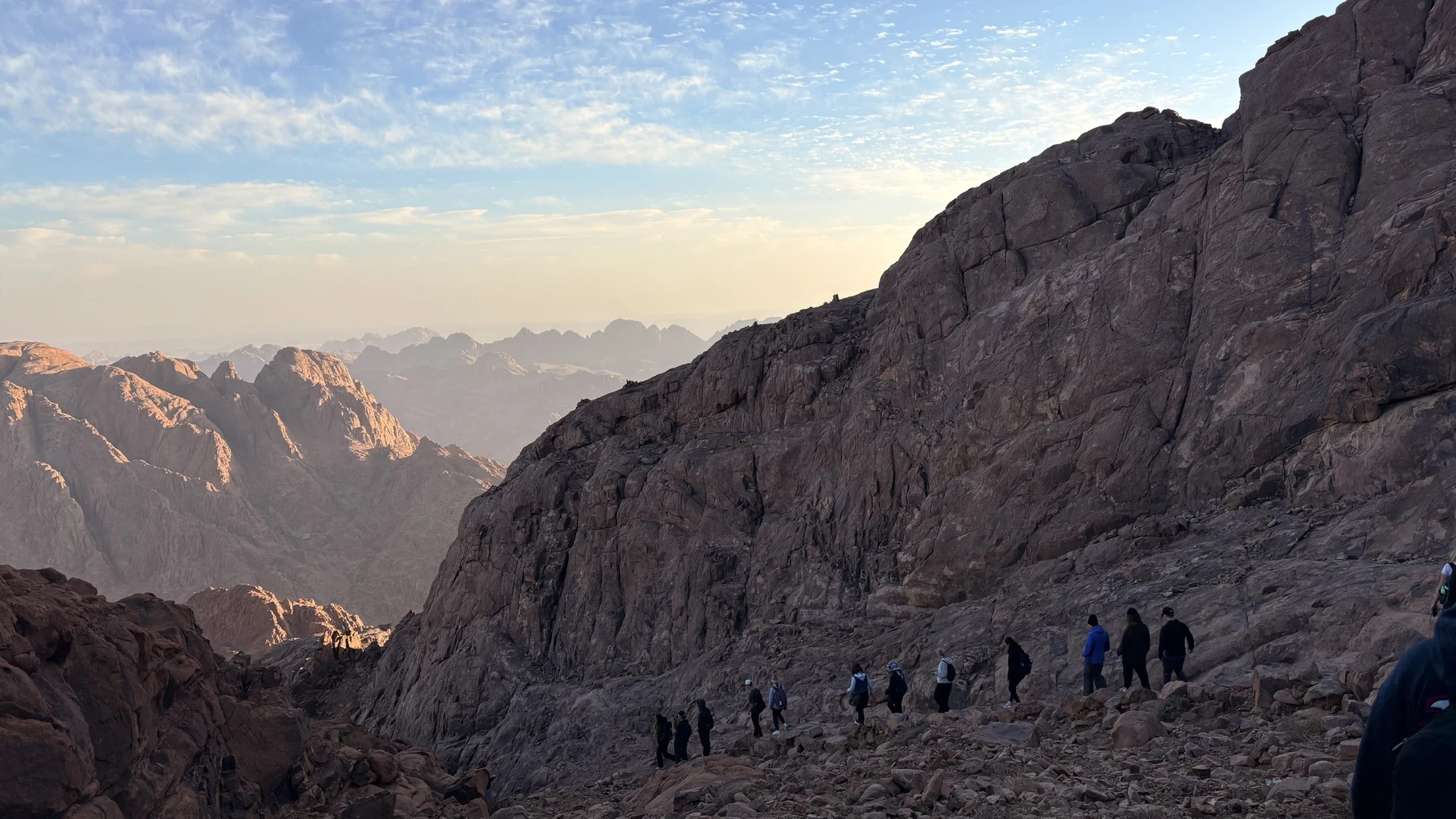
With the tools of this method in hand, we embarked on our voyage—to observe not only the literary features and structural design of the text, but the geography and relics of its world. Our 40-day journey began in Egypt, the pivotal place where God formed a family into a nation for his missional purpose. We floated down the Nile, pondering the fragile beginnings of a national leader chosen by God. At museums, we glimpsed the ancient Egyptian culture marked by a worldview of cosmic tensions from which God protectively drew his people. We hiked Mount Sinai, gaping at the formidable backdrop to the manifestation of God’s power, name, and ways.
In the wilderness, we camped near a replica of the tabernacle. Waking up surrounded by nothing but desert and sparse acacia trees reminded us how God cared for his people’s every need. When they longed for the familiarity of their former land—as we are prone to do, mistaking unanticipated forms of provision as God’s indifference—he patiently taught them to recognize that he alone was their dwelling place.
We entered Canaan, where the manna stopped and dependence on God had to be chosen more deliberately. We observed the figurines of household gods—some dating to Abraham’s time—reminding us of the pervasiveness of paganism in the land. How difficult would it have been to stay true to an invisible God when every surrounding nation worshipped gods you could hold in your hand?
We trekked the terrain where David took refuge in the invisible God and penned psalms about seeking his face. At palace ruins in Samaria, we remembered the tragic collapse of the Northern Kingdom to Assyria, following generations of kings who had no interest in representing YHWH to the nations. Beneath the streets of Jerusalem, we squeezed through Hezekiah’s winding tunnels which had preserved water for the city during a threatened siege.
Above Nehemiah’s reconstruction of Jerusalem’s walls, we observed the remains of Herod the Great’s impressive renovations. Centuries of layers—built, destroyed, and rebuilt—spoke to Israel’s repeated failure to love God’s dwelling place.
Amid Galilee’s understated beauty we contemplated this unexpected birthplace for a king—a king who didn’t claim a city, build a palace, or wage a war. This quiet land with its rolling hills seemed an inviting place to wake up before dawn and converse with God.
We followed Jesus’s route from the tranquil garden of Gethsemane to Pontius Pilate’s Praetorium, to a possible site of Jesus’s tomb. We stood where Peter preached to the crowds about Jesus's resurrection, where the world began to turn upside down. We descended the steps of an ancient mikveh—one of the many ritual baths which likely became baptism sites for the three thousand who believed Peter’s message that day.
We continued to piece the story together as we traced some of Paul’s journeys, catching glimpses of the ancient cultural tensions he faced while nurturing early churches. Climbing the Areopagus in Athens, we were confronted by the prominence of pagan temples rising from the acropolis. In Ancient Corinth, we stood at the judgement seat where Paul appeared before the proconsul Gallio and where early believers would unabashedly take each other to court. In Ephesus, we wandered the marketplace where Paul would have interacted with workers and travellers arriving at the major Asian port. In Rome, we witnessed the opulence of the emperors through the remains of imperial architecture, which once beckoned the Roman world to fear and venerate them.
Every observation we collected painted the biblical narrative in more vivid colours than before. Interacting with the entire story in a short span of time felt like assembling a puzzle we had first begun in Sunday School, now with some pieces refashioned, and a few discarded altogether. Sometimes the pieces didn’t quite seem to fit: God’s all-consuming immanence and his unapproachable majesty; Scripture’s humanity and its divine authorship; owning my faith and receiving from others. I do not expect to complete the puzzle in my lifetime, but it will always be worth investing the time to examine its patterns and draw further connections—within the text itself and between the text and our lives.
One theme that emerged in this iteration of puzzle-building was unity. The call to live as one body came into focus for our class through personal observation and analysis, and our guest lecturers seemed to emphasize it more than in other schools I'd attended. The motif resonated with our immediate experience, as our class represented more than a dozen countries. This setting helped us remove our ethnocentric lenses as we interpreted the culturally complex settings of Scripture, while also growing in our capacity to live alongside people who saw the world differently from us.
We also encountered unity through the believers we met on our journey—we worshiped with travellers singing in other languages, prayed with fellow pilgrims, and broke bread with brothers and sisters we had only just met. Wherever we met fellow believers, we were welcomed as family.
A steady refrain of our school, “the Bible wasn’t written to us,” reminded us to remove another set of lenses—individualism. God’s faithfulness grew more real, not because we experienced instant answers to personal prayer requests, but because we saw how steadily he loved his people over hundreds of years. Instead of deriving identity from our own narratives, we were challenged to find belonging in a story far greater than ourselves.
Experiencing these places for the first time myself as a student and then helping others gain confidence to study God’s Word for themselves was deeply rewarding. And yet what impacted me most was not the travel or the academics. It was engaging with the very God we were learning about.
In each biblically significant nation, we interceded for those living there to know the God who stepped into their history. We prayed for guests in our hostels, visited refugees displaced by war, and shared testimonies of God’s personal love with curious Muslims in public parks. We created space as a class to listen to his Spirit and minister to one another. In every momentous destination, we paused to worship. It seemed the only fitting response to the surreal experience of being where we were.
Engaging with God communally and missionally helped us gain a sense of place beyond our physical location—our place as humans in the grand biblical narrative. It is a story that continues far past its pages, inviting God’s people to a faith that defies worldly values and priorities. The foundation of a faith like this is knowing God: personally encountering his character and nature. If I’m honest, my most meaningful moments of the entire experience were when I found a quiet place—away from the sights, friendships, and adventures—to simply be with him.
It isn't necessary to fly across the globe to encounter God. Here and now, he invites us into the identity-forming, everlasting life of knowing and being known by him. We can see for ourselves who he is in Scripture, discovering the truth with wonder and assurance. And we can approach the source of this text, its stories, and its world, engaging with God himself. His dwelling place is no longer confined to a single mountain or city. Every tribe, nation, and tongue is invited to drink from the water that “becomes a fresh, bubbling spring within them, giving them eternal life” (Jn. 4:14).