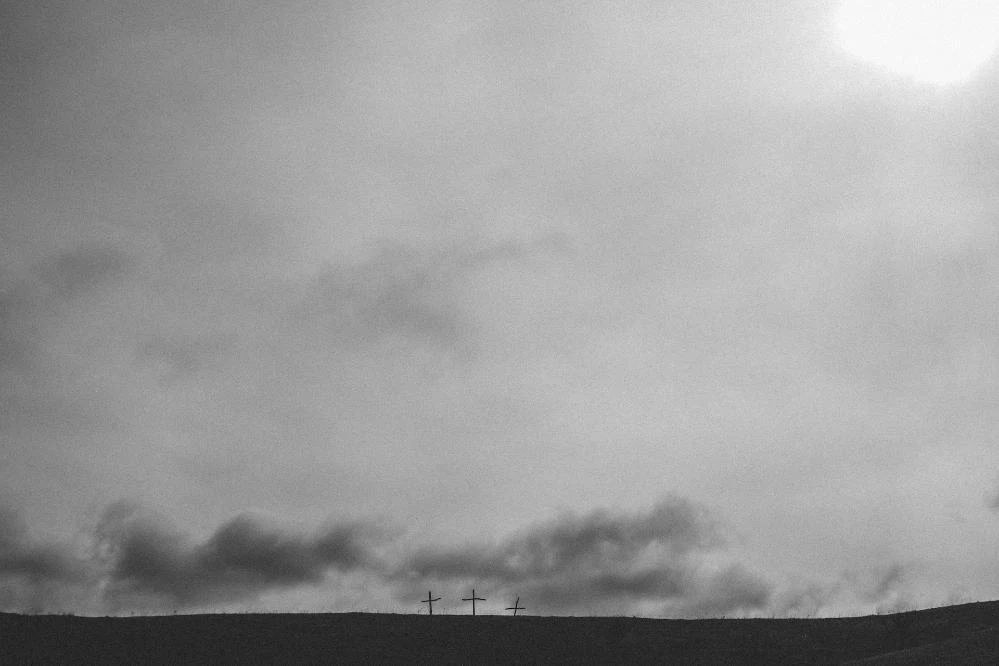
I. Forgive
“Father, forgive them, for they know not what they do.”
Of course the hardest word comes first.
The fragile word, in us so often crushed
by every vice’s press,
every slight and smear,
every unjust word,
the grudges held until they fester,
pressure turning dignity to rage,
protest into spit and fury,
foaming at the mouth for vengeance.
That fragile word we might never speak
even on the point of death
is the first one from Your mouth.
The first word ever spoken
brought light that defined darkness,
held it by a name close to its Maker
like lovers in the night.
Your back gouged through by lashing
tongues of hypocrites and bullies,
Your tongue speaks only love.
The ones You would embrace
have forced Your arms outspread,
wringing from Your mouth
what they need only ask for to receive.
And as a shadow is only known by light,
the first word that You speak
defines their act by Your forgiveness,
and names them as beloved.
II. Paradise
“Truly, I say to you, today you will be with me in paradise.”
Inside me an ember sighs,
spent by years of rage,
made to linger at death’s doorstep.
Gasping for each breath of air,
the last wisps of life
drift up on a wind.
My friend still shoots out
Zealot’s fire and brimstone;
every cry fired like a bullet
aimed at Caesar’s own heart.
We fought to build a paradise
from the bones of our oppressors.
Now we hang fire here,
in hell’s waiting room.
“The devil will be with you shortly.”
My ember almost ashes now,
soon to be forgotten.
Perhaps it’s just the pain
that makes me see the one
who hangs between us
burning like a beacon on this hill.
He made words his only weapon
and now he’s almost silent.
He looks at me like it is no hard fight
to make a paradise from hell.
III. Forsaken
“My God, my God, why have you forsaken me?”
You are the Word,
with God in the beginning—
and God in the beginning—
who gives us every word.
Now You take our words
and make them Yours.
David looked and did not find You,
called himself forsaken;
we look and do not find You,
call ourselves forsaken.
You who are the Word
take our words,
and with them our lament;
take up David’s cry and ours
to claim it as Your own.
You call Yourself forsaken.
Stricken with our pain
afflicted with our grief
rejected by our ignorance,
cast aside, made to sit
in the corner of our eye.
You are where we cannot see You
because You stand beside us
at the moment we call ourselves
forsaken.
IV. Behold
“Woman, behold, your son!...Behold, your mother!”
From the corner of our eyes
we see You, and turning
to see You full and dying
is to squint our eyes
when we behold the sun.
How did she force herself to look,
she who carried You with one arm
while the other stirred a pot,
who saw Your eyes open that first time,
saw their colour when You first saw her?
When others ran, faithless,
she stood and watched—
did her eyes even flinch?
They did not break faith,
those who stood and watched.
Helpless, yes, and grieving,
but with faith to behold You dying,
a sight starker than the noonday sun.
Both of them beloved,
bound by grief in You.
Broken to bring us together,
rejected that we might be reconciled,
You make Yourself the cord
of faith that is not easily broken.
V. Thirst
“I thirst.”
You eagerly desired
to eat this Passover with us;
hungry for our company,
thirsty for our fellowship.
We eagerly desire too,
and know the ache of longing
for things that are not yet.
You felt desire’s
piercing, jagged barb
that cannot be pulled out
but only passed through,
pressing deeper, turning
longing into needing.
On the fifth day You filled the waters
and the air with life.
On this day, barely able to draw air,
You say You thirst for water.
You who are the Living Water
needing water;
You who are the Bread of Life
needing life,
but choosing to drink deep
of sour wine and death.
You let desire pass through You,
feeling every cut and tear,
releasing blood and water,
that we might taste and see
the end of all our need in You.
You starve that we might be fed.
You thirst that we might drink.
You need that we might have.
You feed us with Yourself.
VI. Finished
“It is finished.”
Wholeness comes from endings;
and holiness, too, in endings;
the triumph of the finish line,
crossing into victory,
the laying down of work to rest—
and with Your almost dying breath
You say, “It is finished.”
By words you made the world,
and on the sixth our flesh and blood
became Your image;
now with these words remake the world,
and on this sixth Your flesh and blood
begin to fade.
You are crowned and set on high—
this is Your word of triumph,
Your final battlecry
pushed out between cracked
and thirsty lips,
a king’s victory exhaled from
crushed and battered lungs;
our wholeness in Your brokenness,
our holiness in Your ending.
In destructive crucifixion
does creation find completion;
so that life be neverending,
let all ends be new beginnings,
let this end be everlasting,
and the triumph now take root;
let the world hear “It is finished,”
and cry back that “It is good.”
VII. Hands
“Father, into your hands I commit my spirit!”
Those hands in tatters
from the cruel iron which
grips them tight to the wood.
We prise out with our fingers
the long, hard nails,
receiving You with open hands.
We bear You now, who bore
the heavy yoke of the cross,
and find You a burden
lighter than we expected.
Your breath and life You gave
into Your Father’s hands;
Your body is our gift.
These hands that You have made
now wrap You in grave-clothes.
You walked the earth,
had hands like ours
that built and touched and blessed.
Your work is done,
and on the eve of Sabbath
these hands lay You down to rest.
Commit You to the Father
that the world might be remade,
formed by the Father’s hands.
Give us hands to take Your words
and plant them deep within
our earth, a seed to spring
with the rising of the sun.
But for now,
our hands lay You down to rest,
and that rest is silence.