Note: This interview includes an image gallery available at the bottom of the page.
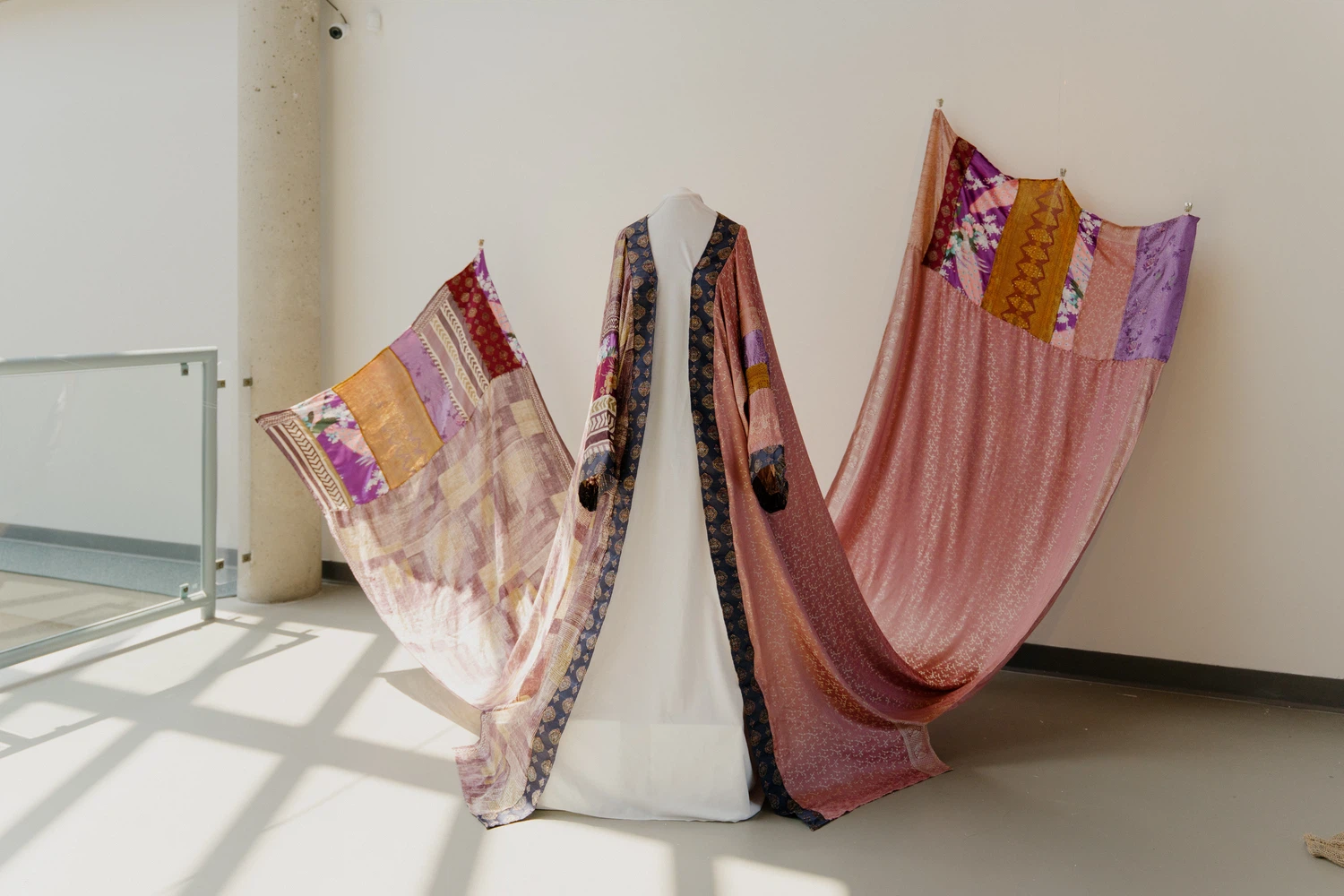
Freeman Lam is an artist and recent Regent College graduate whose Integrated Project in the Arts and Theology (IPIAT), Clothed in Glory: Learning to Embody Christ, centres on three hand-sewn garments. Each piece takes up a theme—cultural and ethnic particularity, suffering and lament, and encounter with Christ—and the three garments are ultimately meant to be layered and read together. Freeman chose to sew everything by hand and to work in communal spaces, letting conversation and collaboration shape the pace and integrity of the work.
I spoke with Freeman by email shortly after his presentation. We discussed why he frames the project around “learning,” how the textile arts invite theological reflection, and how his Chinese Canadian background shaped his work. What follows is an edited conversation.
LS: The “learning to” in your project’s subtitle strikes me as an important feature of the work’s program. You just completed a season of “learning” here at Regent College. What does it mean for this project to be about learning?
FL: Learning is the central posture and purpose of the project. The interesting thing about learning is that the subject has agency to shape the process. In this particular case, with the subject being Christ, his character inevitably challenges the assumptions, expectations, and motivations we bring to what it means to desire embodying him. By opening ourselves to be challenged, we experience embodying Christ as a form of cultivation. What I mean by this is that the act of embodying Christ is not necessarily the goal. Rather, the goal is cultivating an ongoing posture of learning to embody Christ. In this sense, embodying Christ does not depend on us as individuals, but on Christ as God incarnate. Much like the process of making a garment, the more you prepare the fabric, the thread, and the tools needed, the more you are equipped to learn or know about the fabrics and threads you are using. As you increase in knowledge of these, the garment is inevitably formed through intentional participation in the process—with the garment itself as the subject.
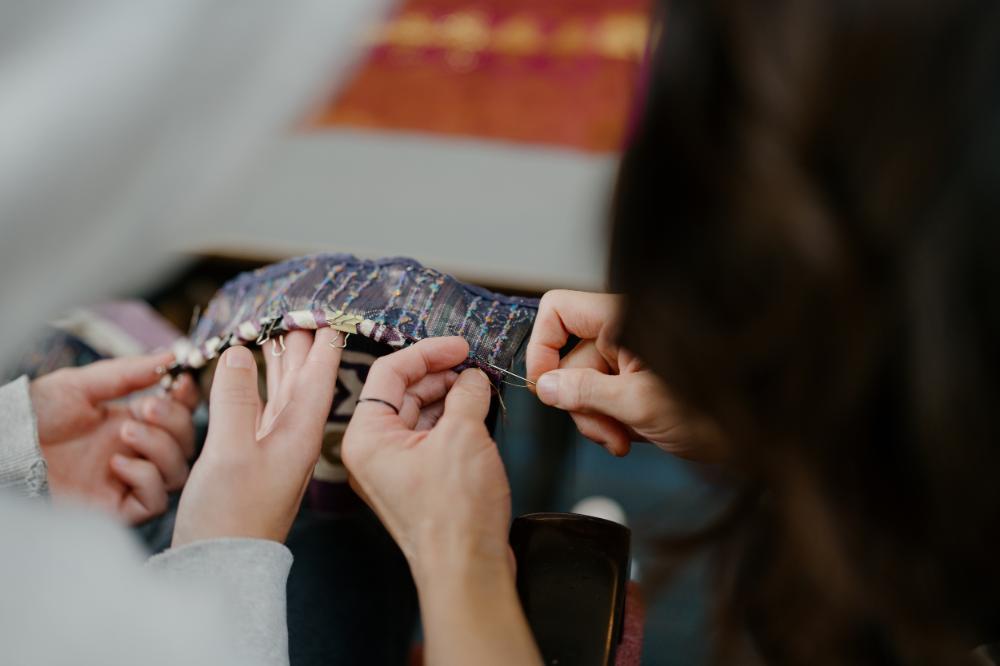
LS: Why did you decide to hand sew all three garments?
FL: The decision to hand sew all three garments was twofold. Firstly, I know how impatient I can be with my art, which I have come to realize is a symptom of a deeper sense of impatience. Therefore, hand sewing is a way of limiting myself: each stitch has to be made by my own hands, my own attention, my own limited capacity. Secondly, because the project is focused on embodying Christ, I became even more aware of the importance of slowing down. With the three different themes—our cultural and ethnic particularities, suffering and lament, and our experience of Christ—each presented a particular need to guard against rushing or being as efficient as possible.
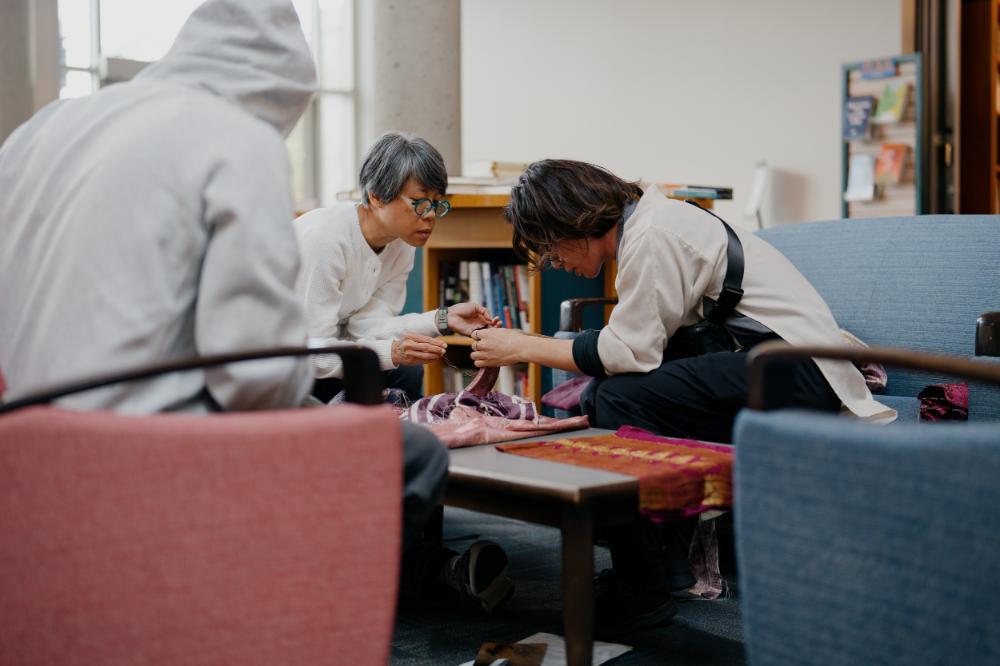
LS: Why was it important to you that this project was worked on in communal spaces, constructed and collaborated on with peers from various communities?
FL: This one is quite simple to answer: because I had to. If Christ is truly who he says he is, then it would be impossible for me to learn and cultivate a posture of learning on my own. There is no doubt that I could have, to a certain degree, completed the project and research on my own, but it would have most definitely been at the expense of the project’s integrity, possibly losing its ability to articulate the heart of Christ.
LS: By hanging mirrors in the gallery, you invite the viewer to see themselves—and what they are wearing—as another artifact in your exhibition. Is your exhibition meant to be self-interrogating? Do you hope that viewers walk out of your exhibition in some way changed?
FL: I appreciate how you start this question because the mirrors were simply hung. They did not have direct instructions to look into them and begin a process of self-interrogation. Interestingly, something I thought much about throughout my IPIAT, whether in the context of the art or the academic paper, was the relationship between invitation and our own free will when it comes to self-interrogation or examination. Invitation is important because it allows us to consider the possibility of us not seeing the full picture. I use “allow” because it speaks to the fragility and tenderness of our own hearts.
For introspection to successfully take place—for it to come from and reach back to the heart of the individual in such a way that obvious change occurs—it needs to be voluntary. It cannot be forced or coerced out of our hearts; our hearts would either harden or be torn apart. Throughout this project, I encountered numerous instances where invitation was the only way forward. Aside from invitation, each stitch would have just been like the one before it—uniform, controlled, and, to a certain degree, detached from the one who stitched it—robbing the individual of their presence.
LS: What kinds of biblical and/or spiritual insights are the textile arts uniquely equipped to be able to illuminate? What particular theological ideas are you investigating with this project?
FL: The textile arts illuminate so many biblical and spiritual insights, largely because of how textiles are produced. Textiles require natural resources to make each thread, hands that weave thread into fabric, and hands that sew fabric and thread together to make a garment. Each of these processes in its own way invites us to consider how we were created to live.
Therefore, for the purposes of this project, I focused on how the textile arts illuminate the threads that either guide or entangle our embodiment. Recognizing that we are created as embodied beings, in the image of God, to be embodiments of his glory—this was of much interest, particularly as our social climate can be quite polarized in how we each go about our embodiment.
LS: And yet, in spite of your work’s biblical and theological interest, it is also a thoroughly culturally and ethnically contextual project. What influences have your cultural and ethnic identities had on your work?
FL: Cultural and ethnic identities have greatly influenced my work, which is also in relation to our embodiment. Keeping in mind that this work was collaborative, it would have lost all meaning if I did not step aside to allow the different cultures, ethnic identities, and particularities to inform the work, both artistically and relationally.
Artistically, it meant paying attention to each fabric’s uniqueness, the stories behind how they were made, the stories of their existence in a city like Vancouver, and what it meant for me as a Chinese Canadian to be working with them from my particular perspective and story.
Relationally, it meant recognizing the parts of the project where my own cultural and ethnic identity felt vulnerable, and asking where Christ was in those moments. This prepared me to make space for others and to invite and be present to stories and experiences that were different from my own—particularly, stories and experiences of Christ and what it means to follow him in different contexts.
Looking back on the project and the process of engaging in my art with others, the cultural and ethnic piece taught me the most, right up until the end of my project. Collaborating with others as a broken human being is not easy. When we lose sight of where Christ is present with us, vulnerability can lead us to react in fear rather than respond in trust. While not an easy lesson, I am thankful for the grace to learn it.
LS: Your presentation culminated in layering the three garments over one another. What do the three individual pieces separately represent, and how do you think each garment’s individual representation is more fully realized when the three are layered?
FL: Separately, each garment represents the particularities and experiences that can often be overlooked or taken for granted. At times, we do this mindlessly. More often, however, we do this because of our own pain, discomfort, or pride. As separate pieces, each garment is an invitation to pay attention to a particular lived experience, both in ourselves and in another.
I appreciate the language of each garment’s representation being fully realized. Is this not what Christ’s presence in our lives does? We see our circumstances, experiences, and histories not less or more than they are. Rather, we see them just as they are—and with the presence of Christ, we see more clearly how he sees them. It moves my heart to know that God sees the whole of my life: my Chinese-ness; my Canadian-ness; my health struggles and trauma; my messy and complicated relationship with him—and he loves me not in spite of these things, but because of these things. So as the layers are placed on one another, they present yet another invitation: to see and know each particular experience the garments represent in relation to Christ.
LS: Keeping in mind the title of your project, what have you “learned” about “embodying Christ” this past year while working on and completing your IPIAT?
FL: I don’t mean to be trite, but I have learned so much through working on and completing my IPIAT. However, if I were to pinpoint something in particular, it would have to be that I have learned how embodying Christ has much more to do with allowing Christ to embody our stories, rather than making ourselves into a perfect representation of Christ.
It's one thing to know that Christ, God incarnate, was born of the Holy Spirit and the Virgin Mary, grew up, and experienced each stage of a human life. It is another to experience the fullness of his life in the context of our own. Throughout the project, there were numerous moments where I saw how personally, and within community, Christ was inviting us to know his abiding presence in the midst of our fears and desires, anxieties and passions, hurts and joys. It seems quite common for us to view our lives disproportionately in relation to God—either we think he does not care, or that he should be caring more. However, when we allow Christ’s life to embody our own, we are each able to understand how he in fact cares just the right amount, allowing us to be present to our fears and desires, anxieties and passions, hurts and joys, just as he is. In this sense, embodying Christ seems more about Christ embodying us, where we see his life in the midst of what is mundane, intimate, exciting, rigorous, and even draining. By seeing his life in the midst of ours, our inward and outward postures change, and we inevitably come to a place of embodying Christ more proportionately.


